
Beyond Calcium: What Vitamins for Bones Should You Take?
Your bones need more than calcium. Here’s the evidence on vitamin D, K2, magnesium, vitamin C, and collagen — what each does, how much you need, and where to get it.
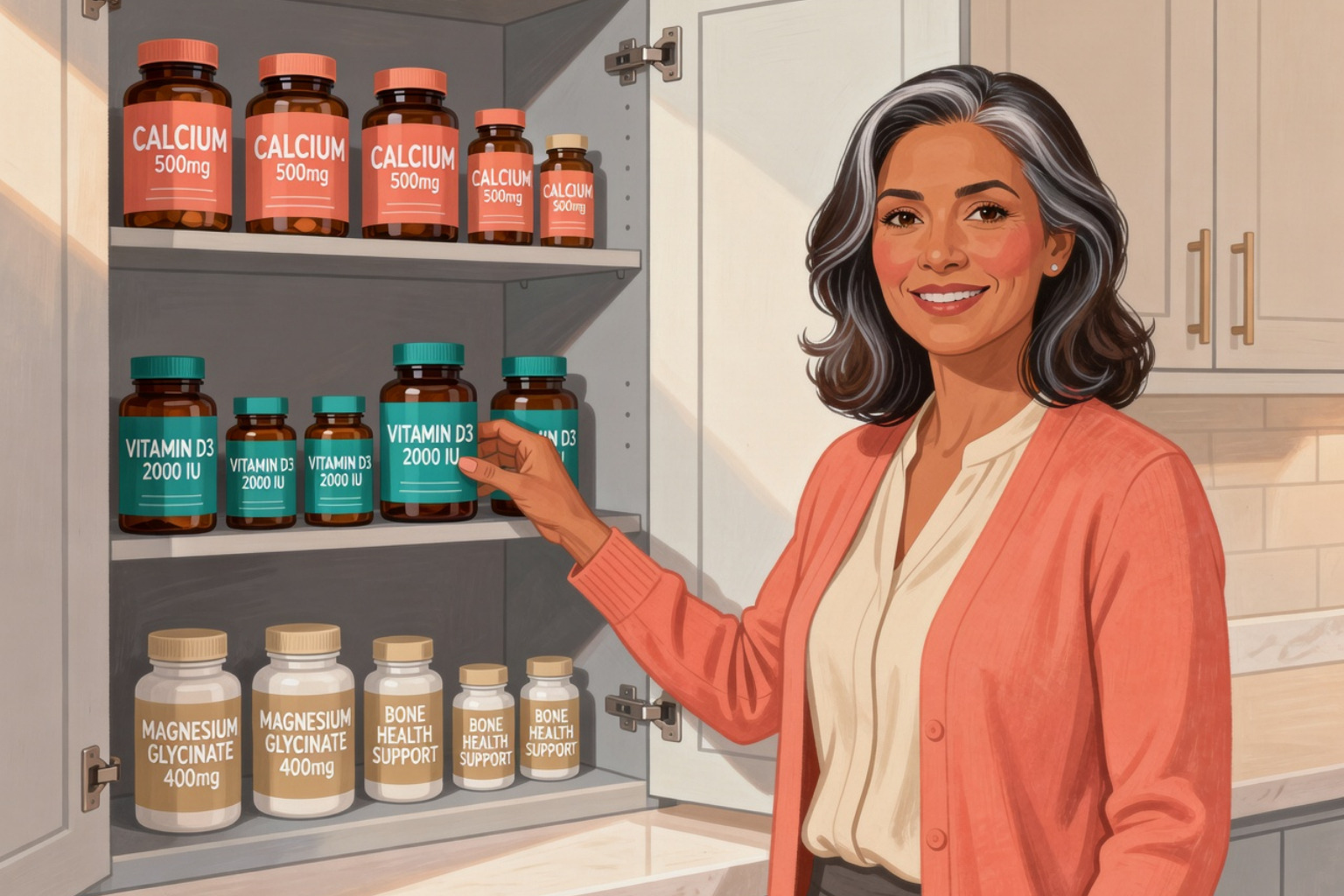
Why Most People Are Missing Key Bone-Building Nutrients
What vitamins for bones are most important? Here is a quick answer before diving deeper:
| Nutrient | Primary Role in Bone Health | Key Daily Target (Adults 50+) |
|---|---|---|
| Calcium | Hardens and mineralizes bone tissue | 1,200 mg |
| Vitamin D | Enables calcium absorption; supports muscle function | 800 IU (20 mcg) |
| Vitamin K2 | Directs calcium into bones; reduces arterial deposits | ~90–120 mcg |
| Magnesium | Activates vitamin D; supports bone mineralization | 320–420 mg |
| Vitamin C | Supports collagen synthesis in the bone matrix | 75–90 mg |
| Protein/Collagen | Provides structural scaffolding for mineral deposition | Varies by body weight |
Most adults know calcium matters for bones. Fewer know that calcium alone accomplishes very little without the right supporting nutrients.
Bone is not simply a hard mineral deposit. It is a living tissue — a protein-rich matrix, built largely from collagen, onto which calcium and phosphorus crystallize to create strength and rigidity. That matrix is constantly being broken down and rebuilt through a process called bone remodeling, driven by specialized cells called osteoclasts (which remove old bone) and osteoblasts (which form new bone).
After approximately age 30, bone breakdown begins to gradually outpace formation. For women, this process accelerates sharply after menopause. The result, over time, is reduced bone mineral density (BMD) — measurable on a DEXA scan — and a rising risk of fracture.
The statistics are sobering. According to clinical data, half of all women over 50 and one in four men will break a bone due to osteoporosis during their lifetime. After age 50, one in three women will experience a fracture related to bone thinning.
Yet bone density loss is largely preventable — and in some cases partially reversible — when the right nutritional foundations are in place, combined with appropriate physical activity and medical oversight.
This guide reviews the full picture of what the evidence says about essential bone nutrients: what each one does, how much is needed, where to get it, and when supplementation may be warranted.
The Biological Synergy of Calcium and Vitamin D in Bone Remodeling
The relationship between calcium and vitamin D is often described as a "foreman and brick" partnership. Calcium provides the structural "bricks" (specifically calcium phosphate) that harden the skeletal frame, but the body cannot absorb these minerals effectively without vitamin D acting as the foreman.
When blood calcium levels drop, the parathyroid gland releases hormones that signal the body to "raid" the bones for supply. This triggers osteoclasts to break down bone tissue to release calcium into the bloodstream for critical functions like heart rhythm and nerve signaling. Consuming adequate nutrients ensures the body does not have to compromise skeletal integrity to maintain these systems.
According to the National Institute of Arthritis and Musculoskeletal and Skin Diseases (NIAMS), Calcium and Vitamin D: Important for Bone Health, these two nutrients must work in tandem to prevent conditions like osteomalacia (softening of the bones) and osteoporosis.
Calcium Requirements and Absorption Limits
The Recommended Dietary Allowance (RDA) for calcium is 1,200 mg daily for women over 50 and men over 70. However, the human gut has a physiological "ceiling" for absorption. Research indicates that the body can only absorb roughly 500–600 mg of calcium at a single time. Taking a 1,200 mg supplement in one dose is largely inefficient and may increase the risk of side effects.
To maximize density, individuals should prioritize a "food-first" approach, spreading intake across the day. Excellent sources include:
- Dairy: Milk, Greek yogurt, and cheese.
- Fortified Foods: Orange juice (300 mg per cup) and almond or oat milks (up to 450 mg per cup).
- Canned Fish: Sardines or salmon with bones (the bones are soft and edible, providing concentrated calcium).
- Leafy Greens: Kale, bok choy, and collard greens (note: spinach contains oxalates that inhibit calcium absorption).
Vitamin D Metabolism and Fall Prevention
Vitamin D (specifically D3, or cholecalciferol) is unique because it acts more like a hormone than a vitamin. Beyond its role in the gut, vitamin D supports the muscle fibers necessary for balance. Clinical observations show that vitamin D deficiency is a major contributor to fall risk in older adults.
While sunlight synthesis is the primary natural source, factors like aging skin, northern latitudes, and consistent sunscreen use (SPF 8 reduces vitamin D production by 95%) make dietary sources and supplements necessary for many. The 25(OH)D blood test is the clinical standard for determining if an individual's serum levels are within the healthy range of 30–60 ng/ml.
Essential Micronutrients Beyond Calcium and Vitamin D
If calcium is the brick and vitamin D is the foreman, other micronutrients serve as the mortar and architectural plans. A Mediterranean-style diet — rich in fruits, vegetables, and healthy fats — has been linked to a 21% lower risk of hip fractures, largely due to its diverse micronutrient profile.
How Vitamin K2 Directs Calcium Into Your Skeleton
Vitamin K exists in two primary forms: K1 (found in leafy greens) and K2 (found in fermented foods and animal products). While K1 is essential for blood clotting, K2 is the "traffic controller" for calcium. It activates a protein called osteocalcin, which binds calcium to the bone matrix.
Equally important, K2 helps prevent "extra-skeletal calcification"—the dangerous accumulation of calcium in the arteries and soft tissues. Clinical studies, particularly in postmenopausal women, suggest that K2 (specifically the MK-7 subtype) can significantly improve bone mineral density in the lumbar spine.
Magnesium: The Hidden Gatekeeper of Vitamin D Activation
Approximately 60% of the body’s magnesium is stored in the bones. Magnesium is a mandatory cofactor for the enzymes that convert vitamin D into its active form. Without sufficient magnesium, vitamin D remains "trapped" and unusable, regardless of how much a person supplements.
Signs of magnesium deficiency can include muscle cramps and fatigue, but the skeletal impact is often silent. To support bone mineralization, adults should aim for 320–420 mg daily through foods such as pumpkin seeds, black beans, almonds, and whole grains.
The Role of Protein and Collagen in the Skeletal Matrix
Bone is approximately 30–35% protein by weight. This protein "scaffolding" is what gives bones their flexibility, allowing them to absorb impact without shattering.
| Nutrient | Role in Matrix | Evidence Level |
|---|---|---|
| Collagen Peptides | Enhances BMD of lumbar spine and femoral neck | High (12-month clinical trials) |
| Protein (General) | Provides the meshwork for mineral crystallization | High (Essential for IGF-1 production) |
| Vitamin C | Cross-links collagen fibers to strengthen the matrix | Moderate (Observational risk reduction) |
A 12-month study of 131 postmenopausal women demonstrated that specific collagen supplementation increased bone mineral density in the femoral neck. For those managing a new diagnosis, Groove Health provides specialized physical therapy that focuses on building the muscle-bone unit through home-based care. You can learn more at Groove Health.
Clinical Considerations for Bone Health Supplementation and Safety
When diet is insufficient, supplements can fill the gap, but they must be used judiciously.
- Calcium Carbonate: Requires stomach acid for absorption; must be taken with food. It is often the most affordable option.
- Calcium Citrate: Can be taken with or without food and is generally better tolerated by those on acid-reflux medications (PPIs) or those with sensitive stomachs.
Excessive calcium supplementation (exceeding 2,000 mg total daily) has been scrutinized for potential cardiovascular risks, including plaque buildup in coronary arteries. Furthermore, high doses can contribute to kidney stones. It is vital to calculate your dietary intake first and only supplement the "gap" to reach the 1,200 mg target. For more details on choosing the right format, see NIH Office of Dietary Supplements: Calcium.
Diagnostic Screening and Lifestyle Interventions for Osteoporosis
Nutrients provide the raw materials, but bones require a "mechanical signal" to grow. This signal comes from weight-bearing and resistance exercises. Activities like brisk walking, dancing, or lifting weights tell the osteoblasts to strengthen the bone tissue.
Clinical guidelines recommend that bone density screening (DEXA scan) should begin at age 65 for women and 70 for men, or earlier if risk factors like long-term steroid use or a history of smoking are present. A T-score of -2.5 or lower indicates osteoporosis, while a score between -1.0 and -2.5 indicates osteopenia (low bone mass).
If you are navigating a recent diagnosis or want to proactively manage your bone density, you can Start your bone health journey with a personalized, Medicare-covered plan.
Frequently Asked Questions about Bone Nutrients
Can I take all my daily calcium at once?
No. The gut’s absorption efficiency decreases as the dose increases. For the best results, split your intake. If you need 1,000 mg of supplemental calcium, take 500 mg in the morning and 500 mg in the evening.
Is Vitamin D3 superior to Vitamin D2 for bone density?
Evidence generally favors Vitamin D3 (cholecalciferol) over D2 (ergocalciferol) for long-term maintenance of serum levels. D3 is the form the body naturally produces from sunlight and is more effective at raising and sustaining vitamin D levels in the blood.
Does Vitamin C intake reduce osteoporosis risk?
Yes, observational research has found that individuals with higher dietary vitamin C intake have a 33% lower risk of osteoporosis. Vitamin C is a vital antioxidant and a necessary component for the synthesis of collagen, the primary protein in the bone matrix.
Building a Complete Bone-Nutrition Strategy
Building and maintaining bone density is a lifelong process that requires more than just a glass of milk. While calcium and vitamin D are the cornerstones, nutrients like magnesium, vitamin K2, and protein are essential for creating a resilient skeletal matrix.
Groove Health offers a comprehensive, Medicare-covered program that pairs older adults with a dedicated physician and physical therapist. This team-based approach focuses on personalized nutrition, targeted exercise, and medication management to prevent fractures and improve quality of life from the comfort of home.
Works Cited
- National Institute of Arthritis and Musculoskeletal and Skin Diseases. "Calcium and Vitamin D: Important for Bone Health." NIAMS, 2023.
- Harvard Health Publishing. "Essential Nutrients Your Body Needs for Building Bone." Harvard Health, 2022.
- Mileti, L. "Do You Need Bone Health Supplements?" Cleveland Clinic, 2025.
- NIH Office of Dietary Supplements. "Calcium: Fact Sheet for Health Professionals." National Institutes of Health, 2024.
- König D, Oesser S, Scharla S, Zdzieblik D, Gollhofer A. "Specific Collagen Peptides Improve Bone Mineral Density and Bone Markers in Postmenopausal Women — A Randomized Controlled Study." Nutrients, 2018.
- National Institutes of Health Office of Dietary Supplements. "Magnesium: Fact Sheet for Health Professionals." NIH Office of Dietary Supplements, 2024.
This content is for informational purposes only and does not constitute medical advice. Consult a qualified healthcare professional for diagnosis and treatment. If you are on Medicare and interested in a personalized bone health program, you can check your eligibility at groovehealth.com.