
Supplements for Bone Health
Food first, supplements to fill the gap. A physician's guide to the four that actually matter for osteopenia and osteoporosis - calcium, vitamin D, protein and collagen - with real doses and safe ceilings.
A quick, evidence-based guide for osteopenia & osteoporosis
The goal is strong bones without overdoing it. Food comes first; supplements are meant to fill the gap between what you eat and what your bones need, not to pile on. More is not always better. Use this guide as a starting point.
1. Calcium: aim for a total, mostly from food
Daily target (food + supplements combined): 1,200 mg for women 51+ and everyone 71+; 1,000 mg for men 51–70.
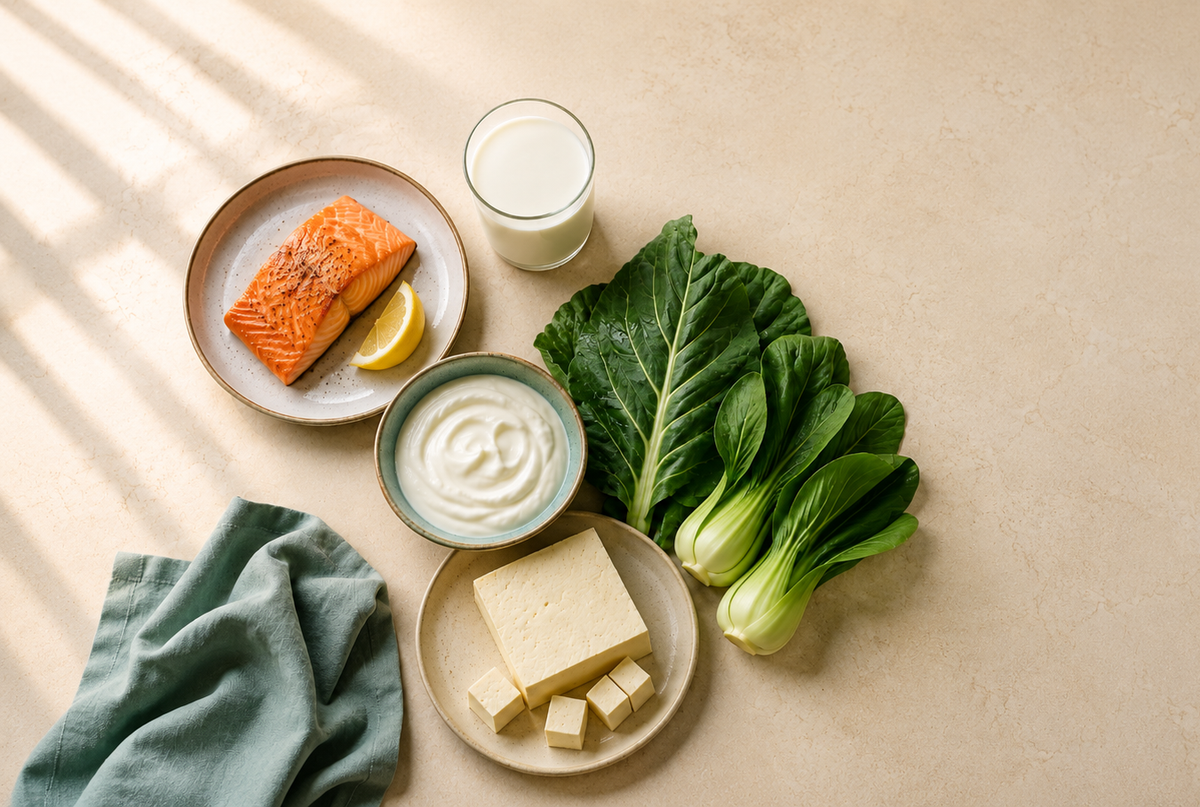
- Food first. Roughly 300 mg per serving of dairy or fortified plant milk. Other good sources: canned salmon or sardines with bones, tofu set with calcium, fortified orange juice, and leafy greens (collard greens, bok choy).
- Supplement only the gap. Add up your usual food sources; most people need only 500–600 mg from a supplement, and some need none.
- Take it in smaller doses. Your body absorbs 500–600 mg of elemental calcium at a time. If you need more, split it — e.g., one dose at breakfast, one at dinner.
- Read “elemental” calcium on the label. That is the number that counts. Calcium citrate absorbs well with or without food and is gentler on the stomach — a good choice if you take acid reducers or get constipated. Calcium carbonate is fine too but should be taken with meals.
2. Vitamin D: the partner that makes calcium work
Typical dose for bone health: 800–1,000 IU of vitamin D3 per day. Vitamin D helps your body actually absorb the calcium you take in.
- We aim for a blood level (25-OH vitamin D) of about 30–50 ng/mL. If yours is low or you’re not sure, you can talk with your primary care physician about checking a level and adjusting the dose.
- Daily dosing is preferred over large weekly or monthly doses. Stay at or below 4,000 IU/day unless specifically prescribed otherwise.
- Some formulas add vitamin K2, which may help steer calcium into bone. It’s generally safe — but if you take warfarin or another blood thinner, check with your doctor first, since vitamin K interacts with those medications.
3. Protein: the scaffolding bones are built on
Aim for 1.0–1.2 grams of protein per kilogram of body weight per day because it protects both muscle and bone as we age.
- Quick math: a 150-lb (68 kg) person needs about 70–80 g of protein a day — roughly 25–30 g at each meal.
- Easy sources: eggs, Greek yogurt, cottage cheese, fish, poultry, beans and lentils, tofu, and dairy. Spreading protein across all three meals works better than one big serving.
4. Collagen: optional, promising, not a substitute
- A 12-month randomized trial found that 5 g/day of specific collagen peptides modestly improved bone density in postmenopausal women. The evidence is encouraging but still limited.
- If you enjoy it, it’s reasonable to add — and it counts toward your protein for the day. Just don’t let it replace the essentials: calcium, vitamin D, protein, and exercise!
⚠️ Don't overdo it: a few safety notes
- More calcium is not safer. Keep your total (food plus pills) under 2,000 mg/day. Very high supplement doses have been linked to kidney stones and possibly heart risk. Taking calcium with food and staying near your target keeps you in the safe zone.
- Watch for hidden overlap. Check your multivitamin and any "bone," "hair/skin/nail," or antacid products. They often contain calcium or vitamin D that add up fast.
- Too much vitamin D over time can raise blood calcium and cause nausea or kidney problems. Sticking to the doses discussed above will help your levels stay consistent.
Examples of good formulations
These are solid, third-party–quality options I trust, examples of what to look for, not the only choices. Any reputable brand with clear “elemental” calcium and D3 works.
- Calcium: Pure Encapsulations Calcium (Citrate) — 150 mg elemental calcium per capsule. Citrate form, so it absorbs with or without food; the low per-capsule dose makes it easy to fine-tune to your gap.
- Vitamin D: NOW Vitamin D-3 & K-2 — 1,000 IU (25 mcg) D3 plus 45 mcg K2 per capsule. (Remember the warfarin/blood-thinner note above if that applies to you.)
Quick answers to common questions
“Can I just take one big pill for everything?” Usually not ideal — calcium absorbs best in smaller, split doses, and combo pills often under- or over-shoot. It’s fine to take calcium and vitamin D together.
“What time of day?” Calcium citrate: anytime. Calcium carbonate: with meals. Vitamin D: with a meal that has some fat helps absorption.
“Do I still need supplements if I eat well and get sun?” Many people do hit calcium through diet. Vitamin D is harder to get from food and sun alone, so a daily D3 is often still worth it.
Works Cited
- National Institutes of Health, Office of Dietary Supplements. Calcium: Fact Sheet for Health Professionals. NIH Office of Dietary Supplements, 2024.
- National Institutes of Health, Office of Dietary Supplements. Vitamin D: Fact Sheet for Health Professionals. NIH Office of Dietary Supplements, 2024.
- Demay MB, Pittas AG, Bikle DD, et al. Vitamin D for the Prevention of Disease: An Endocrine Society Clinical Practice Guideline. Journal of Clinical Endocrinology & Metabolism, 2024;109(8):1907-1947.
- König D, Oesser S, Scharla S, Zdzieblik D, Gollhofer A. Specific Collagen Peptides Improve Bone Mineral Density and Bone Markers in Postmenopausal Women - A Randomized Controlled Study. Nutrients, 2018;10(1):97.
This article is general education based on guidance from the NIH Office of Dietary Supplements, the 2024 Endocrine Society vitamin D guideline, the International Osteoporosis Foundation, and PROT-AGE/ESPEN protein recommendations. It does not replace individualized discussions. Talk to your physician or pharmacist before starting or changing supplements, especially if you have kidney disease, a history of kidney stones, or take other medications.