A Practical Guide to Bone Strengthening Workouts
Not all exercise builds bone. Bone strengthening workouts need heavy, progressive resistance to trigger new growth—here's exactly which moves work, how to load them safely, and what to skip.
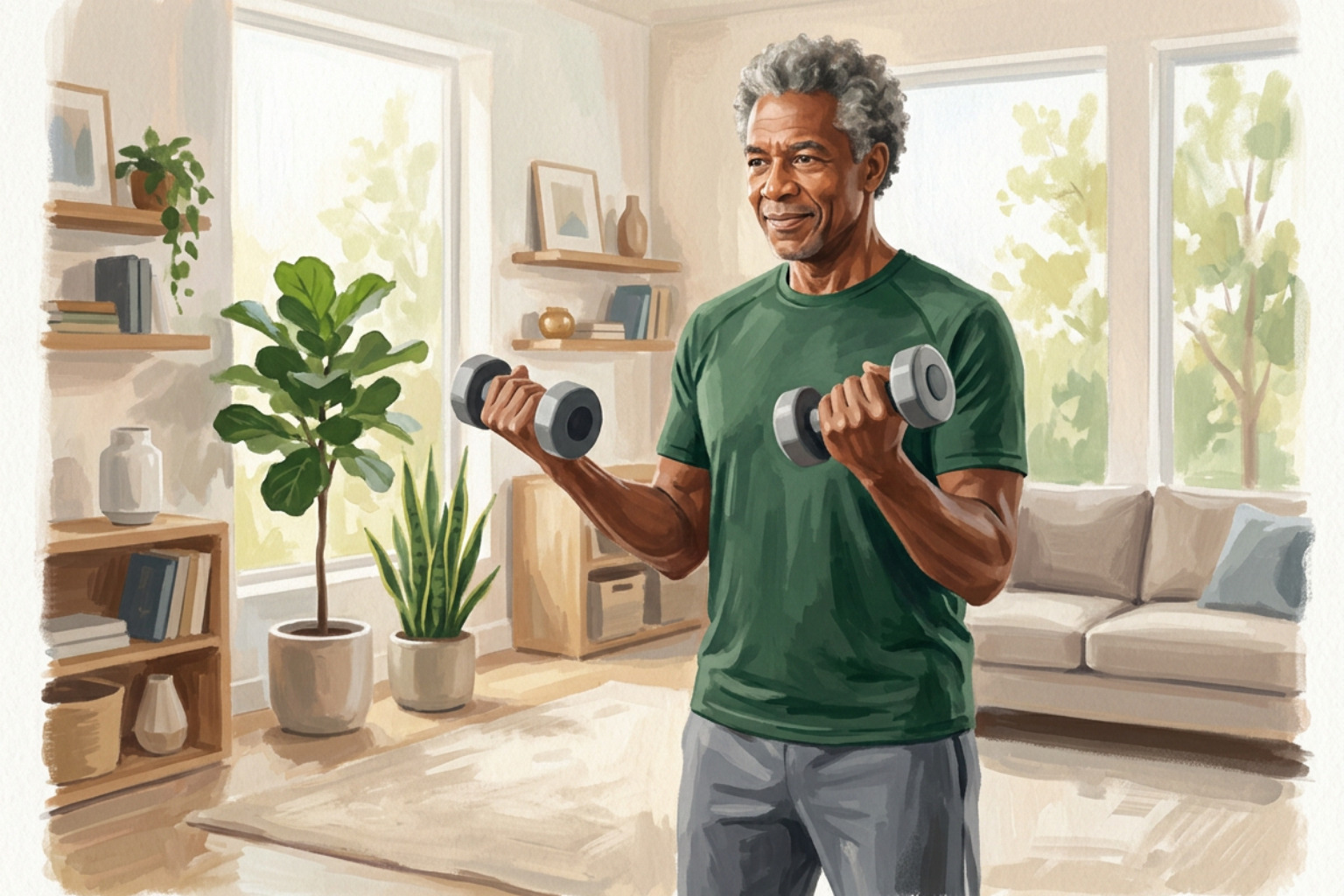
Why Bone Strengthening Workouts Matter More Than Most People Realize
Bone-strengthening workouts are one of the most powerful tools for reducing your risk of fractures as you age. If you've recently received a bone density result that concerns you, you're in the right place.
Here's a quick answer to what actually works:
| Exercise Type | Does It Build Bone? | Best For |
|---|---|---|
| Heavy resistance training (squats, deadlifts, overhead press) | Yes, strong evidence | Spine, hip, wrist |
| High-impact loading (jumping, stomping) | Yes, when safe | Hip, lower body |
| Walking | No, not enough load | General health only |
| Light weights / resistance bands | No, not enough load | Building toward heavier work |
| Balance training | Indirectly (prevents falls) | Fracture prevention |
The short version: bone only gets stronger when you load it hard enough to trigger the cells that build new bone to do so. Light movement helps in other ways, but it doesn't cross the threshold needed to build new bone.
Now, here's a longer explanation on how this works because understanding why this is true can make it easier to stick with.
Bone loss is a quiet process and it doesn't hurt. Most people don't know it's happening until a bone density scan comes back with a number they weren't expecting, or worse, until something breaks. According to the Bone Health & Osteoporosis Foundation (BHOF), most people reach their peak bone mass in early adulthood. After that, bone density gradually declines. For women, bone loss accelerates after menopause, with up to 20% of bone density lost in the first 5 to 7 years.
The good news is that bone is living tissue. It responds to the demands you place on it. With the right kind of exercise, done consistently, research suggests meaningful improvements in bone density are possible, even later in life.
This guide walks you through exactly what that exercise looks like, how to do it safely, and what to realistically expect.
How Exercise Actually Builds Stronger Bones
To understand how exercise changes your skeleton, it helps to know how bone behaves. Bone is not like concrete. It is active, living tissue that constantly breaks down and rebuilds itself. This process is called bone remodeling.
One of the basic principles of bone health is Wolff's Law. It states that bone gets stronger in response to the physical stress you place on it. When you lift something heavy or impact the ground, your bones experience tiny amounts of stress. That stress signals your body to build stronger bone..
This signal wakes up cells called osteoblasts, which are responsible for building new bone. They go to work, building new bone in the areas under the greatest amount of stress. Over time, this process makes bones stronger and denser. To learn more about this biology, read our guide on How Exercise Builds Bones.
Why Walking and Light Weights Aren't Enough
Many people believe that any movement is good for bone strength. While regular movement is great for your heart and joints, it just isn't enough to grow new bone.
To trigger osteoblasts to build bone, you must reach what scientists call an osteogenic load. This simply means exposing your bones to a load that's heavy enough to signal your body to grow new bone.
Think of it like this: walking only puts a force of about one to two times your body weight on your bones. To make your bones grow, you need a force closer to three to four times your body weight. Walking is helpful for your general health, but it is not enough on its own to build bone. You can read more about this in Walking Helpful But Not Enough.
The same is true for light resistance bands and light hand weights. Doing fifty repetitions with a two-pound dumbbell will make your muscles burn, but it will not build bone. The weight has to be heavy enough that you can only lift it a few times.
Designing an Effective Bone-Building Program
An effective bone-building program relies on heavy resistance, compound movements, and activities that challenge your balance and power.
Compound movements are exercises that use more than one joint at a time. Examples include squats and chest presses. These moves are highly effective because they load large areas of your skeleton at once.
To help you see how different types of exercise work together, here is a simple breakdown of the three pillars of bone health training.
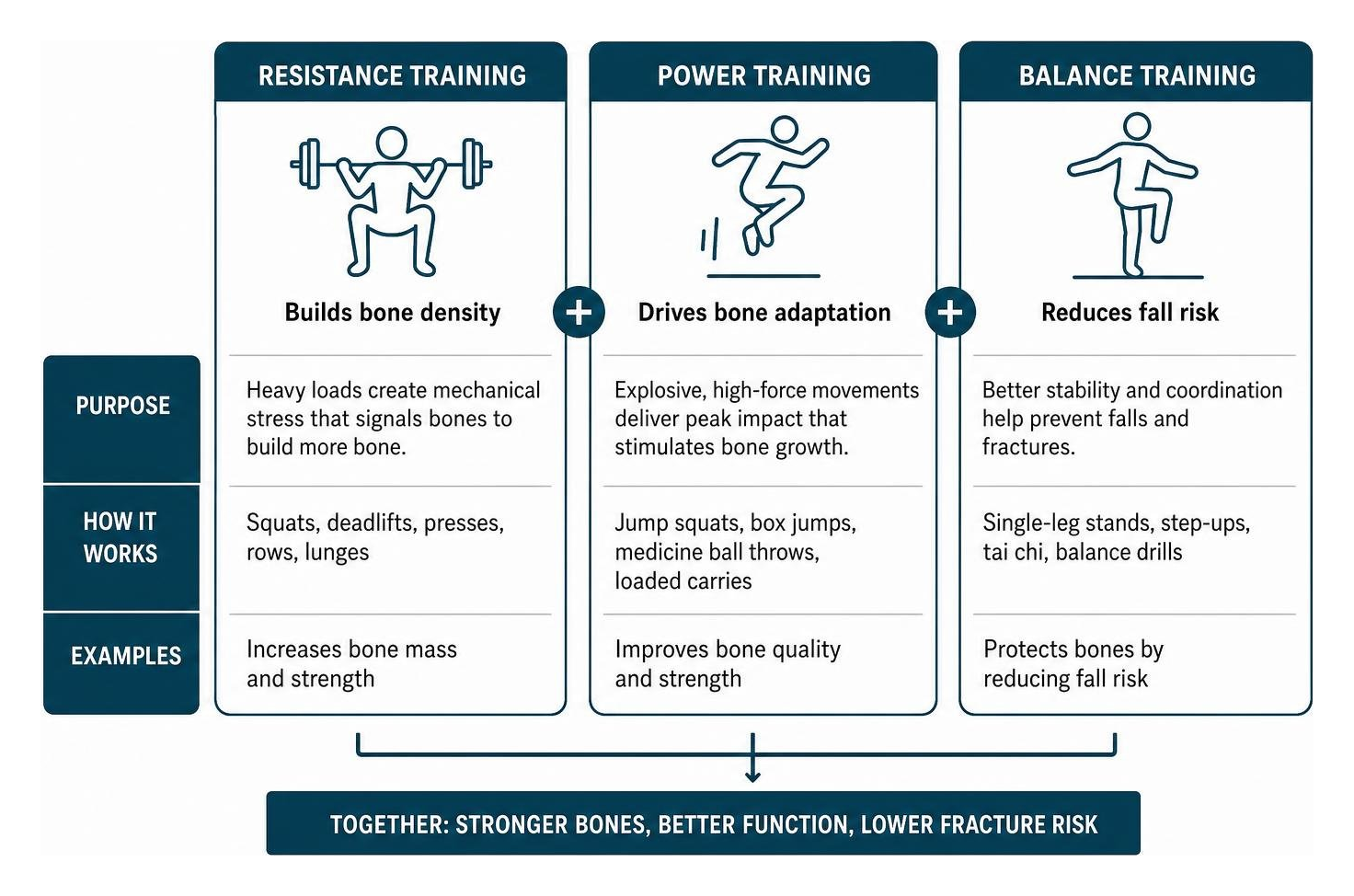
To build a solid foundation, you can learn more about how lifting weights protects your skeleton in Strength Training for Bone Health.
The Core Exercises to Prioritize
To build bone where you need it most, you should focus on the hip, spine, and wrist. These are the most common places for breaks.
The best exercises for these areas are:
- Squats: This movement loads your hips and lower spine. One study found that squat-based strength training increased lumbar spine bone mineral content by 2.9% and femoral neck bone mineral content by 4.9% in just 12 weeks.
- Romanian deadlifts: This is a move where you bend at the hips, not the waist, to lift a weight. It targets your hips and entire back by loading the same muscles and bones that are most vulnerable to fracture.
- Overhead press: Pushing a weight straight up over your head loads your spine and wrists. Research shows that upper body resistance training can improve forearm bone mass, making this a valuable exercise for protecting the wrists, one of the most common fracture sites.
To get these benefits, you must use progressive overload. This means you slowly add more weight over time as your body adapts.
The proof for this approach comes from a famous clinical trial called the LIFTMOR study. In this trial, postmenopausal women with low bone density performed heavy resistance training at greater than 85% of their maximum capacity. After eight months, the women who did the heavy lifting saw a 2.9% increase in their spine bone density and a 0.3% increase in their hip bone density.
You can read a detailed breakdown of these movements in Best Exercise for Bones and see how to structure them in This Is the Workout That Actually Builds Bone Density | SELF.
Balance and Power: Preventing the Falls That Cause Fractures
Building strong bones is only half the battle. You also have to prevent the falls that lead to breaks. The Centers for Disease Control and Prevention (CDC) reports that 88% of hip fracture hospitalizations in older adults are caused by falls.
To lower your risk, you need balance and power training. Balance is a skill you can train, and it comes in two forms:
- Static balance: This means holding steady in place, such as standing on one leg. This is the best starting point for beginners.
- Dynamic balance: This means staying steady while you are moving, such as stepping, reaching, or turning your head. You should progress to this as your static balance improves.
Power is another key piece of the puzzle. Power means strength plus speed. It is how fast you can move your muscles. If you trip over an obstacle, you do not just need strength to stay upright. You need the speed to quickly step and catch yourself.
Research shows that exercise programs combining resistance and balance training reduce fall rates by 34% in older adults. You can explore safe balance routines in our guide on Fall Prevention Bone Exercises.
Safe Movement: What to Do and What to Avoid
Safety is the most important part of any exercise routine, especially if you have thinning bones.
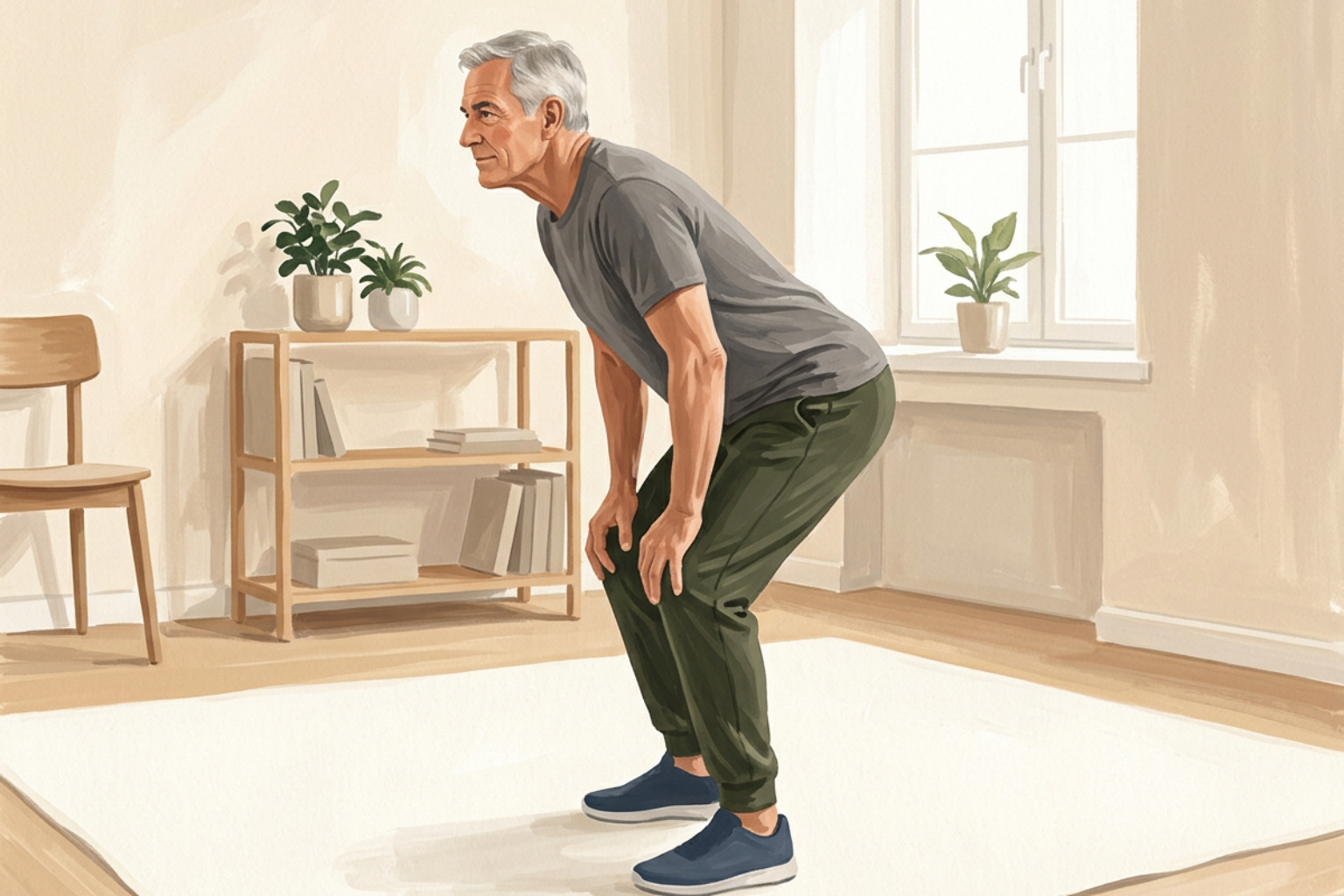
When you lift weights or perform daily tasks, you must protect your spine.
Spinal extension, which means gently arching or straightening your back, is safe and highly recommended. It strengthens the muscles of your back which help support the joints and bones.
Loaded spinal flexion, which means rounding your back forward while holding a weight, should be avoided. Rounding your back under pressure puts too much stress on the front of your spine and can raise the risk of a spine break.
Instead of rounding your back, practice hip hinging, or bending from your hips while keeping your back long and straight. Not all bending is dangerous - rapid, repetitive, or loaded flexion (rounding) held at end range pose the highest risk. You can read more about safe lifting techniques in Strength Training and Osteoporosis.
Modifying Exercises for Beginners and Low Bone Density
If you're new to exercise or have been diagnosed with osteoporosis, don't jump straight into lifting heavy weights. Instead, start with progressive resistance training. That means beginning with safe, manageable exercises and gradually increasing the resistance as your body gets stronger.
For example, you might begin with wall push-ups, bodyweight squats, and simple balance exercises while holding onto a chair. As your strength and confidence improve, you can progress to light dumbbells and eventually heavier weights.
This is where professional guidance is highly valuable. In a bone health program like Groove Health, a physical therapist designs a personalized, progressive exercise plan. This plan is safely matched to your current ability and helps you build toward the loads that actually strengthen bone and cut fall risk.
To learn more about safe entry-level movements, see our guide on the Best Osteoporosis Exercises and learn about Closing the Exercise Gap in Osteoporosis Care.
Frequently Asked Questions About Bone Health
How long does it take to see improvements in bone density from exercise?
Bones are slow to change. It takes about twelve to sixteen weeks for bone tissue to remodel and strengthen. Because of this, you will not see changes overnight.
Most doctors recommend waiting six to twelve months of consistent training before getting a new DEXA scan, which is an X-ray that measures how strong your bones are. Consistency is the key to seeing these long-term results.
What role does nutrition play alongside exercise for bone health?
Exercise provides the signal for your bones to grow, but nutrition provides the building blocks.
You need enough calcium to mineralize and harden your bones. Women over fifty should aim for 1,200 milligrams of calcium daily, while men need 1,000 milligrams.
You also need Vitamin D, which helps your body absorb calcium. A common target range for Vitamin D is 30 to 50 nanograms per milliliter in your blood.
Finally, do not forget protein. Eating 1.0 to 1.2 grams of protein per kilogram of body weight daily helps maintain the muscle strength you need to load your bones.
Can I exercise instead of taking osteoporosis medication?
No. Exercise is a wonderful tool, but it is not a direct replacement for prescription medication if you have a high risk of breaks.
Instead, think of exercise and medication as team players. Medication helps slow down the cells that break down bone, while exercise stimulates the cells that build new bone. Always talk to your doctor to find the right balance for your body.
Your Next Steps Toward Stronger Bones
Starting a journey to stronger bones can feel overwhelming, but you do not have to do it alone. The key is a safe, structured plan that moves you progressively toward the heavy loads your bones need.
At Groove Health, we help you take the guesswork out of bone health. Our care model connects you directly with a physical therapist who designs a personalized, home-based exercise plan tailored to your exact needs. By focusing on targeted resistance training and balance exercises from the comfort of home, we help you safely build bone strength, improve your stability, and prevent the falls that lead to fractures.
If you are ready to take control of your bone health, explore our resources on strength training or visit the main Groove Health website.
Are you ready to take the first step? Start your personalized bone health journey with Groove Health today.
Works Cited
- Bone Health & Osteoporosis Foundation. Bone Basics. Bone Health & Osteoporosis Foundation. Accessed July 29, 2026. https://www.bonehealthandosteoporosis.org/preventing-fractures/general-facts/bone-basics/
- Mosti MP, Kaehler N, Stunes AK, Hoff J, Syversen U. Maximal strength training in postmenopausal women with osteoporosis or osteopenia. J Strength Cond Res. 2013;27(10):2879-2886.
- Watson SL, Weeks BK, Weis LJ, Harding AT, Horan SA, Beck BR. High-Intensity Resistance and Impact Training Improves Bone Mineral Density and Physical Function in Postmenopausal Women With Osteopenia and Osteoporosis: The LIFTMOR Randomized Controlled Trial. J Bone Miner Res. 2018;33(2):211-220.
- Centers for Disease Control and Prevention. Preventing falls and hip fractures. Centers for Disease Control and Prevention. Updated January 27, 2026. Accessed July 29, 2026. https://www.cdc.gov/falls/prevention/index.html
- Giangregorio LM, McGill S, Wark JD, et al. Too Fit To Fracture: exercise recommendations for individuals with osteoporosis or osteoporotic vertebral fracture. Osteoporos Int. 2014;25(3):821-835.
- Kohrt WM, Bloomfield SA, Little KD, Nelson ME, Yingling VR. American College of Sports Medicine Position Stand: physical activity and bone health. Med Sci Sports Exerc. 2004;36(11):1985-1996.
- Sherrington C, Fairhall NJ, Wallbank GK, et al. Exercise for preventing falls in older people living in the community. Cochrane Database Syst Rev. 2019;1(1):CD012424.
- Shojaa M, von Stengel S, Kohl M, Schoene D, Kemmler W. Effects of dynamic resistance exercise on bone mineral density in postmenopausal women: a systematic review and meta-analysis with special emphasis on exercise parameters. Osteoporos Int. 2020;31(8):1427-1444.
- Martyn-St James M, Carroll S. High-intensity resistance training and postmenopausal bone loss: a meta-analysis. Osteoporos Int. 2006;17(8):1225-1240.
- National Academies of Sciences, Engineering, and Medicine. Dietary Reference Intakes for Calcium and Vitamin D. National Academies Press, 2011.
This content is for informational purposes only and does not constitute medical advice. Consult a qualified healthcare professional for diagnosis and treatment. If you are on Medicare and interested in a personalized bone health program, you can check your eligibility at groovehealth.com.