Why Free Weights Are Your Best Friend for Osteopenia
A bone density scan showing osteopenia is a warning light, not a verdict. Lifting heavy enough to challenge your skeleton, two to three days a week, is the most reliable way to slow bone loss and cut fracture risk.
Weight Training for Osteopenia: What You Need to Know Before You Start
Weight training for osteopenia is one of the most effective tools you have to slow bone loss, build strength, and lower your risk of a serious fracture.
If you just got a bone density scan back and your doctor mentioned osteopenia (bone density that is lower than normal but not yet at the level of osteoporosis), here is the short answer on where to start:
The most effective weight training approach for osteopenia, in brief:
- Lift heavy enough to challenge your bones. Light weights and resistance bands build muscle but do not create the level of stress bones need to get stronger. Aim to work toward loads that feel genuinely hard in the 5 to 8 rep range.
- Focus on compound movements. Squats, lunges, and hip hinges like deadlifts load the hip and spine, which are the two most important sites to protect.
- Train 2 to 3 days per week. Research on postmenopausal women consistently points to two or three sessions per week as the effective range for improving bone density.
- Progress gradually over months, not weeks. Bone remodeling is slow. Studies show meaningful improvements typically take at least six months of consistent training.
- Add impact and balance work. Jumping, hopping, and dynamic balance drills complement strength training by loading bone differently and cutting fall risk.
- Get clearance first. If you have a fracture history or other health conditions, work with a professional before starting.
Here is why this matters. By around age 35, your body starts breaking down bone faster than it rebuilds it. After menopause, that process speeds up significantly because estrogen, a hormone that acts like a brake on bone breakdown, drops sharply. The result, over time, is osteopenia, and eventually osteoporosis if nothing changes.
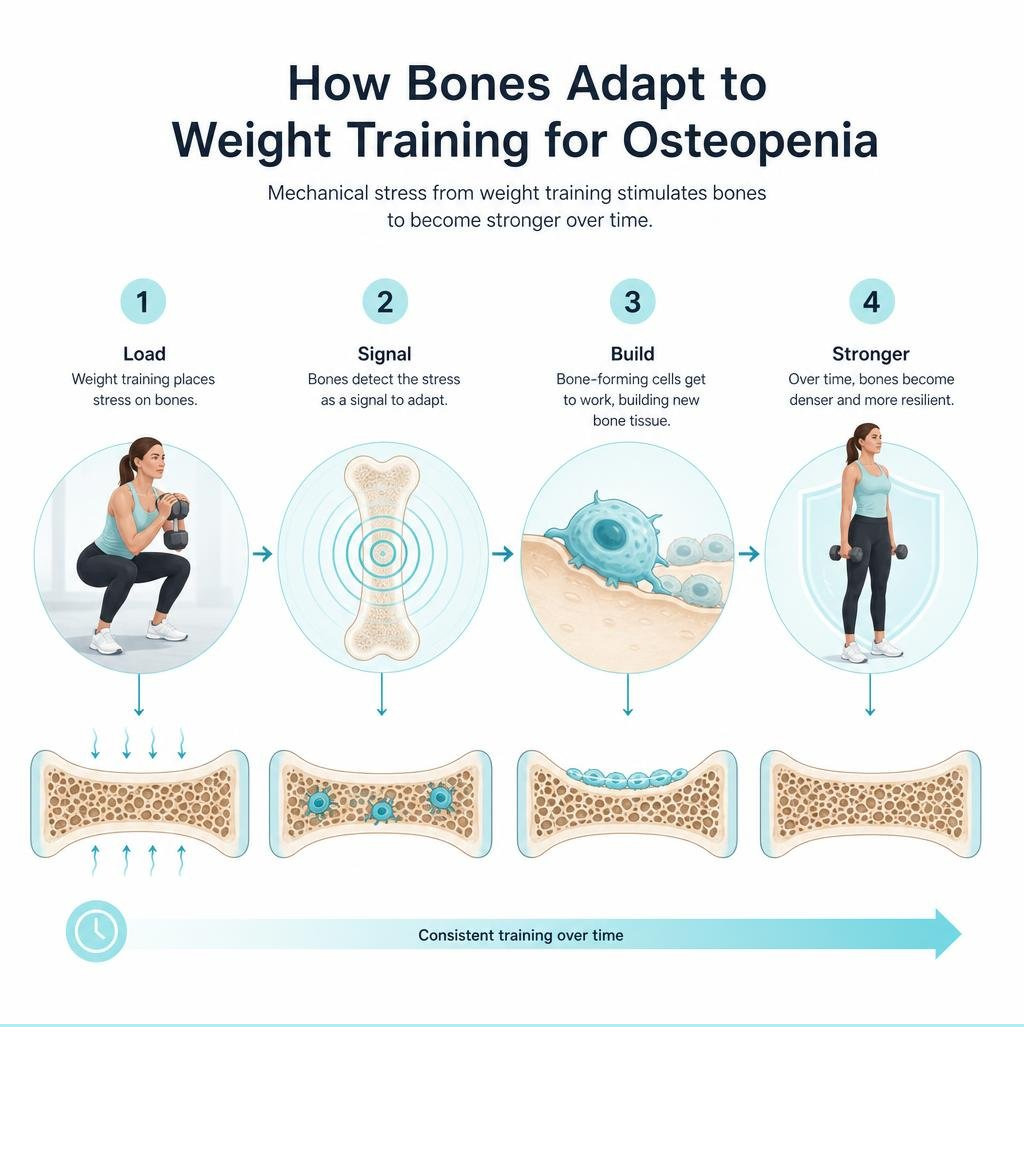
The good news is that bone is living tissue. It responds to the demands you put on it. When you load it hard enough, the cells that build new bone, called osteoblasts, get the signal to go to work. Weight training, done at the right intensity, is one of the clearest ways to send that signal.
This guide walks you through exactly how to design a safe, effective weight training routine for osteopenia, what the research actually shows, which exercises matter most, and what to avoid.
What is Osteopenia and How Does It Differ From Osteoporosis?
To understand how to protect the skeleton, it helps to understand what is happening inside the bones. Bones are not static, solid structures. They are living tissues that constantly renew themselves through a process called bone remodeling. During this cycle, cells called osteoclasts (the cells that break down old bone) remove worn-out bone tissue, while other cells called osteoblasts (the cells that lay down new bone) build fresh bone in its place.
As people age, this balance shifts. The body begins to break down old bone faster than it can replace it. When this happens, bones begin to lose their mineral content, especially calcium. The inner part of the bone, which normally looks like a tight honeycomb, develops larger spaces. This thinning of the bones reduces overall bone mineral density, which is a measurement of how tightly packed the minerals are inside the bones.
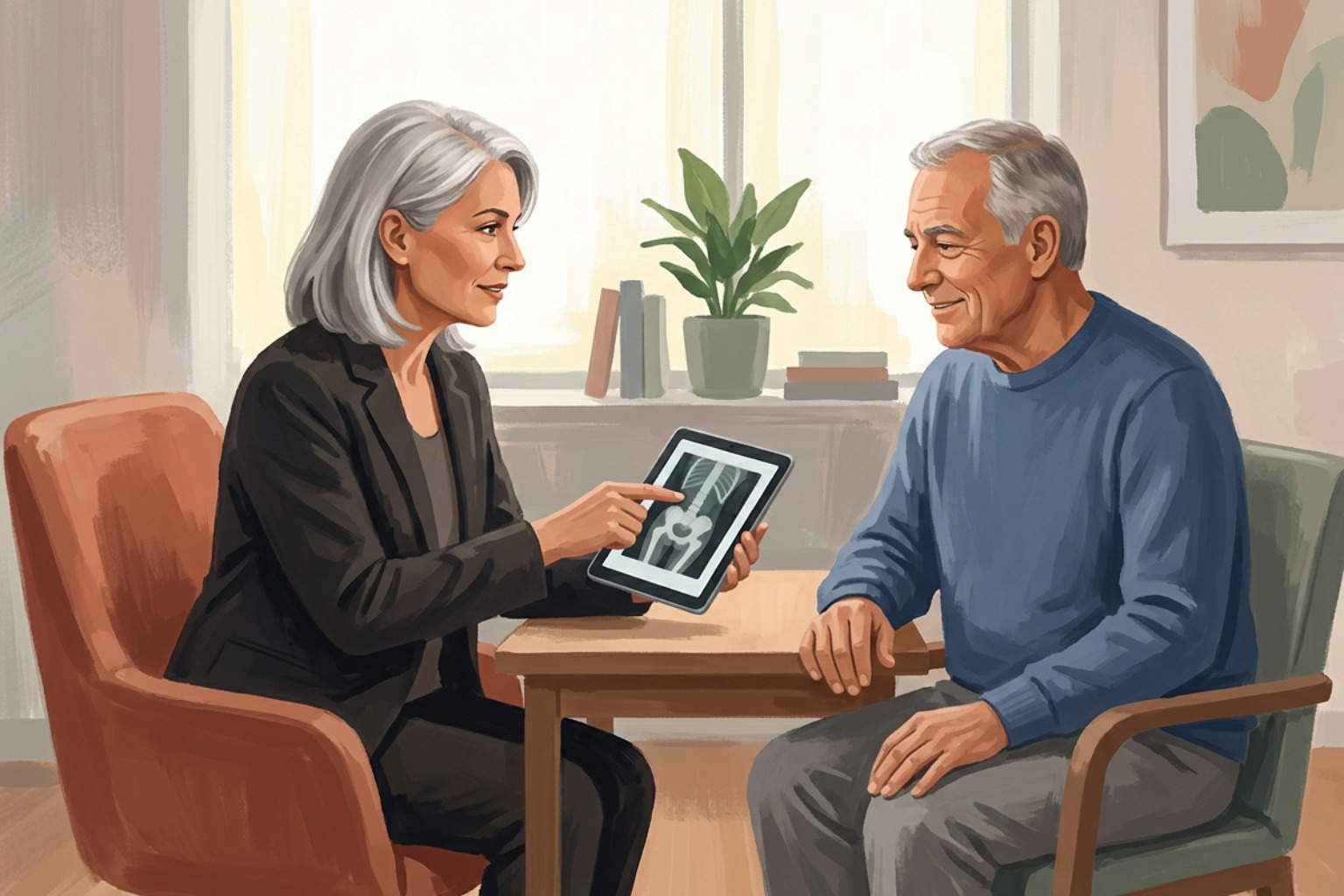
Doctors diagnose these changes using a DEXA scan, an X-ray that measures how strong your bones are. The scan compares a person's bone density to that of a healthy young adult and provides a score called a T-score.
The differences between normal bones, osteopenia, and osteoporosis are defined by these T-score ranges:
- Normal Bone Density: A T-score of -1.0 or higher.
- Osteopenia: A T-score between -1.0 and -2.5. This means the bones are thinner than normal, but they are not yet brittle enough to be classified as osteoporosis.
- Osteoporosis: A T-score of -2.5 or lower. At this stage, the bones have lost significant density and are highly vulnerable to breaks.
Think of osteopenia as a yellow warning light. It is a sign that the bones are losing strength, but it is also a valuable window of opportunity. Because the bones have not yet reached the more fragile state of osteoporosis, older adults can still engage in progressive, heavy loading exercises safely. Starting an active routine during the osteopenia stage provides the best chance to protect the skeleton and prevent a progression to osteoporosis. For a deeper look at these bone changes, readers can explore Bone Health 101.
Why Lifting Heavy Is the Best Defense Against Bone Loss
Many people believe that gentle activities like walking, swimming, or light stretching are enough to keep bones strong. While these activities are excellent for cardiovascular health and joint mobility, they do not provide what is known as an osteogenic load. An osteogenic load is a physical force heavy enough to signal the body to grow new bone.
To understand why weight training for osteopenia is so effective, it helps to look at how bones respond to mechanical stress. When a muscle contracts during heavy lifting, it pulls on the tendon, which in turn pulls on the bone where it attaches. This pulling force creates mechanical stress across the bone. The bone cells sense this stress and release chemical signals that tell the osteoblasts to lay down more minerals. This process is explained in detail in How Exercise Builds Bones.
Without enough mechanical stress, the body has no reason to maintain high bone density. This is why non-weight-bearing exercises like swimming or cycling do not build bone. The water or the bicycle seat supports the body weight, meaning gravity is not putting enough force through the skeleton.
Scientific evidence strongly supports the use of progressive strength training for bone health. A landmark PMC Study on Strength Training followed postmenopausal women with low bone density over a six-month period. The participants performed a strength training protocol twice a week. Each session included exercises like leg presses, squats, and back extensions. The training was structured so that participants performed six repetitions at 70 percent of their maximum capacity, followed immediately by six repetitions at 50 percent of their maximum capacity within the same set.
At the end of the six months, the exercise group showed a statistically significant 1.82 percent increase in lumbar spine bone density. Meanwhile, the group that did not exercise showed no significant change.
A recent Optimal resistance training parameters review found the strongest results generally came from progressive, higher-load resistance training, often at 70 percent of one-repetition maximum or above, performed about three times weekly, with outcomes varying by bone site and program design.
How to Design a Safe and Effective Osteopenia Workout Routine
An effective exercise program for bone health must focus on the areas of the body most prone to fractures: the hips, the spine, and the wrists. Because bone only adapts where the load is placed, general fitness routines must be modified to target these specific sites through compound movements. Compound movements are exercises that work multiple joints and muscle groups at the same time.
To understand the difference between general physical activity and bone-building exercise, consider this comparison:
A simple way to think about exercise for osteopenia:
- Helpful for general health, but usually not enough bone-building load
- Walking on flat surfaces
- Swimming laps
- Gentle resistance band stretching
- Stationary cycling
- More likely to create osteogenic load when done safely and progressively
- Weighted squats for hip and spine loading
- Romanian deadlifts for hip and posterior chain loading
- Overhead dumbbell presses for spine and wrist loading
- Weighted lunges for hip and thigh loading
To learn more about selecting the right activities, readers can check out the guide on the Best Exercise for Bones.
How Much Weight Is Heavy Enough to Build Bone?
To trigger the osteoblasts to build new bone, the weight used must be heavy enough. In professional training, intensity is measured using a metric called the one-repetition maximum (1RM), which is the absolute most weight a person can lift for a single repetition with perfect form.
For bone growth, research suggests that training at a high intensity of 70 percent to 85 percent of a person's 1RM is ideal. This means the weight should be heavy enough that the lifter can only complete 5 to 8 repetitions before feeling tired. Performing high repetitions with very light weights builds muscular endurance, but it does not apply enough mechanical stress to the skeleton to increase bone strength.
To continue making progress, the routine must incorporate progressive overload. This means gradually and systematically increasing the weight over time as the muscles and bones adapt. Without progressive overload, bone growth will stall. Older adults can learn more about how to apply these concepts in Strength Training for Bone Health.
The strongest evidence for lifting heavy comes from the LIFTMOR randomized controlled trial. Postmenopausal women with low bone mass performed just two supervised 30-minute sessions per week of high-intensity resistance and impact training, working at around 80 to 85 percent of their 1RM. After eight months, their lumbar spine bone density improved by about 2.9 percent while the low-intensity comparison group continued to lose bone, and the supervised program had a strong safety record. The takeaway: intensity matters more than duration, but supervision and gradual progression are what make that intensity safe.
Designing Your Weekly Routine
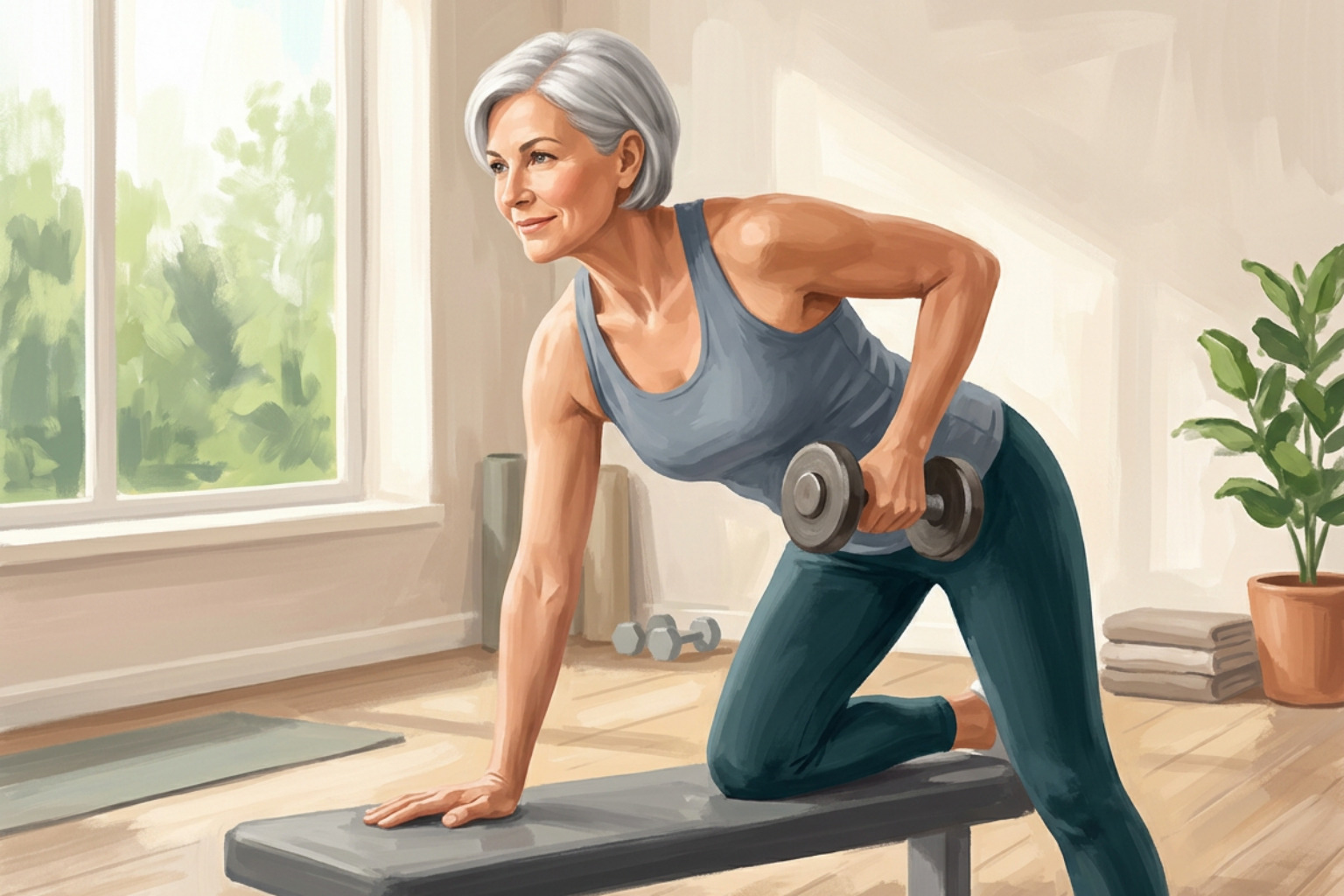
A balanced weekly routine should target the hips, spine, and upper body while prioritizing safety. A solid structure includes two to three strength sessions per week, with at least 48 hours of rest between sessions to allow the bones and muscles to recover.
Key compound exercises to include are:
- Squats: This movement loads both the hips and the spine. It can be done as a bodyweight squat for beginners, progressing to a goblet squat (holding a weight at the chest) or a barbell squat.
- Lunges: Lunges put a direct load on one leg at a time, which mimics the forces of walking and running while strengthening the muscles around the hip joint.
- Romanian Deadlifts (RDLs): An RDL is a move where you bend at the hips to lift a weight. This movement relies on hip hinging, which means bending from the hips rather than rounding the back. This targets the entire back of the body, including the glutes, hamstrings, and lower back muscles.
- Overhead Presses: Lifting weights overhead applies a safe, vertical load through the spine and strengthens the wrist joints.
Safety matters when building your routine. In general, spinal extension - gently straightening or arching the back - can help strengthen the muscles that support your spine. But be careful with loaded spinal flexion - rounding forward while holding weight - because it can increase stress on the vertebrae, especially if bone density is low. When bending forward, choose a hip hinge, keep your spine long, and ask a qualified professional to check your form. For exercise examples, see Best Osteoporosis Exercises.
Here is what a sample week could look like:
| Day | Focus | Example exercises | Sets x reps |
|---|---|---|---|
| Monday | Lower body + hip loading | Goblet squat, lunge, heel drops | 3 x 6-8 |
| Wednesday | Upper body + posture | Overhead press, bent-over row, back extension | 3 x 6-8 |
| Friday | Hips + balance | Romanian deadlift, step-up, single-leg stance | 3 x 6-8, plus 2-3 min balance work |
Rest at least one day between sessions. Start with a weight you could lift about 15 times, and progress gradually toward the 5-to-8-repetition range with professional guidance.
Fall Prevention: The Critical Role of Balance and Power
While building bone density is a primary goal, preventing falls is equally critical. According to the Centers for Disease Control and Prevention (CDC), approximately 88 percent of hip fracture hospitalizations in older adults are caused by falls. A fall can cause a fracture even if bone density is relatively stable. Therefore, an effective osteopenia routine must include balance and power training.
Power training means strength plus speed. It is the ability to produce force quickly. As people age, power declines faster than plain strength. Power is what allows an older adult to quickly step out and catch themselves if they stumble over an uneven sidewalk.
Safe power-building exercises include:
- Jump Squats: Squatting down and then exploding upward into a small jump.
- Hopping or Bounding: Small, controlled hops on a hard surface, which also apply a high-rate impact load to the hip and heel bones.
Because impact and power exercises carry higher risks, they must be cleared by a medical professional and progressed slowly.
To complement power, older adults should practice balance training daily. Single-leg balance (moving while balancing on one leg) is highly effective because it challenges the nervous system in the same way real-life walking does. Simple drills like single-leg stands, toe-to-heel walking, or side-stepping over obstacles help train the brain and muscles to maintain stability.
Frequently Asked Questions About Exercise and Bone Density
Can exercise actually reverse osteopenia?
Yes, clinical studies indicate that targeted exercise can improve bone density and help reverse the trajectory of bone loss. Through the process of bone remodeling, consistent progressive loading signals the body to deposit more minerals into the bone matrix. While a complete reversal to perfectly normal bone density depends on genetics and overall health, many dedicated lifters show measurable bone density improvements on their follow-up DEXA scans after 6 to 12 months of consistent training.
Is walking enough to strengthen my bones?
Walking is a weight-bearing aerobic activity that is excellent for heart health, mental well-being, and joint mobility. However, walking on its own does not provide a large enough osteogenic load to build new bone. The impact forces of walking are repetitive and predictable, and the body quickly adapts to them. Walking plays an important supporting role in an active lifestyle, but it must be paired with progressive resistance training to actively strengthen the skeleton.
What movements should I avoid if I have thinning bones?
Older adults with thinning bones should avoid loaded spinal flexion, which is rounding the spine forward while holding a weight (such as a traditional sit-up or bending over to lift a heavy object with a curved back). Twisting the spine forcefully while holding a weight should also be avoided. These movements place uneven pressure on the spinal vertebrae and increase the risk of a spinal fracture. Instead, focus on keeping the back long and straight by bending from the hips.
Conclusion
Managing thinning bones does not mean avoiding physical activity. On the contrary, weight training for osteopenia is one of the most reliable ways to take control of bone health, build physical resilience, and prevent future fractures. By focusing on heavy, progressive compound lifts, dynamic balance, and safe movement patterns, older adults can protect their active lifestyles for years to come.
For those looking for guidance, Groove Health offers a personalized bone health and exercise program. Through Groove Health, a physical therapist designs a personalized, progressive exercise plan tailored to each member's unique physical abilities, T-scores, and goals. This ensures that every movement is both safe and effective for building bone density and reducing fall risks. Older adults in Menlo Park CA, Berkeley CA, and Downingtown PA can learn more by visiting the Groove Health Program and can check their eligibility to Get Started with Groove.
Works Cited
- National Institute of Arthritis and Musculoskeletal and Skin Diseases. Exercise for Your Bone Health. NIAMS, 2023.
- Holubiac, I. Ș., Leuciuc, F. V., Crăciun, D. M., & Dobrescu, T. "Effect of Strength Training Protocol on Bone Mineral Density for Postmenopausal Women with Osteopenia/Osteoporosis Assessed by Dual-Energy X-ray Absorptiometry (DEXA)." Sensors, vol. 22, no. 5, 2022.
- Zhao, F., Su, W., Sun, Y., Wang, J., Lu, B., & Yun, H. "Optimal resistance training parameters for improving bone mineral density in postmenopausal women: a systematic review and meta-analysis." Journal of Orthopaedic Surgery and Research, vol. 20, 2025.
- Moreland, B. L., Legha, J. K., Thomas, K. E., & Burns, E. R. "Hip Fracture-Related Emergency Department Visits, Hospitalizations and Deaths by Mechanism of Injury Among Adults Aged 65 and Older, United States 2019." Journal of Aging and Health, vol. 35, no. 5-6, 2023.
- Watson, S. L., Weeks, B. K., Weis, L. J., Harding, A. T., Horan, S. A., & Beck, B. R. “High-Intensity Resistance and Impact Training Improves Bone Mineral Density and Physical Function in Postmenopausal Women With Osteopenia and Osteoporosis: The LIFTMOR Randomized Controlled Trial.” Journal of Bone and Mineral Research, vol. 33, no. 2, 2018.
This content is for informational purposes only and does not constitute medical advice. Consult a qualified healthcare professional for diagnosis and treatment. If you are on Medicare and interested in a personalized bone health program, you can check your eligibility at groovehealth.com.