T-Score Improving Workouts: Your Weekly Strength Schedule for Denser Bones
Bone responds to load, not effort. Here is the weekly mix of heavy strength work, safe impact, and balance training that research shows can move a T-score, plus how to progress it without hurting yourself.
Why T-Score Improving Workouts Are Worth Understanding
T-score improving workouts use targeted strength and impact training to give your bones the kind of healthy stress they need to rebuild, become denser, and support a stronger T-score over time.
Here’s a quick summary of the article before we get into the details:
The most effective exercises for improving your T-score are:
- Strength training with challenging resistance: squats, hinges, lunges, and rows that feel hard by the last few reps.
- Safe impact or weight-bearing work: stomps, step-ups, or small hops if your clinician says impact is appropriate.
- Balance practice: single-leg stands, heel-to-toe walking, and controlled direction changes to reduce fall risk.
- Back-strengthening exercises: moves that build the muscles supporting your spine and posture.
Together, these four types of exercise help load your bones, build strength, improve balance, and lower fall risk, giving you the best shot at better bone health over time.
If you recently got a bone density scan back and the number felt concerning, you are not alone. Millions of older adults are told their T-score is low -- and then left wondering what to actually do about it.
The good news is that bone is living tissue. It responds to the demands you place on it. When you give your skeleton the right level of challenge, special cells called osteoblasts (the cells that build new bone) get to work. With consistent training over time, that process can move your T-score in the right direction.
But not all exercise does this equally. Walking is good for your heart. Gentle stretching helps mobility. Light bands can build some muscle. But on their own, they usually do not create enough force to stimulate new bone growth. Bones respond best to higher-load strength exercises that target the hips, spine, and wrists.
This guide explains exactly what works, why it works, and how to do it safely -- whether you are just starting out or looking to push further.
What is a T-Score and How Does It Measure Bone Strength?
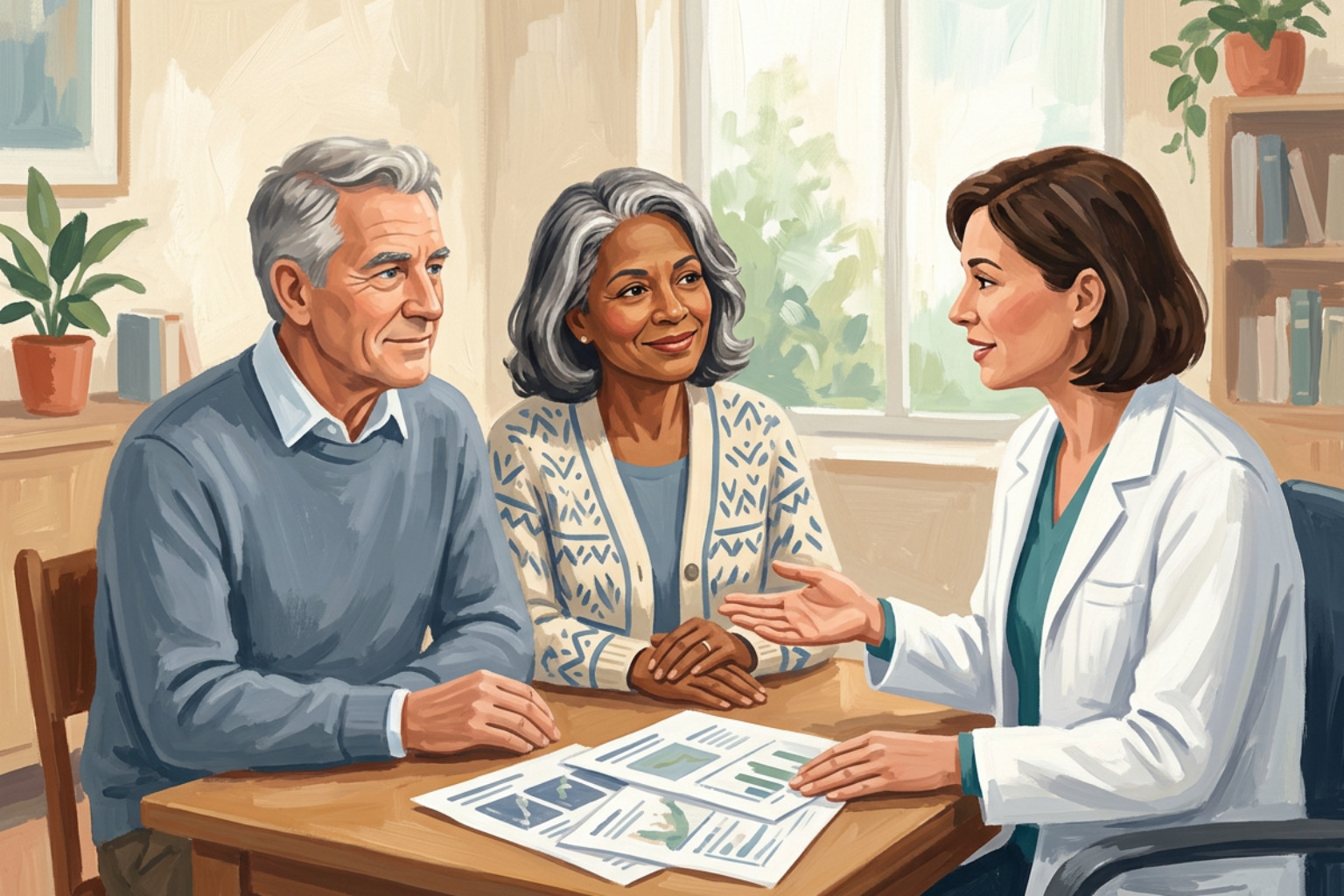
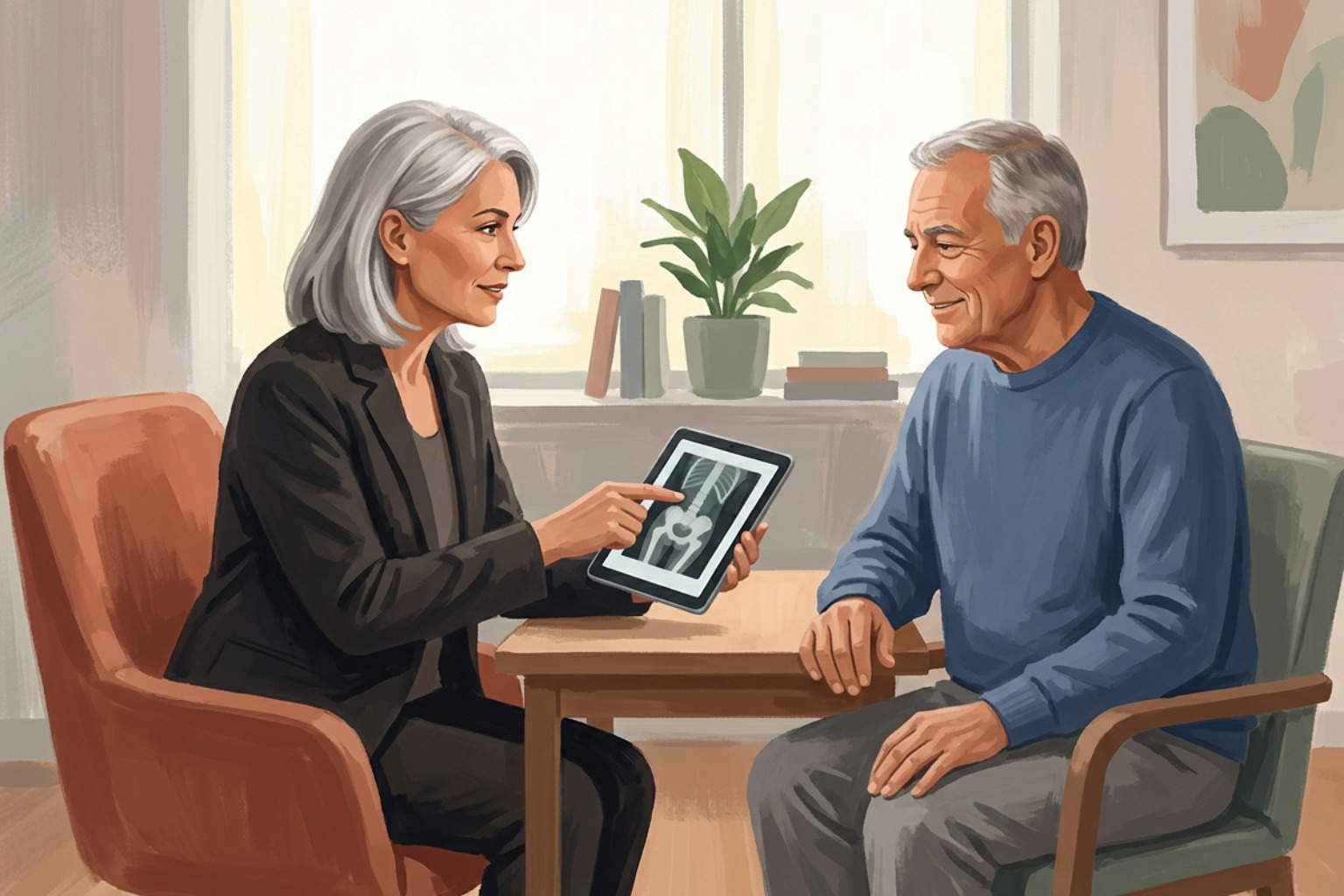
To understand how to improve your bones, you first need to understand how doctors measure them. Your primary tool is a DEXA scan, which is a quick, painless X-ray that measures how strong and dense your bones are.
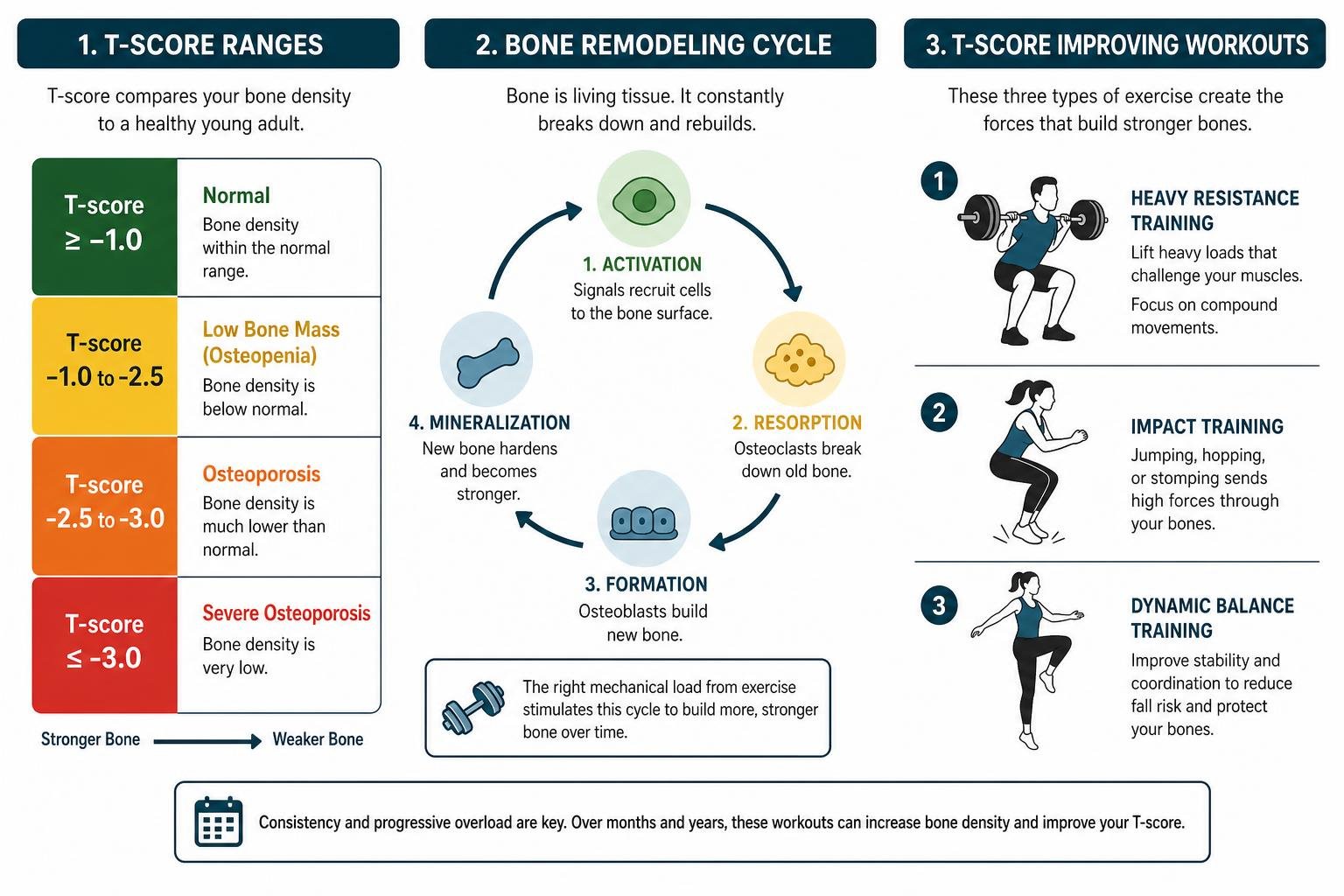
The scan compares your bone density to that of a healthy young adult. The difference between your bones and that healthy young adult standard is shown as a number called a T-score. It is measured in standard deviations, which is just a mathematical way of saying how far you are from the average.
Understanding your scan is the first step toward building a plan. You can read more about what these numbers mean in our guide to reading a bone density report.
How Doctors Use DEXA Scans to Diagnose Osteoporosis
Doctors use specific T-score ranges set by the World Health Organization to diagnose bone thinning:
- Normal Bone Density: A T-score of -1.0 or higher.
- Osteopenia (Thinning Bones): A T-score between -1.0 and -2.5. This means your bones are weaker than normal, but they have not yet reached the level of osteoporosis.
- Osteoporosis: A T-score of -2.5 or lower. At this stage, your bones have lost significant strength and are much more likely to break.
A lower T-score means your bones have become more porous, like a sponge with larger holes. When bones are porous, even a minor trip or fall can lead to a serious break. This is why knowing your score is so important. To learn more, read about how your score relates to your personal risk of a broken bone.
How to Design a Safe and Effective Weekly Routine
Bones get stronger when you use them. This is based on a medical rule called Wolff's Law, which states that bone grows and strengthens in response to the physical forces placed on it. If you do not load your bones, they slowly lose their strength over time.
To trigger this growth, you must apply what is called an osteogenic load. This is a scientific term for a physical force that is heavy enough to signal your body to lay down new bone minerals. You can learn more about the biology behind that signal.
How Bone Responds to Mechanical Load
Inside your skeleton, bone is constantly being broken down and rebuilt in a process called bone remodeling. This process relies on two main types of cells:
- Osteoclasts: Cells that break down and remove old, worn-out bone tissue.
- Osteoblasts: Cells that lay down new bone minerals to build strength.
During T-score improving workouts, your bones feel pressure from lifting, pushing, pulling, or controlled impact. Your body reads that pressure as a message: this bone needs to be stronger. In response, bone-building cells help add new bone tissue over time, especially when workouts progress safely and consistently.
A 2023 randomized controlled trial, High versus Low-Intensity Resistance Training on Bone Mineral Density, found that higher loading intensity is a key factor in stimulating osteoblast-driven bone remodeling.
Why Heavy Resistance Training Outperforms Light Weights
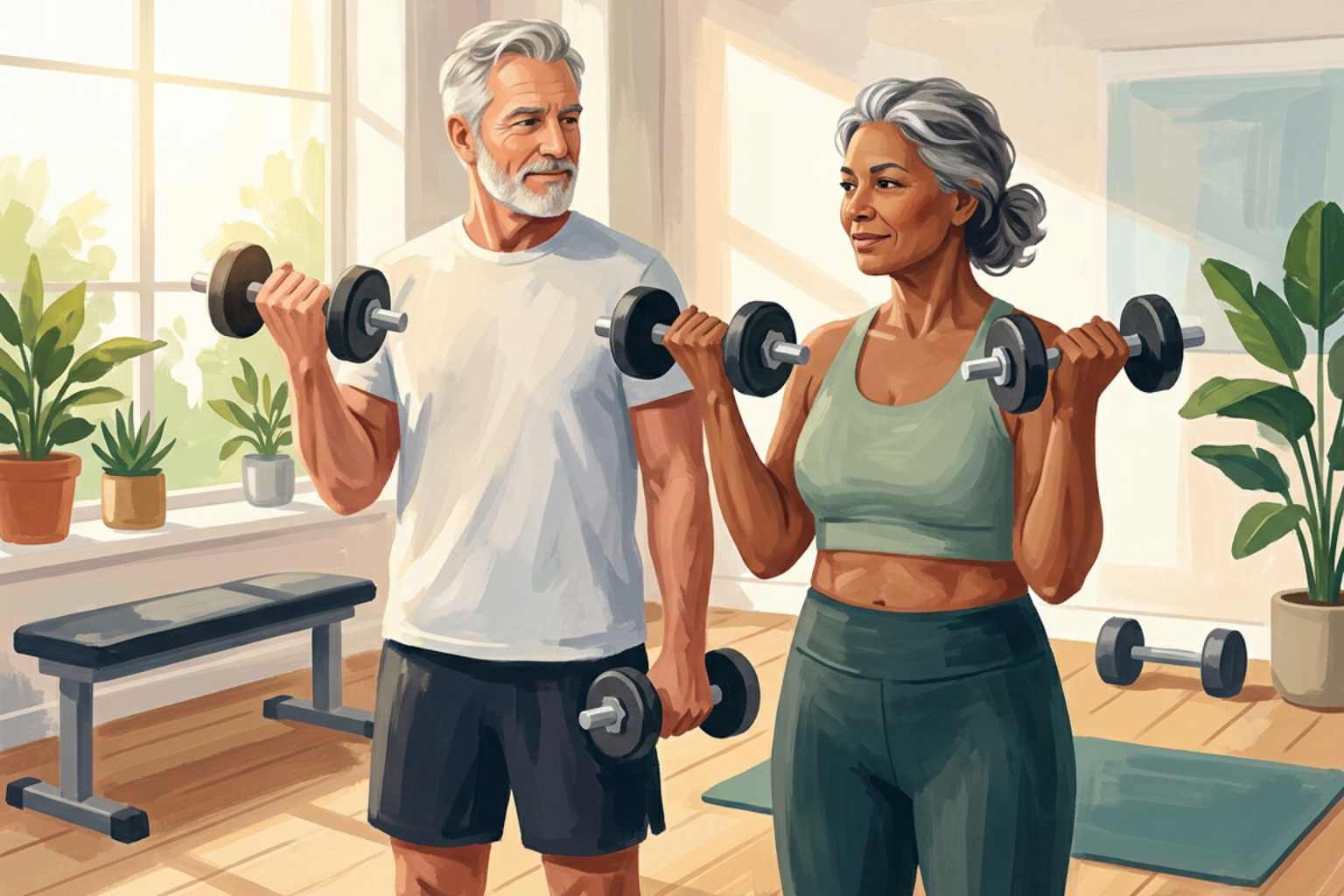
Light hand weights can support joint-friendly movement, muscle endurance, and better exercise form as you age. But for improving bone density, research shows they usually do not create enough force to strongly stimulate bone growth.
To build bone, you need progressive overload. This means you must gradually lift heavier weights over time. The LIFTMOR trial, which tested this directly in postmenopausal women with low bone mass, had participants lift 5 sets of 5 repetitions at more than 85% of their one-repetition maximum (the heaviest weight you can lift exactly once with good form), twice a week for eight months. That group gained bone density at the spine and femoral neck, while a low-intensity home exercise group lost some. In practice, that level of effort means a weight you can lift only about 5 to 8 times before your muscles tire.
| Exercise Type | Load Intensity | Primary Benefit | Effect on T-Score |
|---|---|---|---|
| High-Intensity Resistance | 80% or more of 1RM | Builds new bone minerals and muscle power | High improvement |
| Low-Intensity Resistance | 50% to 60% 1RM | Improves muscle endurance and coordination | Low to no improvement |
| Walking or Light Cardio | Body weight only | Improves heart health and general fitness | Maintains but does not increase |
To see how to structure these sessions, you can read our guide to building a bone-focused strength routine.
Safe Impact and Power Training to Stimulate Bone Growth
Power is your ability to use strength quickly, like stepping up onto a curb, rising from a chair, or regaining balance after a stumble. For people with osteoporosis, safe power and impact training can support stronger bones while helping reduce fall risk.
Impact training gives your bones a brief, firm “wake-up signal.” When your foot lands during a hop, stomp, or small jump, your skeleton has to absorb that quick pressure. Bones can respond to that challenge by remodeling and becoming stronger over time. These exercises are not right for everyone, especially people with osteoporosis or a fracture history, so they should only be added when a clinician says they’re appropriate. For a breakdown of which movements load bone best, see our exercise guide.
How to Target the Hip and Spine with Compound Exercises
Bone adaptation is site-specific. This means that if you only exercise your arms, only your arm bones will get stronger. Because most osteoporotic breaks occur in the hip and the lower spine, your workouts must directly load these two areas.
The best way to load the hip and spine is with compound exercises: movements that use more than one joint and several large muscle groups at once. Think squats, lunges, step-ups, hip hinges, and deadlift variations. These exercises matter because they put useful force through the hips, pelvis, legs, and trunk together, which is exactly where many people want to protect bone density and reduce fracture risk. You can find a complete list in our guide to exercises for people with osteoporosis.
Large Muscle Movements That Load the Skeleton
To strengthen your hips and spine, focus on these three foundational movements:
- Squats: Bending your knees and hips as if sitting in a chair. This loads the femoral neck (the part of your hip bone most likely to break).
- Lunges: Stepping forward or backward and lowering your hips. This builds single-leg strength and loads the hip joints.
- Hip Hinges (Romanian Deadlifts): Bending forward from your hips while keeping your back long and straight. This directly loads the lower spine and back muscles.
Daily walks are excellent for your heart, mood, balance, joint mobility, and general fitness, but they usually do not provide enough mechanical force to build new bone. Read more about why walking alone will not raise your T-score.
Dynamic Balance Exercises to Lower Fall Risk
Building stronger bones is only half the battle. The other half is making sure you do not fall. According to CDC researchers, about 88% of hip fracture emergency department visits and hospitalizations among adults aged 65 and older are caused by falls.
While standing still on one leg is a good start, real life is dynamic. You need balance exercises that challenge you while you move. Good options include:
- Three-way toe taps: Balancing on one leg while tapping the other foot forward, to the side, and backward.
- Single-leg heel raises: Holding onto a sturdy surface for safety and rising onto your toes on one foot.
- Tai Chi movements: Slow, controlled shifts of your weight from one foot to the other.
To start practicing these at home, read our guide to balance and fall-prevention exercises.
Safe Progression and Precautions for Older Adults
If you have never lifted weights before, the idea of heavy training can feel intimidating. However, clinical studies show that even older adults with severe osteoporosis can safely lift heavy weights when they progress slowly and use proper form. To understand how clinical programs handle that transition, read about closing the exercise gap in osteoporosis care.
How to Add Weight Safely Over Time
The key to safe training is progressive resistive exercise. This means you start with light loads to master your movement form, and then slowly add weight as your body adapts. For load targets specific to the osteopenia range, see our guide to weight training for osteopenia.
A safe timeline for beginners typically looks like this:
- Weeks 1 to 4 (Movement Learning): Focus on learning the exercises using only your body weight or very light weights.
- Weeks 5 to 8 (Loading Introduction): Slowly add resistance using weights that feel moderately heavy.
- Weeks 9 and Beyond (Intensity Building): Move toward weights that challenge your muscles within 5 to 8 repetitions.
For more details on setting up your progression, view our guide to strength training with osteoporosis.
Movements to Avoid to Protect Your Spine
Loading your bones is healthy, but some movements can place extra stress on the spine. If you have a low T-score, it’s usually best to limit loaded spinal flexion unless your clinician says it’s safe. That means rounding your back forward while holding weight, or doing deep forward-bending moves like sit-ups and toe touches.
Instead, aim to keep your spine neutral, with the natural curve of your lower back maintained. When you bend down to pick up a weight, hinge at your hips and shift your hips backward, keeping your torso controlled rather than rounded. Use smooth, deliberate movement when rotating, and avoid combining deep bending with twisting under load.
Frequently Asked Questions About Improving Bone Density
Can exercise replace osteoporosis medication?
Exercise can help improve or maintain bone density, especially when it includes progressive strength training, safe impact, and balance work. But it usually should not replace prescribed osteoporosis medication if your doctor says your fracture risk is high. The strongest approach is often both: medication helps reduce bone loss and fracture risk, while exercise builds strength, improves balance, and lowers fall risk.
How long does it take to see improvements in a T-score?
Because the bone remodeling cycle is a slow process, it takes time to see measurable changes on a DEXA scan. It typically takes 12 to 18 months of consistent training to show visible improvements in bone density. Most doctors recommend waiting one to two years between bone scans to accurately track your progress.
What role do calcium and vitamin D play alongside exercise?
Nutrition provides the raw building blocks your body needs to make new bone. Calcium is the primary mineral that hardens bone tissue, and Vitamin D acts like a key that helps your gut absorb that calcium. Without these nutrients, your osteoblasts cannot build strong bone, no matter how hard you train. Talk to your doctor to see if you need a supplement to support your workouts.
Where to Start This Week
Improving your T-score is a journey that requires consistency, the right level of weight, and a clear plan. While light activity is wonderful for your general health, building bone requires progressive, heavy resistance training paired with dynamic balance work.
If you are looking for guidance, Groove Health offers a Medicare-covered bone health program that directly translates these clinical exercise principles into your daily life. Our care model is built around personalized, home-based physical therapy and customized exercise plans designed specifically to prevent fractures and build bone strength. Each member works with a dedicated physician and a physical therapist who tailors a progressive, safe loading program to your current abilities, ensuring you can confidently perform the targeted exercises needed to improve your T-score from the comfort of home.
To take the first step toward stronger bones, you can check your eligibility for our personalized program at Groove Health.
Works Cited
- World Health Organization. "Prevention and Management of Osteoporosis: Report of a WHO Scientific Group." World Health Organization, 2003.
- Eslamipour, Fatemeh, Mehdi Gheitasi, Fariborz Hovanloo, and Zohreh Yaghoubitajani. "High versus Low-Intensity Resistance Training on Bone Mineral Density and Content Acquisition by Postmenopausal Women with Osteopenia: A Randomized Controlled Trial." Medical Journal of the Islamic Republic of Iran, vol. 37, 2023.
- Watson, Steven L., Benjamin K. Weeks, Lisa J. Weis, Amy T. Harding, Sean A. Horan, and Belinda R. Beck. "High-Intensity Resistance and Impact Training Improves Bone Mineral Density and Physical Function in Postmenopausal Women With Osteopenia and Osteoporosis: The LIFTMOR Randomized Controlled Trial." Journal of Bone and Mineral Research, vol. 33, no. 2, 2018.
- Moreland, Briana L., Jaswinder K. Legha, Karen E. Thomas, and Elizabeth R. Burns. "Hip Fracture-Related Emergency Department Visits, Hospitalizations and Deaths by Mechanism of Injury among Adults Aged 65 and Older, United States 2019." Journal of Aging and Health, vol. 35, no. 5-6, 2023.
This content is for informational purposes only and does not constitute medical advice. Consult a qualified healthcare professional for diagnosis and treatment. If you are on Medicare and interested in a personalized bone health program, you can check your eligibility at groovehealth.com.