The Definitive Guide to Vitamin D3 for Bone Density
Vitamin D3 lets your bones absorb the calcium you eat. But trials show 4,000-10,000 IU a day can lower bone density instead of raising it. Here's the dose that actually works, by age.

What Vitamin D3 Does for Your Bones (And How Much You Actually Need)
Vitamin D3 for bone density is one of the most searched topics in bone health — and for good reason. If you just got a DEXA scan result (a bone density X-ray that shows how dense your bones are) or your doctor mentioned osteoporosis or osteopenia (thinning bones), vitamin D3 is probably something you've heard about.
Here's a quick answer before we go deeper:
- Vitamin D3 helps your body absorb calcium from food. When vitamin D is low, you absorb less of the calcium you eat, and over time that can weaken your bones
- Most adults need 600–800 IU per day from food, sunlight, and supplements combined. Adults over 70 generally need the higher end of that range.
- More is not always better. Research shows that very high doses (4,000 IU or more per day) may actually reduce bone density rather than improve it.
- Getting tested matters. If you're at higher risk, your doctor may check your vitamin D level with a 25(OH)D blood test before recommending supplements
- Vitamin D3 works best alongside calcium and other bone-supporting nutrients. It's one piece of the puzzle, not the whole solution.
Most people who are otherwise healthy and not severely deficient won't see meaningful bone density gains from vitamin D3 alone. But for those who are genuinely low, correcting that deficiency can help reduce bone loss and lower the risk of breaking a bone.
Vitamin D earned the nickname "the sunshine vitamin" because your skin makes it when exposed to sunlight. The problem? By the time most people reach their 60s and 70s, their skin produces only about a quarter of the vitamin D it did in their 20s. That's one reason deficiency becomes so common with age — and why paying attention to your levels matters more as you get older.
This guide covers how vitamin D3 actually works in your body, how much you need based on your age and health, the best ways to get it, and what the research really says about supplements.
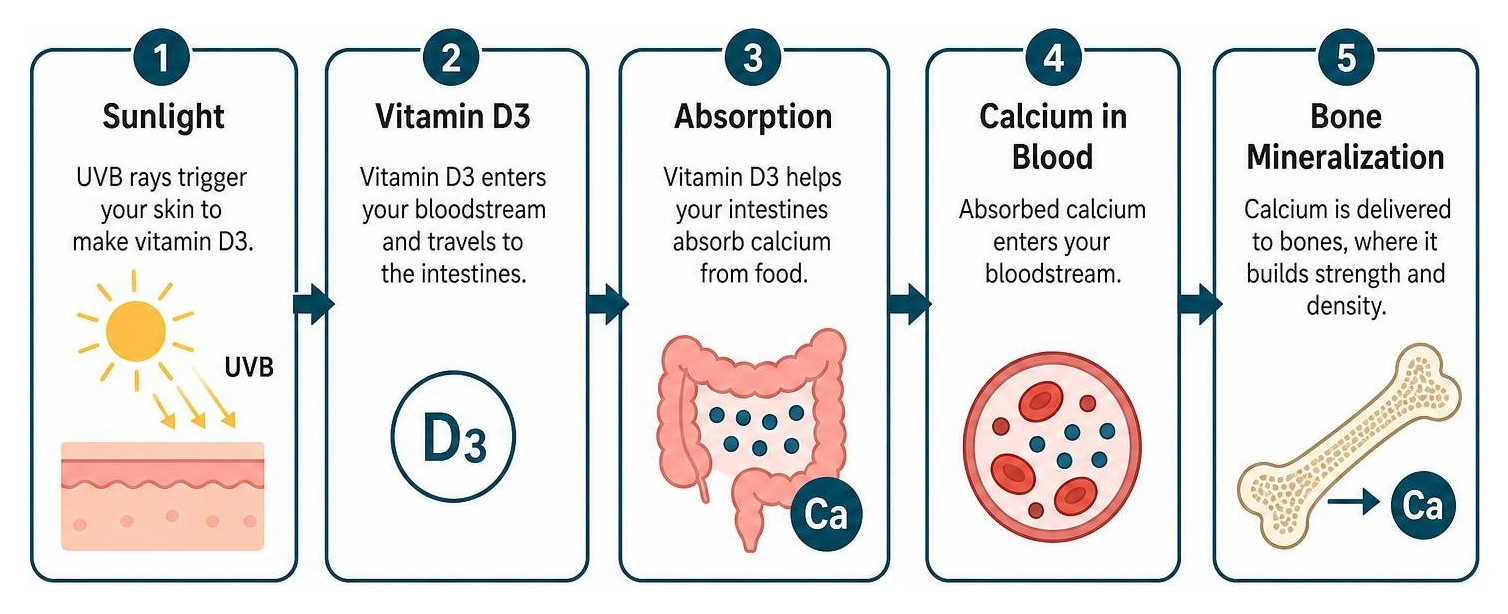
Simple guide to vitamin d3 for bone density:
How Vitamin D3 Works to Support Your Bones
To understand why vitamin D3 is so important, you have to look at how your body handles calcium. Calcium is the primary building block of your skeleton. However, your body cannot absorb calcium from your food on its own.
When you eat calcium-rich foods, they travel to your small intestine. Vitamin D3 acts like a key that opens the doors in your gut, allowing calcium to enter your bloodstream. When vitamin D3 is severely lacking, your body can only absorb a small fraction of the calcium you consume — roughly 10 to 15 percent, compared with 30 to 40 percent when vitamin D levels are adequate.
Once calcium is in your blood, your body uses it to build and maintain your skeleton. This process relies on osteoblasts, the cells that lay down new bone. Vitamin D3 helps support these cells so they can do their job of supporting healthy bone formation.
If your blood calcium levels drop too low because you do not have enough vitamin D, your body has to find that calcium somewhere else. It does this by releasing parathyroid hormone. This hormone acts like a messenger that tells your body to pull calcium out of your bones to keep your blood levels steady. While this protects your heart and muscles, it leaves your bones weak, porous, and more likely to break. Over time, this constant borrowing of calcium contributes to osteoporosis, a condition that makes bones weak and fragile.
Getting enough vitamin D3 can help stop this pattern. It supports calcium absorption so your bones have the minerals they need, and it helps reduce the chance that your body pulls calcium from bone tissue. For more background, see our guide to essential nutrients for bone health.
Finding the Right Dose of Vitamin D3 for Bone Density
Knowing how much vitamin D3 to take can be confusing. The right amount for you depends on your age, your lifestyle, and your current blood levels.
According to guidelines from the International Osteoporosis Foundation, daily requirements change as we age. For adults under 50, a daily intake of 400 to 800 IU is generally recommended. For adults aged 50 and older, the recommendation rises to 800 to 1,000 IU per day to help protect against bone loss.
To find out if you are getting enough, you can ask your doctor for a 25(OH)D blood test. This test measures the amount of vitamin D in your blood. Doctors generally agree that a level of 30 ng/mL (75 nmol/L) or higher is ideal for maintaining strong bones. If your levels are below this threshold, you may need a higher daily dose for a short time to bring your levels back up. You can learn more about finding your ideal balance in our supplement guide for better bone density.
| Age Group | Recommended Daily Intake (IU) | Target Blood Level |
|---|---|---|
| Adults under 50 | 400 to 800 IU | 30 ng/mL (75 nmol/L) or higher |
| Adults 50 to 70 | 600 to 1,000 IU | 30 ng/mL (75 nmol/L) or higher |
| Adults over 70 | 800 to 1,000 IU | 30 ng/mL (75 nmol/L) or higher |
| Adults with severe deficiency | 1,500 to 2,000 IU (under medical care) | 30 ng/mL (75 nmol/L) or higher |
Best Food Sources of Vitamin D3
While your skin can make vitamin D from sunlight, several factors make this harder. Skin becomes much less efficient with age—people over 65 may produce only about a quarter as much vitamin D from the sun as they did in their 20s. This is why getting vitamin D from your diet and supplements is so important.
Very few foods naturally contain high amounts of vitamin D3, but there are several excellent options to include in your meals:
- Fatty fish: Wild-caught salmon is one of the best sources, providing 600 to 1,000 IU per 100-gram serving. Farmed salmon provides about 100 to 250 IU, while canned sardines offer 300 to 600 IU.
- Egg yolks: One egg yolk contains about 50 IU of vitamin D3.
- Fortified foods: Many everyday foods have vitamin D added to them. A single cup of fortified milk or fortified orange juice typically provides around 100 IU. Fortified breakfast cereals are also common options.
- Mushrooms: Some mushrooms that have been exposed to ultraviolet light can provide a helpful amount of vitamin D.
For a deeper look at which vitamins and minerals support your skeletal system, read our article on what vitamins for bones are most effective.
How to Choose a Vitamin D3 Supplement
If you cannot get enough vitamin D from food and sunlight, a daily supplement can help. When shopping for a supplement, you will likely see two different forms: vitamin D2 and vitamin D3.
Vitamin D2, also known as ergocalciferol, is made from plants and mushrooms. Vitamin D3, also known as cholecalciferol, is the form naturally made by the human body and found in animal products.
Clinical studies show that vitamin D3 is more effective at raising and maintaining your blood levels than vitamin D2. Because it raises your levels more efficiently and stays active in your body longer, it is the preferred choice for supporting bone health. If you are choosing a supplement, look for vitamin D3 (cholecalciferol) on the label. To learn more about choosing high-quality options, check out our guide on supplements for bone health and bone density.
Why More Is Not Always Better: The Risks of High-Dose Vitamin D3
Many people believe that if a small amount of a vitamin is good for you, a large amount must be even better. However, when it comes to vitamin D3, taking too much does not help, and higher doses are linked to greater bone density loss.
A major clinical trial published in the Journal of the American Medical Association studied the effects of high-dose vitamin D3 on healthy adults over three years. The participants were split into three groups taking either 400 IU, 4,000 IU, or 10,000 IU of vitamin D3 daily.
The results surprised many researchers. The adults taking the high doses of 4,000 IU or 10,000 IU daily actually lost significantly more bone mineral density in their wrists than those taking the standard 400 IU dose. Specifically, those taking 4,000 IU saw a 2.4 percent drop in radial bone density, and those taking 10,000 IU saw a 3.5 percent drop, compared to just a 1.2 percent drop in the 400 IU group. You can read the details of this study in the JAMA study on high-dose vitamin D and BMD.
Another large study, known as the VITAL trial, followed over 25,000 participants. It concluded that daily supplementation with 2,000 IU of vitamin D3 did not lower the risk of bone breaks or improve bone density in generally healthy, older adults who were not already deficient. You can read more about these findings in the VITAL trial bone health outcomes.
Taking too much vitamin D3 can also cause a condition called hypercalcemia, which means you have too much calcium in your blood. This can lead to painful kidney stones, muscle weakness, and calcium deposits in your blood vessels. To keep your bones safe, avoid taking more than 4,000 IU per day unless your doctor specifically prescribes a higher dose to treat a severe deficiency.
Frequently Asked Questions about Vitamin D3 and Bone Health
Does taking more vitamin D3 always improve bone density?
No. Taking very high doses of vitamin D3 does not improve bone density and may actually cause you to lose bone faster. In a three-year clinical trial, adults taking 4,000 IU or 10,000 IU daily lost more bone density in the wrist than those taking a standard 400 IU dose. Stick to moderate daily amounts unless your doctor tells you otherwise.
What is the difference between vitamin D2 and D3?
Vitamin D3 (cholecalciferol) is the form your body makes naturally from sunlight, while vitamin D2 (ergocalciferol) comes from plants. Studies show that vitamin D3 is much better at raising and maintaining the level of vitamin D in your blood over time.
How does vitamin D3 interact with calcium and magnesium?
Vitamin D3 and calcium must work together. Vitamin D3 helps your body absorb calcium from your food. Meanwhile, magnesium is the key that activates vitamin D so your body can use it. Without enough magnesium, the vitamin D you take may remain stored and inactive. You can learn more about how these minerals work together by reading our articles on magnesium for bone density and vitamin k2 for bone density.
Pairing Vitamin D3 With the Load Your Bones Need
Vitamin D3 is a vital partner for your bones, helping you absorb the calcium needed to keep your skeleton strong. However, supplements are only one part of protecting your health. To truly build bone strength and lower your risk of falls, your bones need to be physically loaded.
This is where a structured, progressive exercise program makes a difference. To trigger the cells that build new bone, you need to perform heavy resistance exercises that target your hips and spine. Light activities like walking are excellent for your heart, but they do not place enough load on your skeleton to grow new bone.
At Groove Health, we directly connect these nutritional foundations to physical action. Our care model is built around personalized exercise plans designed specifically to prevent fractures and build bone strength. When you join, a physical therapist works with you to design a customized exercise plan tailored to your current abilities. This plan safely guides you toward the progressive resistance training and balance exercises that build bone density, lower your risk of falling, and ensure the calcium your vitamin D3 helps absorb is actually put to work strengthening your skeleton.
Works Cited
- Burt, Lauren A., et al. Effect of High-Dose Vitamin D Supplementation on Volumetric Bone Density and Bone Strength: A Randomized Clinical Trial. JAMA, 2019.
- Giustina, Andrea, et al. Vitamin D in the Older Population: A Consensus Statement. Endocrine, 2023.
- Goltzman, David. Functions of Vitamin D in Bone. Histochemistry and Cell Biology, 2018.
- Heaney, Robert P., et al. Vitamin D3 Is More Potent Than Vitamin D2 in Humans. Journal of Clinical Endocrinology & Metabolism, 2011.
- Holick, Michael F. Vitamin D Deficiency. New England Journal of Medicine, 2007.
- LeBoff, Meryl S., et al. Effects of Supplemental Vitamin D on Bone Health Outcomes in Women and Men in the VITamin D and OmegA-3 TriaL (VITAL). Journal of Bone and Mineral Research, 2020.
- International Osteoporosis Foundation. Vitamin D recommendations. International Osteoporosis Foundation, 2020.
- Reid, Ian R., et al. Effect of monthly high-dose vitamin D on bone density in community-dwelling older adults substudy of a randomized controlled trial. Journal of Internal Medicine, 2017.
- Kistler-Fischbacher, Michaela, et al. Effects of vitamin D3, omega-3s, and a simple strength training exercise program on bone health: the DO-HEALTH randomized controlled trial. Journal of Bone and Mineral Research, 2024.
- Jorde, Rolf, et al. No significant effect on bone mineral density by high doses of vitamin D3 given to overweight subjects for one year. Nutrition Journal, 2010.
- Tripkovic, Laura, et al. Comparison of Vitamin D2 and Vitamin D3 Supplementation in Raising Serum 25-Hydroxyvitamin D Status: A Systematic Review and Meta-Analysis. American Journal of Clinical Nutrition, 2012.
This content is for informational purposes only and does not constitute medical advice. Consult a qualified healthcare professional for diagnosis and treatment. If you are on Medicare and interested in a personalized bone health program, you can check your eligibility at groovehealth.com.