
Keep Your Bones Strong After Menopause by Taking Action Early
Estrogen loss speeds up bone thinning around menopause. Learn when to get a DEXA scan, how to read your T-score, how medications and hormone therapy compare, and the nutrition and fall-prevention steps that help.

Why Bone Health After Menopause Calls for Early Action
After menopause, falling estrogen levels can speed up bone loss. You may not feel it happening, but weaker bones can raise your chance of a break. Ask your doctor when to check your bone strength, especially if you have already broken a bone or have other risk factors. Strength training, balance exercise, and enough calcium and vitamin D may also help protect your bones.
If a scan has left you wondering what your results mean, start with understanding osteoporosis. This guide focuses on what changes after menopause and the steps you can take early.
How Estrogen Loss Accelerates Postmenopausal Bone Loss
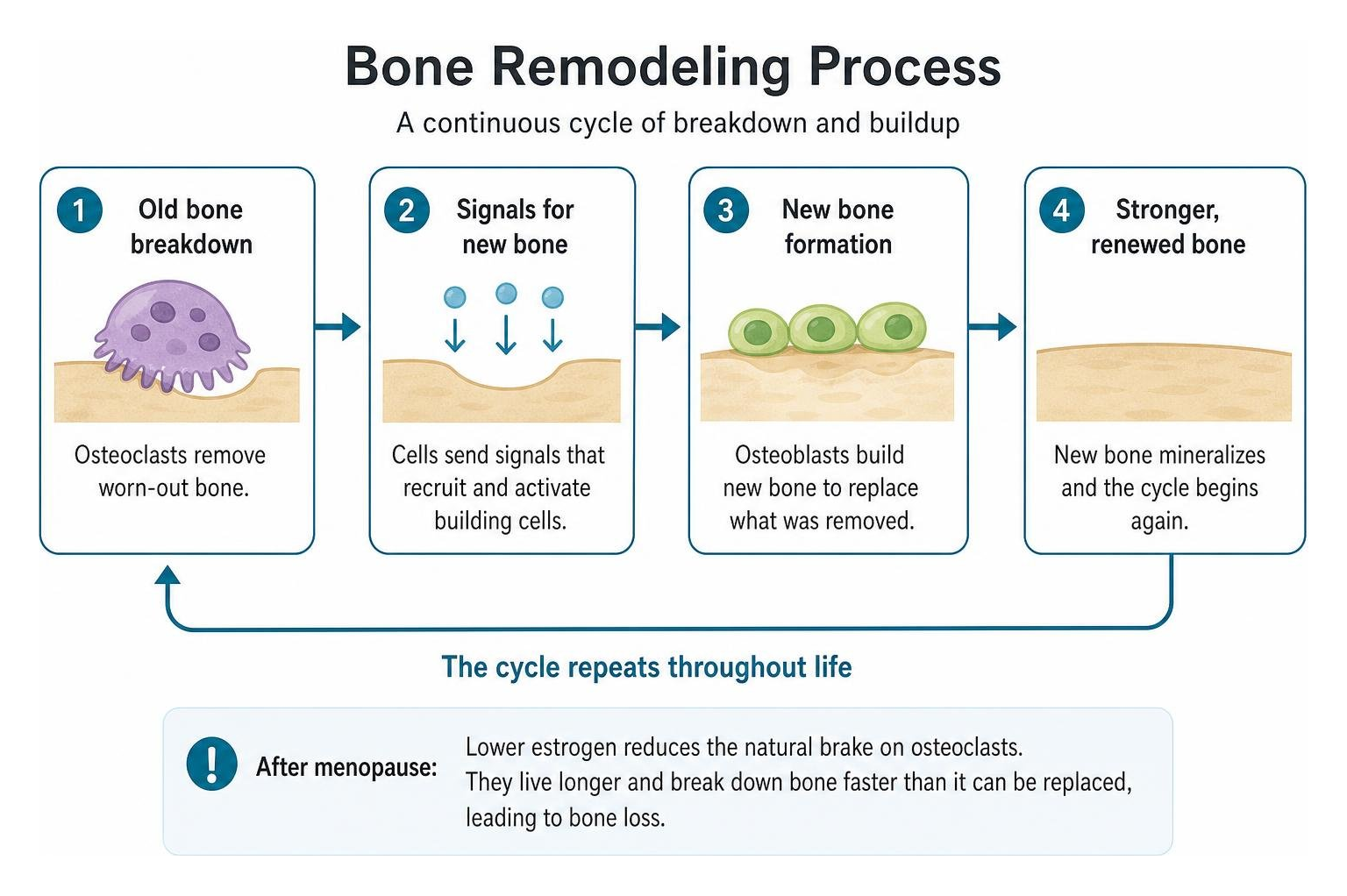
Bone loss speeds up because estrogen drops during menopause, which disrupts your body's natural bone renewal cycle. Your skeleton is living tissue that constantly breaks down old bone and replaces it with new bone. Specialized cells called osteoclasts remove worn-out bone, while cells called osteoblasts build new bone to take its place.
Estrogen acts as a natural brake on osteoclasts. When estrogen levels decline, these cleanup cells live longer and break down bone faster than building cells can replace it. You can explore the cellular details in our guide on how estrogen affects osteoblasts and osteoclasts.
Where Bone Loss Hits First and How Fast It Happens
Estrogen decline affects trabecular bone first, the spongy inner bone found in larger amounts in the spine, hip, and wrist. Current menopause-transition research shows bone loss is fastest from about one year before the final period through the first few years after menopause. Average yearly loss is often around 2% at the spine, and in one large multiethnic study, women lost about 10% of their spine bone density on average over the decade around menopause.
According to the Bone Health and Osteoporosis Foundation, this rapid bone loss leaves internal bone structures thinner and more porous. Over time, the inner scaffolding resembles a wider honeycomb, which significantly lowers structural strength and increases the chance of a break from minor bumps or everyday falls.
Clinical Risk Factors for Accelerated Bone Thinning
While every woman experiences a drop in estrogen during menopause, certain factors can make bone loss happen even faster:
- Low body weight: Having a smaller frame or low body weight means you have less baseline bone mass to spare.
- Family history: Having a parent who experienced thinning bones or a broken hip increases your personal risk.
- Early menopause: Going through menopause naturally or surgically before age 45 lengthens the total time your body spends without estrogen's protective effects.
- Glucocorticoid medications: Long-term use of steroid medicines like prednisone can slow down bone-building cells.
- Aromatase inhibitors: These medications, commonly used in breast cancer treatment, lower estrogen levels further and accelerate bone loss.
- Smoking and heavy alcohol intake: Both habits directly hinder bone renewal and reduce how well your body absorbs essential minerals.
Diagnosing Osteopenia and Osteoporosis in Postmenopausal Women
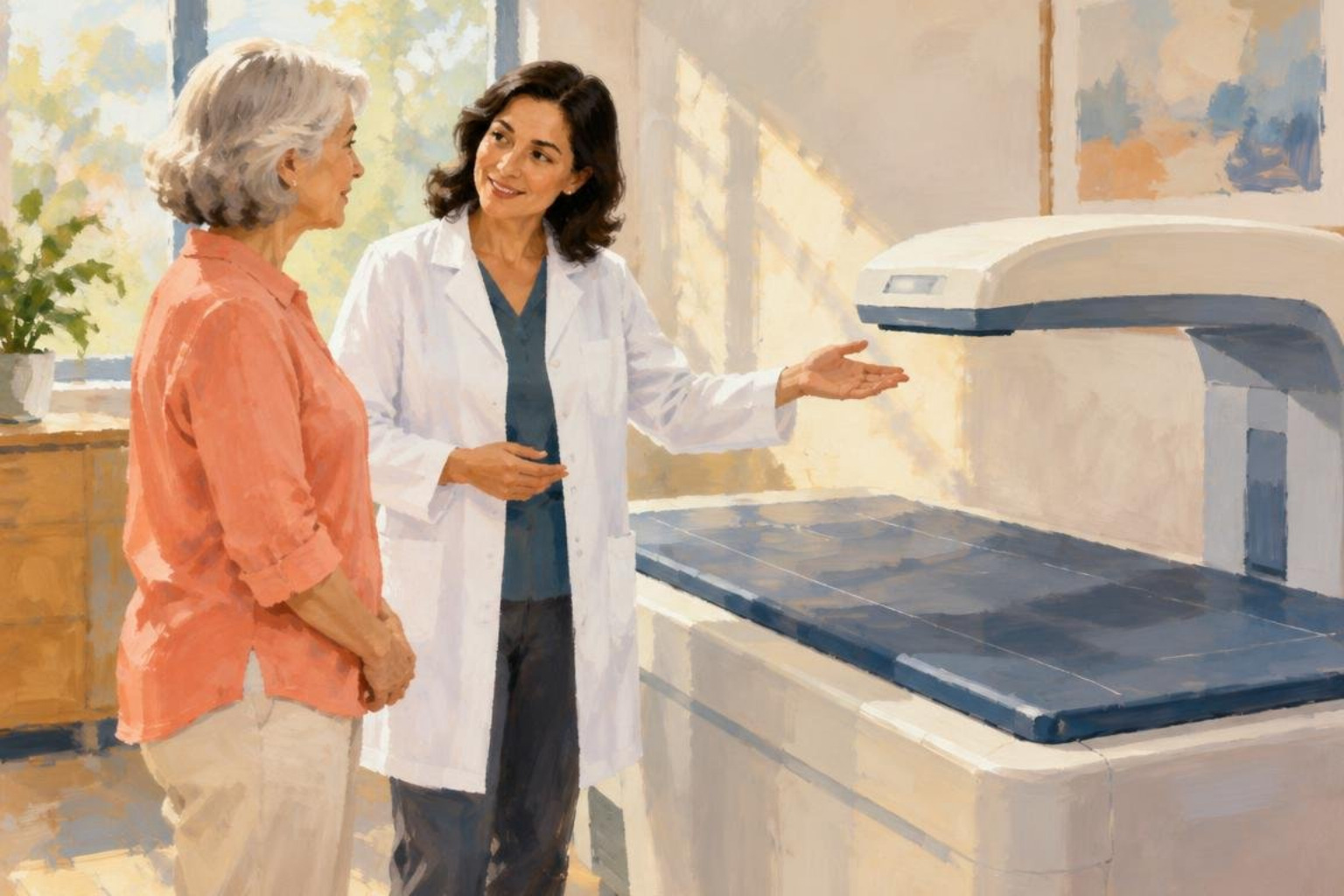
Osteopenia (mild bone thinning) and osteoporosis are diagnosed using a dual-energy X-ray absorptiometry scan, commonly called a DEXA scan. This is a low-dose X-ray that measures how strong your bones are at key areas like the lower back and hip.
According to official Medicare bone mass measurement coverage rules described by Medicare.gov, Medicare Part B covers a bone density test once every 24 months for qualified individuals, or more often when medically necessary, with zero out-of-pocket costs when the healthcare provider accepts assignment. Coverage rules may vary by plan type, such as Medicare Advantage.
When to Schedule a Bone Density Scan
Leading health organizations, including the U.S. Preventive Services Task Force (USPSTF), recommend that all women age 65 and older receive a baseline DEXA scan. Testing is also advised for postmenopausal women under 65 who have risk factors like a prior break, low body weight, or high-risk medication use.
Doctors often combine DEXA scan results with the Fracture Risk Assessment Tool (FRAX). This tool uses your medical history, age, and bone density scores to calculate your 10-year probability of experiencing a broken hip or major fracture, helping your care team determine if medical treatment is needed.
Understanding Your T-Score and Fracture Risk
A DEXA scan reports your bone strength as a T-score. A T-score compares your bone density to the optimal peak bone density of a healthy young adult.
| Diagnostic Category | T-Score Range | Fracture Risk Level |
|---|---|---|
| Normal Bone Density | -1.0 or higher | Standard baseline risk |
| Osteopenia (Low Bone Mass) | Below -1.0 and above -2.5 | Mild to moderately elevated |
| Osteoporosis | -2.5 or lower | High risk of fracture from minor impact |
| Severe Osteoporosis | -2.5 or lower with a prior fracture | Very high risk of future breaks |
A T-score of -2.5 or lower at the hip or spine confirms a diagnosis of osteoporosis. A hip or spine fracture from a minor fall can lead to an osteoporosis diagnosis regardless of your T-score. Some other fractures, such as a wrist fracture, can too if your bone density is already low.
Medical Treatments for Postmenopausal Osteoporosis
Medical treatments help lower your risk of broken bones by altering the bone renewal process. Despite safe options being available, a recognized "treatment gap" exists in healthcare today, where many older adults who break a bone never receive bone density screening or preventive medication.
As outlined in the Endocrine Society's osteoporosis treatment guideline, managing osteoporosis involves matching the right medication class to your fracture risk level. Doctors may also use sequential therapy, starting with a medication that builds bone quickly and following it with a medicine that maintains those gains over the long term.
Antiresorptive vs. Anabolic Medications
Osteoporosis medications generally fall into two main categories: antiresorptive agents that slow down bone breakdown, and anabolic agents that stimulate new bone creation.
| Medication Type | Common Examples | How It Works | Best Suited For |
|---|---|---|---|
| Antiresorptive Agents | Alendronate, Zoledronic Acid, Denosumab | Slows down osteoclast activity to preserve existing bone | First-line treatment for moderate to high fracture risk |
| Anabolic (Bone-Building) Agents | Teriparatide, Abaloparatide, Romosozumab | Directly stimulates osteoblasts to form new, dense bone tissue | Patients with very low T-scores or multiple prior fractures |
Antiresorptive drugs like oral bisphosphonates are frequently prescribed first. For patients at very high risk, doctors may start with daily or monthly bone-building injections (such as teriparatide or romosozumab) for one to two years before transitioning to an antiresorptive medicine to lock in newly gained bone density.
Hormone Therapy and Bone Density Preservation
Menopausal hormone therapy (MHT), which provides supplemental estrogen, helps maintain bone strength by keeping osteoclast activity in check. Studies indicate that taking estrogen can preserve spine and hip bone density and lower fracture rates while the therapy is active.
Medical consensus from organizations like The Menopause Society suggests that hormone therapy is most beneficial when started early, within 10 years of menopause or before age 60. Using transdermal estrogen (skin patches or gels) may help protect bone health while carrying lower blood clot risks compared to oral pills. However, because bone loss resumes once hormone therapy stops, your doctor will evaluate your overall health profile, including cardiovascular and breast health, before deciding if this option is right for you.
Nutrition and Lifestyle Strategies for Bone Health After Menopause
Non-drug habits provide essential building blocks for the skeleton and support overall stability. Weight-bearing and resistance exercise is one of the most important non-drug habits because it signals bones and muscles to stay strong. Readers can explore daily habits in this overview of ways to increase bone density naturally.
Groove Health is an insurance covered bone health program that pairs each member with a physician and a physical therapist who designs a personalized exercise plan. To support long-term physical strength, you can also learn about structured movement in our guide on bone strengthening workouts.

Essential Nutrients for Stronger Bones
Proper nutrition provides the raw minerals required to keep bones sturdy:
- Calcium: Postmenopausal women need adequate daily intake to maintain bone mineralization. Review our guide on calcium for postmenopausal women to learn how to meet daily targets through food and supplements.
- Vitamin D: Helps your gut absorb calcium effectively. Read our vitamin D3 complete guide to learn about maintaining healthy blood levels through sunlight, fortified foods, and supplementation.
- Magnesium and Vitamin K2: Both play supporting roles in building and mineralizing bone.
- Dietary Protein: Provides structural amino acids for bone collagen scaffolding and helps preserve muscle mass around joints.
Managing Post-Fracture Recovery and Fall Prevention
Experiencing a minor break substantially increases your risk of suffering another fracture within the next one to two years. This period is known as the imminent fracture window and requires prompt medical attention.
Preventing falls is essential for protecting weakened bones. According to the CDC guide to preventing falls and hip fractures, simple adjustments can lower your fall risk. Focus on physical balance routines, get your vision checked regularly, and review medications with your pharmacist to identify prescriptions that cause dizziness.
Frequently Asked Questions About Postmenopausal Bone Health
Why does bone loss happen so quickly right after menopause?
Bone loss accelerates because estrogen drops sharply rather than gradually. Estrogen naturally restrains bone-clearing cells (osteoclasts). Without sufficient estrogen, these cells break down bone much faster than bone-building cells (osteoblasts) can replace it, leading to a temporary phase of rapid bone loss.
How much calcium and vitamin D do postmenopausal women need daily?
According to the National Institutes of Health (NIH) Office of Dietary Supplements, women over age 50 should aim for 1,200 milligrams of calcium per day from food and supplements combined. For detailed meal ideas, visit our guide on how much calcium per day for women after menopause. The NIH also recommends 600 to 800 International Units (IU) of vitamin D daily for older adults, though your doctor may recommend higher levels based on blood tests.
What is the osteoporosis treatment gap after a fracture?
The osteoporosis treatment gap refers to the large percentage of older adults who break a bone from a low-impact fall but never receive a bone density scan or medical treatment for bone loss. Many patients have their broken bone casted or surgically repaired without investigating the underlying bone weakness that caused the fracture.
Your Early-Action Plan for Stronger Bones After Menopause
Bone health after menopause changes as declining estrogen levels speed up natural bone loss. Left unchecked, this thinning can weaken the hips, spine, and wrists, raising your chance of experiencing a fracture from a simple fall.
Taking action early makes a meaningful difference. Getting a baseline DEXA scan, ensuring adequate daily intake of calcium and vitamin D, and discussing medical options with your healthcare team can help preserve your skeletal strength.
Combining clinical screenings with targeted lifestyle habits allows you to protect your independence and keep your bones sturdy for years to come.
Works Cited
- Greendale GA, Sowers M, Han W, Huang MH, Finkelstein JS, Crandall CJ, Lee JS, Karlamangla AS. "Bone Mineral Density Loss in Relation to the Final Menstrual Period in a Multiethnic Cohort: Results From the Study of Women's Health Across the Nation (SWAN)." Journal of Bone and Mineral Research, 2012;27(1):111-118.
- National Institute of Arthritis and Musculoskeletal and Skin Diseases. "Bone Mineral Density Tests: What the Numbers Mean." National Institutes of Health, 2025.
- US Preventive Services Task Force; Nicholson WK, Silverstein M, Wong JB, et al. "Screening for Osteoporosis to Prevent Fractures: US Preventive Services Task Force Recommendation Statement." JAMA, 2025;333(6):498-508.
- The 2022 Hormone Therapy Position Statement of The North American Menopause Society Advisory Panel. "The 2022 Hormone Therapy Position Statement of The North American Menopause Society." Menopause, 2022;29(7):767-794.
- Johansson H, Siggeirsdóttir K, Harvey NC, Odén A, Gudnason V, McCloskey E, Sigurdsson G, Kanis JA. "Imminent Risk of Fracture After Fracture." Osteoporosis International, 2017;28(3):775-780.
- Eastell R, Rosen CJ, Black DM, Cheung AM, Murad MH, Shoback D. "Pharmacological Management of Osteoporosis in Postmenopausal Women: An Endocrine Society Clinical Practice Guideline." Journal of Clinical Endocrinology & Metabolism, 2019;104(5):1595-1622.
- Sauhta R, Makkar D, Siwach PS. "The Sequential Therapy in Osteoporosis." Indian Journal of Orthopaedics, 2023;57(Suppl 1):150-162.
- Bone Health and Osteoporosis Foundation. "What Is Osteoporosis and What Causes It?" BHOF, accessed November 18, 2026.
- Centers for Disease Control and Prevention. "Preventing Falls and Hip Fractures." CDC, 2026.
- National Institutes of Health, Office of Dietary Supplements. "Calcium: Fact Sheet for Health Professionals." National Institutes of Health, accessed November 18, 2026.
- National Institutes of Health, Office of Dietary Supplements. "Vitamin D: Fact Sheet for Health Professionals." National Institutes of Health, accessed November 18, 2026.
This content is for informational purposes only and does not constitute medical advice. Consult a qualified healthcare professional for diagnosis and treatment. If you are on Medicare and interested in a personalized bone health program, you can check your eligibility at groovehealth.com.