
Support Your Recovery After a Bone Fracture With Nutrition and Rest
Bone heals in four overlapping stages, and what you eat, how you rest and whether you smoke all shape how fast it happens. Here is what supports fracture repair and the warning signs of delayed healing.

What Helps Bone Repair After a Fracture?
Start with the care plan for your break. Keep your cast or brace in place as directed, and ask your clinician when it is safe to put weight on the bone. Eat regular meals with enough protein, calcium, and vitamin D. Make time for sleep, avoid smoking, and follow your care team's advice on gentle movement.
These steps support your body's natural repair process, but healing takes time. If pain gets worse or you are concerned about your progress, contact your clinician. For more on bone health basics, the National Institute of Arthritis and Musculoskeletal and Skin Diseases offers a helpful overview.
The Biological Stages of Fracture Healing
When a bone breaks, your body immediately launches a complex biological repair process. Healing requires energy, healthy blood flow, and specialized cells working together.
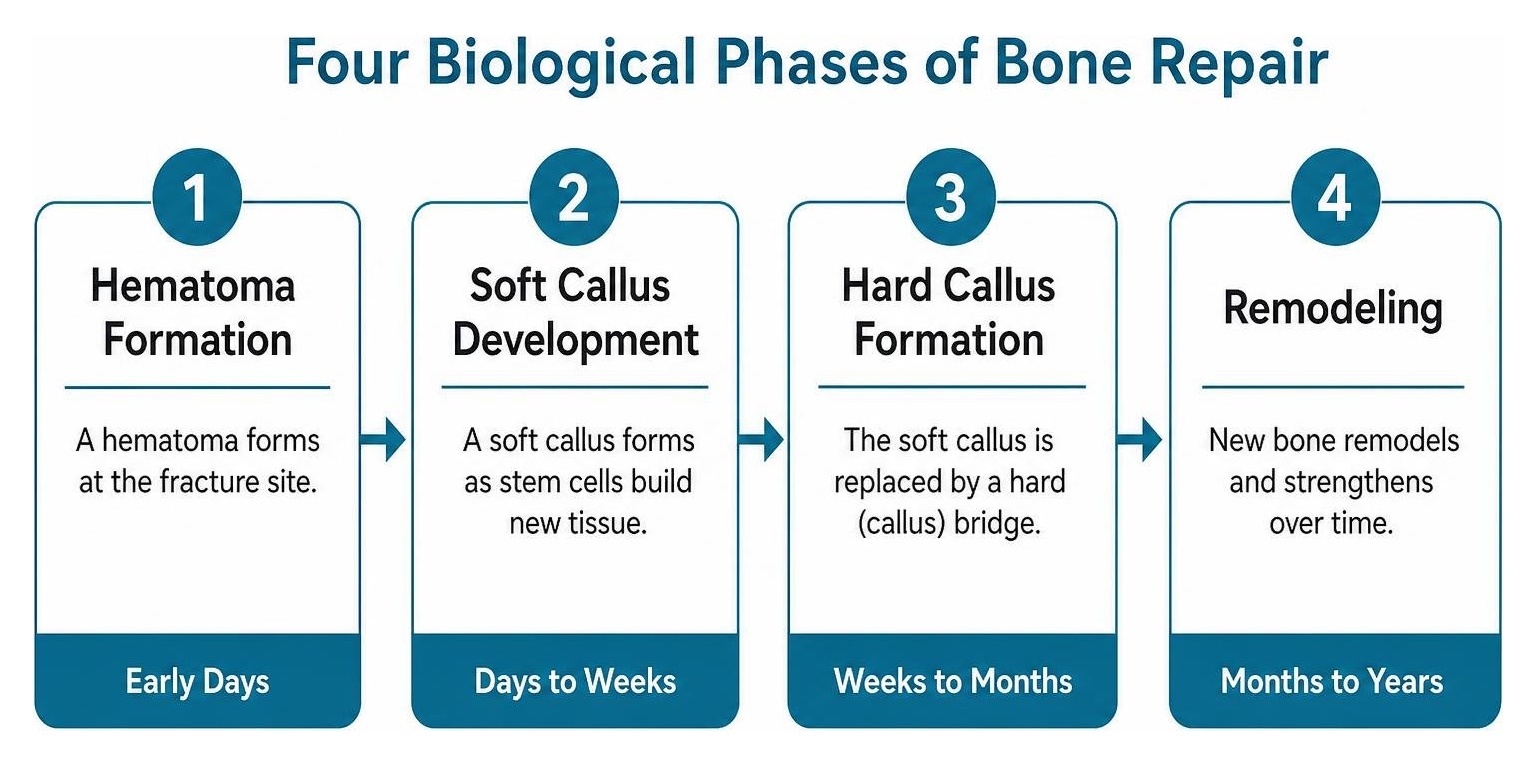
According to clinical overviews from StatPearls, a clinical reference hosted by the National Library of Medicine, bone heals through two main pathways based on mechanical stability. Primary healing happens when broken ends are locked tightly together with almost no movement (less than 2% mechanical strain). In this setting, bone remodels directly across the gap without forming an external bridge.
Secondary healing is much more common. It occurs when a cast, splint, or rod allows tiny amounts of natural micro-motion (between 2% and 10% strain). This flexible environment stimulates stem cells from the periosteum (the thin, fibrous outer sleeve of the bone) to build a protective callus.
Phase 1 and 2: Hematoma Formation and Soft Callus Development
Healing begins the moment an injury occurs. Blood vessels tear, forming a protective blood clot called a fracture hematoma. White blood cells, including macrophages and neutrophils, clear away cellular debris.
Within days, local signaling proteins such as vascular endothelial growth factor (VEGF) stimulate new blood vessels to sprout, a process known as angiogenesis. Mesenchymal stem cells then travel from the periosteum and bone marrow to the break site. These cells turn into cartilage-producing cells (chondrocytes), laying down a rubbery framework of collagen and fibrocartilage known as a soft callus.
Phase 3 and 4: Hard Callus Ossification and Bone Remodeling
Next, bone-building cells called osteoblasts replace the soft cartilage with rigid, woven bone. This phase, known as endochondral ossification, creates a hard callus that stabilizes the broken ends.
Over the following months to years, the final remodeling phase continues. Specialized bone-resorbing cells called osteoclasts remove excess woven bone, while osteoblasts replace it with organized, dense lamellar bone. Guided by everyday physical forces, the bone gradually reshapes itself to better match its original strength and contour.
Key Nutrients and Vitamins for Fracture Healing
Your metabolic rate rises after a fracture as your body works to rebuild skeletal tissue. Getting enough essential nutrients for bone health ensures your cells have the materials needed to create new bone matrix.
Eating a balanced diet to increase bone density provides steady energy, amino acids, and minerals during recovery.
| Nutrient | Main Role in Fracture Repair | Dietary Sources (USDA FoodData Central) |
|---|---|---|
| Protein | Forms the structural collagen scaffold of bone | Poultry, fish, eggs, tofu, beans, Greek yogurt |
| Calcium | Mineralizes the soft callus into hard bone | Milk, fortified soy milk, yogurt, collard greens |
| Vitamin D | Helps your gut absorb calcium efficiently | Salmon, canned tuna, fortified milk, egg yolks |
| Vitamin C | Supports collagen cross-linking and fights oxidative stress | Bell peppers, oranges, strawberries, broccoli |
| Vitamin K | Activates osteocalcin to bind calcium in bone matrix | Kale, spinach, natto, Brussels sprouts |
| Magnesium | Acts as an enzymatic cofactor for bone-building cells | Pumpkin seeds, almonds, spinach, black beans |
| Zinc | Stimulates osteoblast activity and matrix remodeling | Oysters, beef, pumpkin seeds, lentils |
Essential Vitamins for Fracture Recovery
Vitamins serve as vital biological regulators throughout fracture healing, though evidence suggests their benefits depend heavily on baseline nutritional status.
- Vitamin C: This water-soluble antioxidant is a necessary cofactor for enzymes that stabilize collagen fibers. Without adequate vitamin C, the soft callus remains structurally weak.
- Vitamin A: Physiological levels support early stem cell differentiation. However, high doses can overstimulate osteoclasts and weaken bone, making dietary sources safer than high-dose pills.
- Vitamin E: Tocotrienol forms help neutralize oxidative stress around the injury, though excessive alpha-tocopherol supplementation may interfere with normal bone formation.
- Vitamin K: Research highlights the role of vitamin K2 for bone density, as it helps activate osteocalcin, a protein that binds calcium into bone tissue. If you take blood thinners, such as Warfarin, be sure to check with your doctor before increasing vitamin K intake.
- B-Complex Vitamins: Vitamins B6, B12, and folate help keep blood levels of homocysteine in a healthy range, supporting proper collagen structure.
Key Minerals and Protein for Bone Repair
Understanding how protein supports bone building is essential because protein is a major building block of bone. Amino acids from dietary protein form the structural collagen framework that holds minerals in place.
Mineralization requires a steady supply of calcium and phosphorus to create hydroxyapatite crystals. Incorporating calcium rich foods into daily meals supports this calcification process. Magnesium activates the enzymes needed for mineral deposition, while zinc promotes local cell growth and tissue remodeling.
Advanced Medical and Biologic Therapies for Fracture Healing
For severe injuries or large bone gaps, orthopedic specialists may consider advanced biologic therapies. These treatments use targeted growth factors, cellular grafts, or biomaterial scaffolds to jump-start stalled healing. While several biologics are approved for specific orthopedic uses, many emerging therapies remain investigational.
Growth Factors and Biologics for Complex Fractures
When standard healing stalls, targeted biological agents can stimulate cellular activity:
- Bone Morphogenetic Proteins (BMPs): Recombinant BMP-2 can signal immature cells to form bone and is used only in select surgical situations.
- Chemically Modified mRNA: Early research suggests synthetic mRNA may prompt local cells to make short-lived healing proteins, but this remains investigational.
- Cell-Based Therapies: Bone marrow aspirate concentrate and mesenchymal stem cell grafts may be considered for stubborn nonunions, though evidence varies.
- Platelet-Rich Plasma (PRP): PRP contains concentrated growth factors, but results for bone healing are mixed.
- MicroRNAs: These remain mainly in laboratory research.
Medical Treatments and Medications for Compromised Bone Healing
Certain systemic bone conditions can complicate fracture recovery. Clinicians often evaluate patients for secondary osteoporosis causes or disorders like Paget's disease, osteogenesis imperfecta, and metastatic bone changes.
For patients at high risk of future fractures, doctors may prescribe osteoporosis medications. Teriparatide, abaloparatide, and romosozumab are considered bone-building treatments because they increase bone formation, though they are not routine “fracture-healing drugs.” Denosumab is an antiresorptive medication that slows bone breakdown. During fracture recovery, medication choices should be individualized and supervised by a clinician.
Lifestyle Factors, Rest, and Preventing Delayed Union
Medical devices and good nutrition provide internal support, but daily lifestyle habits shape the physical environment needed for bone repair.

Following evidence-based fracture prevention strategies and proper resting protocols protects delicate, healing tissue.
Mechanical Stability, Sleep, and Rest
Getting adequate sleep supports the release of natural growth factors that coordinate tissue repair. Keeping your cast or splint properly fitted prevents unstable movement from tearing newly forming blood vessels.
Some care plans incorporate low-intensity pulsed ultrasound (LIPUS) devices, which deliver gentle acoustic pressure to stimulate bone-forming cells, though a large review of randomized trials found LIPUS does not improve recovery for fresh fractures. Always discuss pain management with your clinician; while over-the-counter nonsteroidal anti-inflammatory drugs (NSAIDs) help with discomfort, evidence regarding their potential impact on early bone healing is mixed.
Risk Factors for Delayed Union and Nonunion Fractures
According to the U.S. Food and Drug Administration (FDA), a nonunion occurs when at least nine months have passed since the fracture, and the bone has shown no visible progressive signs of healing for three months. Up to 10% of fractures experience delayed union or nonunion.
Common risk factors include:
- Smoking and Nicotine: Nicotine constricts blood vessels, starving the injury of oxygen and essential nutrients.
- Uncontrolled Blood Sugar: Diabetes can impair angiogenesis and alter early inflammatory signaling.
- Medications: Long-term use of oral corticosteroids can suppress osteoblast activity.
- Poor Blood Supply: Vascular disease near the injury limits the delivery of repair cells.
- Local Infection: Bacteria create chronic inflammation that destroys new bone matrix.
Frequently Asked Questions About Fracture Healing
How long does the average bone fracture take to repair?
Many fractures take about 6 to 8 weeks to heal, while others take several months or longer. Healing times depend on the specific bone involved, local blood flow, the severity of soft tissue injury, and your overall health.
Can certain vitamins or supplements slow down bone healing?
Yes. Very high doses of fat-soluble vitamins can be harmful. Chronic excess vitamin A is linked with increased bone breakdown and fracture risk. For vitamin E, evidence is mixed: some animal research suggests high-dose alpha-tocopherol may promote bone loss, but human data are less clear. Balanced meals are safest unless a clinician recommends a supplement.
What is the difference between a delayed union and a nonunion fracture?
A delayed union means a bone is healing more slowly than expected but still shows measurable progress on X-rays. The FDA defines a nonunion as a fracture that has not healed after at least nine months and has shown no visible progress toward healing for three straight months. Nonunions usually need medical or surgical treatment to heal.
Putting Your Fracture Recovery Plan Together
Supporting your recovery after a bone fracture requires a balance of proper nutrition, adequate rest, and mechanical stability. By eating balanced meals rich in protein and micronutrients, avoiding nicotine, and protecting the injured limb, you provide your body with what helps bone repair naturally.
Once a fracture heals, protecting long-term bone health focuses on preventing future falls and building strength. Participating in personalized, home-based exercise plans designed by clinicians helps older adults safely rebuild bone density and maintain lasting mobility.
Works Cited
- Sheen JR, Mabrouk A. "Fracture Healing Overview." StatPearls, StatPearls Publishing, 2026.
- Thomas JD, Kehoe JL. "Bone Nonunion." StatPearls, StatPearls Publishing, 2023.
- Zura R, Xiong Z, Einhorn T, et al. "Epidemiology of Fracture Nonunion in 18 Human Bones." JAMA Surgery, 2016;151(11):e162775.
- Pearson RG, Clement RG, Edwards KL, Scammell BE. "Do smokers have greater risk of delayed and non-union after fracture, osteotomy and arthrodesis? A systematic review with meta-analysis." BMJ Open, 2016;6(11):e010303.
- Michaëlsson K, Lithell H, Vessby B, Melhus H. "Serum retinol levels and the risk of fracture." New England Journal of Medicine, 2003;348(4):287-294.
- Fujita K, Iwasaki M, Ochi H, et al. "Vitamin E decreases bone mass by stimulating osteoclast fusion." Nature Medicine, 2012;18(4):589-594.
This content is for informational purposes only and does not constitute medical advice. Consult a qualified healthcare professional for diagnosis and treatment. Groove Health is a Medicare-covered bone health program for adults 65 and older that pairs each member with a physician and a physical therapist who designs a personalized exercise plan. If you are on Medicare and interested in a personalized bone health program, you can check your eligibility at groovehealth.com.