The Ultimate Guide to T-Score Below -2.5 Meaning
A T-score of -2.5 or below is the clinical threshold for osteoporosis. Here is what that number means for your fracture risk, and the exercise, nutrition, and medical steps proven to rebuild bone.
What a T-Score Below -2.5 Really Means for Your Bone Health
Understanding the T-score below -2.5 meaning is simpler than it sounds. Here is the short answer:
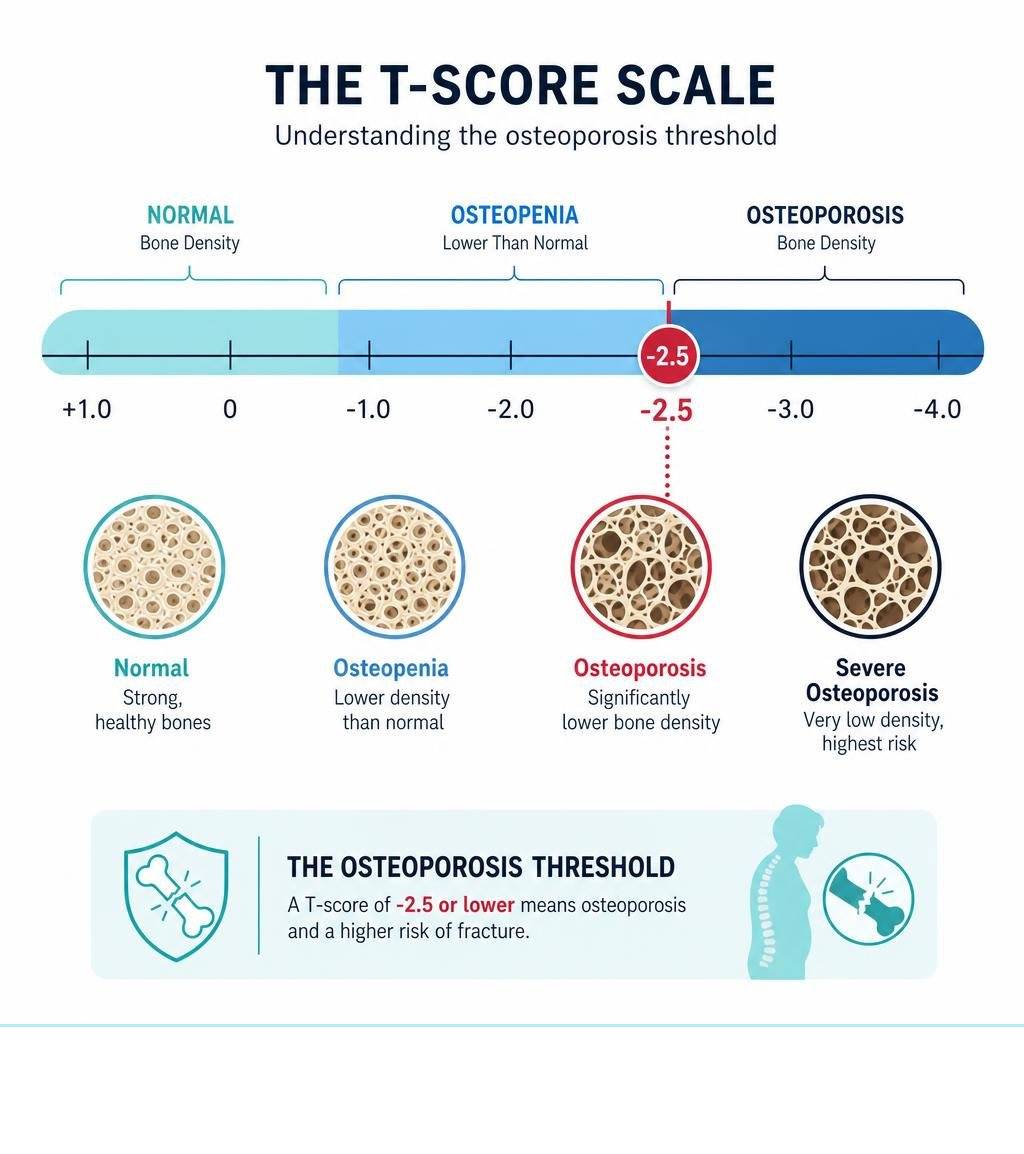
A T-score of -2.5 or below means you have osteoporosis. This is the official threshold set by the World Health Organization (WHO). It means your bone density is significantly lower than that of a healthy young adult, and your risk of breaking a bone is meaningfully higher than average.
| T-Score Range | What It Means |
|---|---|
| -1.0 and above | Normal bone density |
| Between -1.0 and -2.5 | Osteopenia (lower than normal, not yet osteoporosis) |
| -2.5 or lower | Osteoporosis |
| -2.5 or lower with a prior fragility fracture | Severe osteoporosis |
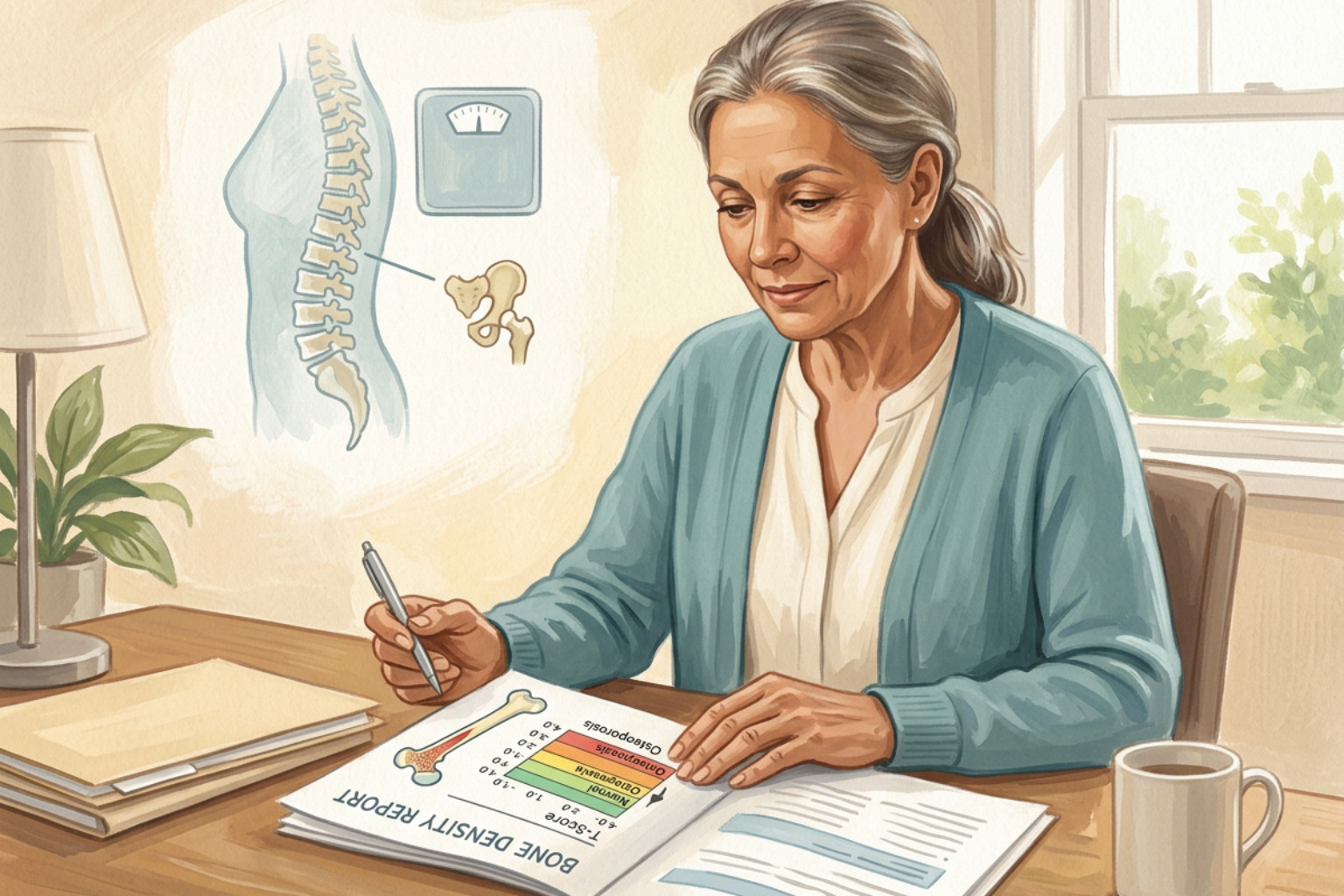
If you just got your bone density results back and saw a number like -2.7 or -3.1, that number is called a T-score. It comes from a test called a DEXA scan (short for dual-energy X-ray absorptiometry), which is a low-radiation X-ray that measures how dense and strong your bones are. The National Institute of Arthritis and Musculoskeletal and Skin Diseases offers a helpful overview of what bone mineral density test numbers mean if you want the source-level explanation.
The T-score compares your bone density to the average bone density of a healthy 30-year-old. At age 30, most people are at their peak bone mass. The further your score falls below zero, the more bone density you have lost compared to that peak. For a more practical walkthrough, see our guide on how to interpret bone density.
Research suggests, roughly speaking, each full point drop in T-score is associated with about a doulbing in fracture risk. So a score of -2.5 carries meaningfully more risk than a score of -1.5, and a score of -3.5 carries more risk still. We explain that relationship in more detail in our article on DEXA T-score fracture risk.
This guide explains exactly what this number means, what causes it, what your fracture risk looks like, and what you can do about it.
How T-Scores and Z-Scores Measure Bone Strength
To understand bone health, doctors look at bone mineral density, which is the amount of bone mineral (like calcium) in your bone tissue. When you receive your DEXA scan report, you will see two primary scores: a T-score and a Z-score. Both are calculated using standard deviations, which is a statistical way to measure how far your results are from the average.
T-Score vs. Z-Score: What Is the Difference?
While a T-score compares you to a young adult at peak bone mass, a Z-score compares you to an age-matched group. This means your bone density is compared to other people of your same age, sex, and ethnicity.
The Z-score is not used to diagnose osteoporosis in postmenopausal women or men over 50. Instead, doctors use Z-scores for children, premenopausal women, and younger men. A Z-score of -2.0 or below indicates that your bone density is significantly lower than expected for your age group, which may suggest secondary osteoporosis. This is bone loss caused by another medical condition or a medication rather than normal aging.
To see a visual example of how these two scores can differ on the same chart, you can look at the National Center for Biotechnology Information resource on Figure 8-7, T-Scores and Z-Scores - Bone Health and Osteoporosis - NCBI Bookshelf .
| Feature | T-Score | Z-Score |
|---|---|---|
| Comparison Group | Healthy young adults (age 20–30) | Age-matched, sex-matched peers |
| Primary Use | Diagnosing osteopenia and osteoporosis | Identifying unusual bone loss in younger people |
| Who It Is For | Postmenopausal women and men over 50 | Children, premenopausal women, men under 50 |
| Concern Threshold | -1.0 or below (osteopenia), Below -2.5 (osteoporosis) | -2.0 or below (abnormal bone loss for age) |
What Your Osteoporosis Diagnosis Means
A T-score of -2.5 or lower is the clinical definition of osteoporosis. Under a microscope, healthy bone looks like a living honeycomb with small, tight spaces. When osteoporosis develops, these spaces grow much larger. The bone becomes thin, brittle, and far more likely to break from a minor bump or fall.
The Clinical Implications of an Osteoporosis Diagnosis
If your bone scan shows a T-score below -2.5, indicating osteoporosis, your risk of a fragility fracture is high. A fragility fracture is a broken bone that happens from a minor event, such as a fall from standing height, sneezing, or bending over to make a bed.
The most common and serious areas for these breaks are the hip, spine (vertebrae), and wrist. A hip fracture can be life-altering for older adults, often requiring surgery and long-term recovery. According to a a landmark meta-analysis of bone density and fracture risk, every standard deviation decrease in bone mineral density roughly doubles your overall risk of fracture. For more details on this relationship, read our article on DEXA T-score fracture risk.
How T-Scores Distinguish Osteopenia from Osteoporosis
Bone loss is a gradual process. Peak bone mass is reached around age 25, remains stable for about a decade, and then begins to drop. For women, this decline accelerates during menopause, when estrogen levels fall. Estrogen acts like a shield, slowing down the cells that break down bone. In a healthy body, bone remodeling is a constant balance where old bone is removed and new bone is laid down. Estrogen helps maintain this balance by keeping the bone-removing cells in check; without enough estrogen, these cells break down bone faster than the body can rebuild it, leading to a loss of up to 2% of bone mass in the years immediately following menopause.
To learn more about tracking this progression, you can read our guide on interpreting DEXA scan results.
Treatment and Lifestyle Steps for a T-Score Below -2.5
Receiving an osteoporosis diagnosis can feel overwhelming, but bone is a living tissue that constantly remodels itself. With the right combination of targeted exercise, nutrition, and medical support, you can protect your bones and lower your risk of a fall.
Why Osteoporosis Requires Targeted Exercise
To make bones stronger, you must give them a reason to grow. This requires an osteogenic load, which means a physical load heavy enough to trigger osteoblasts, the cells that lay down new bone.
Light activities like walking, gentle stretching, or light resistance bands are excellent for general health, but they provide much less stimulus for building bone. Instead, the evidence points to heavy resistance training as the most effective path. This involves lifting heavier weights for a low number of repetitions, typically 75% to 85% of the maximum weight you can lift once, performed a few days per week.
Because bone adapts to load where the load is placed, you should focus on compound movements that load the hip and spine. Safe exercises include:
- Squats and lunges to load the hips and legs.
- Hip hinges (like a Romanian deadlift, where you bend from the hips and keep your back long and straight, rather than rounding your spine) to strengthen the lower back and glutes.
- Spinal extension exercises (gently straightening or arching the upper back) to build back strength and support the spine.
You should avoid loaded spinal flexion, which means rounding your back forward while holding weight, as this can increase the risk of a spine fracture.
Additionally, because about 9 in 10 hip fractures are caused by a fall, balance training is essential. Dynamic single-leg balance work, where you move while balancing on one leg, challenges your stability in ways that mimic real-life movements.
Medical and Nutritional Support for Bone Strength
Exercise is highly effective, but your body also needs the raw materials to build bone:
- Calcium: This mineral is the primary building block of bone. Older adults should aim for adequate dietary calcium through foods like yogurt, leafy greens, and fortified foods.
- Vitamin D: This vitamin acts like a key, helping your body absorb the calcium you eat.
When lifestyle changes are not enough to stop bone loss, doctors often recommend osteoporosis medications. The most common are bisphosphonates, which work by slowing down the cells that break down bone, helping to maintain or improve your T-score.
Frequently Asked Questions About Bone Density Scores
Can a T-score below -2.5 be reversed?
While you may not completely reverse your T-score back to a normal range, you can improve your bone density and significantly lower your fracture risk. By combining progressive resistance exercise, proper nutrition, and medical treatment, you can slow down bone loss and help your body build new bone.
How often should I get a DEXA scan?
For most older adults with a T-score below -2.5, doctors recommend a repeat DEXA scan every two years to monitor bone loss and see how well your treatment is working. Medicare directly covers bone density testing once every 24 months for qualified individuals, and sometimes more frequently if medically necessary.
What factors can affect my DEXA scan results?
Several physical factors can affect the accuracy of a DEXA scan. For example, past spinal surgeries can interfere with results because of surgical hardware, while arthritis or spinal degeneration can create bone spurs or calcium build-ups. These changes may falsely raise your spine bone density score, making bones appear stronger than they are. A doctor will review multiple sites, such as the hip and femoral neck, for a more accurate picture.
Your Next Steps Toward Stronger Bones
A T-score at or below -2.5 is an important piece of health information, but it is not a guarantee of a fracture. It is a signal to take proactive control of your bone health.
If you are looking for a structured, safe way to build bone strength, Groove Health offers a personalized bone health and exercise program covered by Medicare. Each member works with a physician, as well as a physical therapist who designs a personalized exercise plan. This specialized program safely guides you through targeted resistance and balance training to build bone strength, improve stability, and actively prevent falls and fractures where you live. You can check your eligibility at Groove Health.
Works Cited
- National Institute of Arthritis and Musculoskeletal and Skin Diseases (NIAMS). Bone Mineral Density Tests: What the Numbers Mean. NIAMS, 2025.
- Office of the Surgeon General (US). Figure 8-7, T-Scores and Z-Scores. Bone Health and Osteoporosis: A Report of the Surgeon General, 2004.
- Marshall D, Johnell O, Wedel H. Meta-analysis of how well measures of bone mineral density predict occurrence of osteoporotic fractures. BMJ, 1996.
This content is for informational purposes only and does not constitute medical advice. Consult a qualified healthcare professional for diagnosis and treatment. If you are on Medicare and interested in a personalized bone health program, you can check your eligibility at groovehealth.com.