
How Does Estrogen Affect Osteoblasts and Osteoclasts?
Estrogen quietly keeps your skeleton in balance—slowing the cells that break down bone and supporting the ones that build it. Here's how it works at the cellular level, and what shifts when estrogen falls at menopause.

Why Estrogen Is the Key to Understanding Bone Loss After Menopause
Understanding how does estrogen affect osteoblasts and osteoclasts is one of the most important questions in bone health — especially for women after menopause.
Here is a quick answer:
| Bone Cell | Simple Job | What Estrogen Does |
|---|---|---|
| Osteoblasts | Build bone | Helps these bone-building cells stay alive and do their job. It also nudges stem cells to become more osteoblasts. |
| Osteoclasts | Clear away old bone | Helps keep these bone-removing cells from working too long by telling them when to shut down and die off. |
The short version: Estrogen helps slow down the cells that remove old bone, while also supporting the cells that build new bone. When estrogen drops — as it often does during menopause — bone-removing cells become more active and live longer. Bone removal speeds up. Bone building cannot keep pace. Over time, bones become weaker and more likely to break.
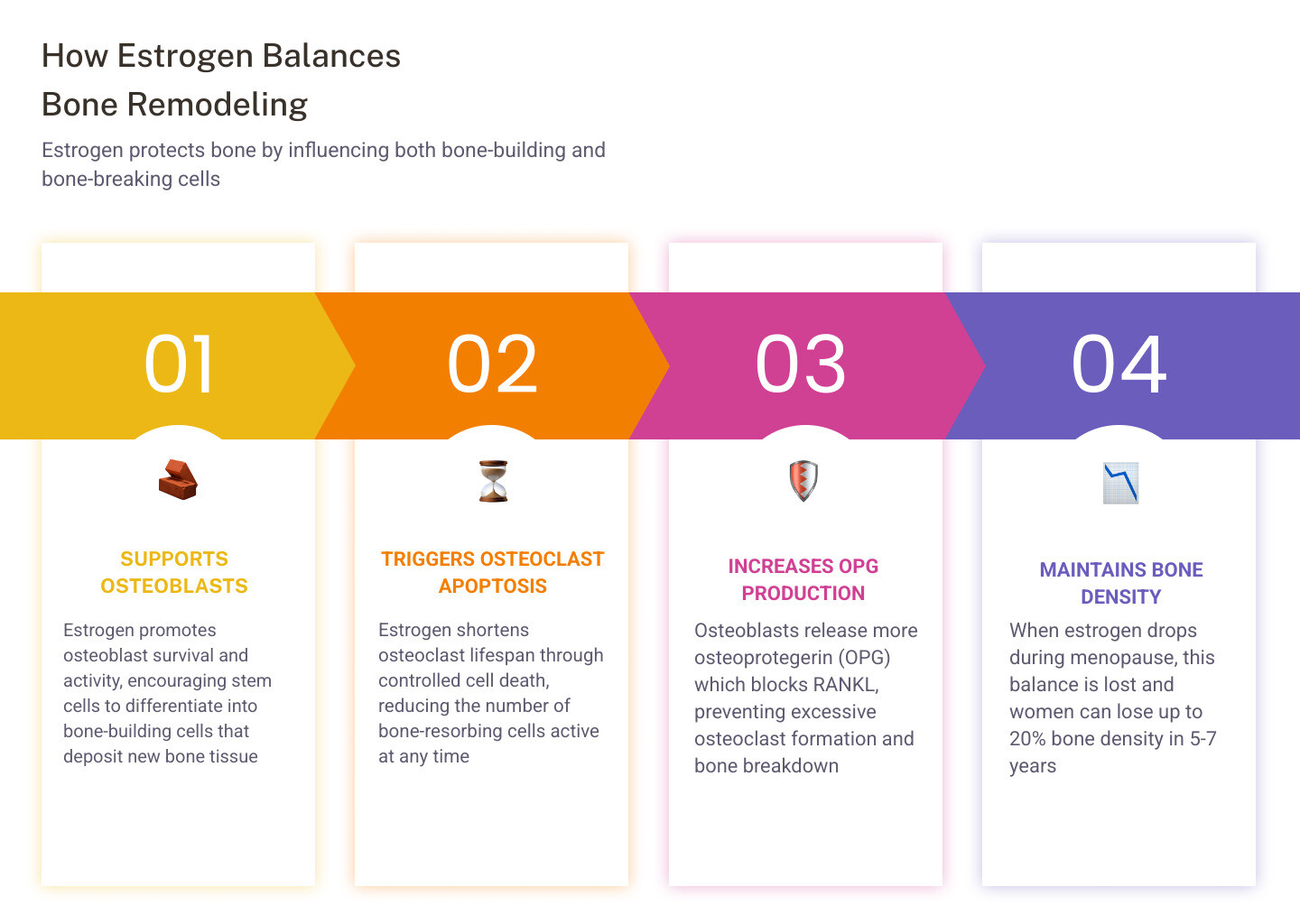
This is not a slow or subtle shift. Research suggests women can lose up to 20% or more of their bone density in the five to seven years right after menopause. That rapid loss is directly tied to falling estrogen levels.
For the 10 million people in the United States living with osteoporosis — and the millions more with early bone thinning — understanding this cellular process is the foundation for making sense of diagnoses, treatment options, and what can actually be done to protect bone health.
The Basics of Bone Remodeling: Meet the Builders and the Clean-up Crew
To understand how estrogen protects your skeleton, it helps to first understand the process of bone remodeling. Although bones may seem like static structures, they are actually living tissue that is constantly being renewed. Throughout your life, old bone is broken down and replaced with new bone to help maintain strength and repair everyday wear and tear.
Remodeling relies on a continuous partnership between four main types of bone cells:
- Osteoclasts: These cells are the bone's "clean-up crew." They break down and remove old or damaged bone tissue using specialized enzymes.
- Osteoblasts: These cells are the "builders." After old bone is removed, they lay down the protein framework that eventually becomes new, mineralized bone.
- Osteocytes: Making up about 95% of all bone cells, osteocytes act as the bone's communication network. They sense mechanical stress—such as walking, lifting weights, or jumping—and signal where bone needs to be strengthened.
- Bone Lining Cells: These flat cells cover the quiet surfaces of bones that are not currently being remodeled. They act like a protective barrier and help control when the clean-up crew can access the bone.
In healthy adults, these cells are perfectly balanced. The clean-up crew removes just enough bone, and the builders replace it exactly. This balance helps you maintain peak bone mass — the maximum strength and density your bones reach, usually in your late 20s or early 30s.
Estrogen helps maintain this balance by supporting the cells that build bone and regulating the cells that break it down. When estrogen levels are healthy, bone formation and bone breakdown remain in equilibrium, helping preserve bone strength.
- On Osteoblasts (Builders): Estrogen helps osteoblasts stay active and survive longer, giving them more time to build new bone. This supports bone formation and helps maintain bone density over time.
- On Osteoclasts (Clean-up Crew): Estrogen has the opposite effect on osteoclasts. It slows their activity and promotes their natural turnover, preventing excessive bone breakdown.
When estrogen levels decline, osteoclasts become more active while osteoblasts are less able to keep pace. As a result, bone is broken down faster than it can be rebuilt, leading to bone loss and an increased risk of fractures.
The Direct Impact: How Estrogen Controls Osteoclast Lifespan
One of the most powerful ways estrogen protects your bones is by directly controlling the clean-up crew: osteoclasts.
Osteoclasts are supposed to break down old or damaged bone. That's a normal and necessary part of bone remodeling. The problem starts when they live too long or become too active. When that happens, bone is removed faster than it can be rebuilt.
Estrogen helps slow down osteoclasts, the cells that break down old bone. When estrogen drops, these cells can live longer and remove too much bone, so bone is lost faster than it is rebuilt.
A landmark study on Estrogen and Bone Resorption showed that when estrogen is present, it directly triggers apoptosis — a scientific term for programmed cell death — in osteoclasts. In other words, estrogen helps tell the clean-up crew when their job is done. Without that signal, osteoclasts keep working longer than they should, removing more bone than the builders can replace.
The Indirect Shield: How Osteoblasts and Bone Lining Cells Protect Bone
Estrogen does not just act on bone cells directly. It also works indirectly by telling osteoblasts and bone lining cells to send chemical “slow down” signals to osteoclasts, so they break down less bone.
The most important signal in this process is a protein that acts like a "green light" for bone loss. When osteoblasts and bone lining cells release this signal, it tells osteoclasts to multiply, mature, and start dissolving bone.
To prevent too much bone loss, the body also makes a protective decoy protein. This decoy acts like a sponge, soaking up the "green light" signal before it can reach the clean-up crew.
Estrogen acts as a shield by:
- Lowering the "green light" signal: It tells bone lining cells and osteoblasts to produce less of this bone-dissolving trigger.
- Raising the protective decoy: It encourages cells to produce more of the sponge-like decoy protein to neutralize any remaining triggers.
Research published in Estrogen and RANKL in Bone Lining Cells shows that a lack of estrogen selectively boosts the "green light" signal, particularly in bone lining cells. Without estrogen, these lining cells produce a flood of this trigger, which rapidly multiplies the clean-up crew and accelerates bone loss.
Frequently Asked Questions about Estrogen and Bone Health
What happens to bones when estrogen levels drop during menopause?
When estrogen levels fall, the protective shield is lost. The clean-up crew (osteoclasts) lives longer and works faster, while the builders (osteoblasts) die off more quickly.
At the same time, the body's immune cells and bone cells release more inflammatory proteins, which further stimulate the production of the signals that trigger bone dissolution. This combination leads to rapid bone loss, thinning of the inner bone architecture, and an increased risk of breaks.
Can hormone replacement therapy help prevent osteoporosis?
Yes. Hormone replacement therapy (HRT) works by replacing the estrogen that the ovaries stop making after menopause. By restoring estrogen levels, HRT puts the brakes back on the clean-up crew and supports the builders.
Clinical research shows that starting HRT within ten years of menopause significantly reduces the risk of bone loss and lowers the chance of breaking a bone. However, because HRT can have side effects, it is important to discuss your personal health history with a doctor.
What exercises help strengthen bones when estrogen is low?
When estrogen is low, bones need a stronger mechanical signal to maintain or build density. Research supports osteogenic loading: safe, progressive forces that are high enough to tell osteocytes, the bone’s “sensor” cells, to activate bone-building pathways.
The most helpful options include:
- Progressive resistance training: Lifting weights, using machines, or doing body-weight exercises that get harder over time. Think squats, deadlifts, step-ups, rows, and presses.
- Impact or weight-bearing exercise: Brisk walking, stair climbing, dancing, jogging, or jumping drills when appropriate. Impact creates short bursts of load that bone responds to.
- Balance and fall-prevention work: Strengthening hips, legs, and core muscles helps reduce fracture risk by lowering the chance of falls.
The key is progression. Bone adapts when the challenge gradually increases, not when the same easy routine is repeated forever. If you have osteoporosis, prior fractures, or pain, work with a qualified clinician before adding high-impact or heavy-load exercise.
If you have been diagnosed with osteopenia (bone thinning) or osteoporosis, working with a physical therapist can help you learn how to exercise safely to build strength and prevent falls.
How to Protect Your Bones as Estrogen Declines
Estrogen is one of the body's most powerful natural bone protectors. By directly signaling osteoclasts to self-destruct and prompting osteoblasts to build and protect, it keeps the continuous cycle of bone remodeling in perfect balance. When menopause removes this hormonal shield, the balance shifts toward bone loss, making proactive steps to protect your skeleton essential.
When estrogen levels drop and can no longer shield your bones, physical force becomes one of the clearest signals your bone-building cells, called osteoblasts, can respond to. That is why movement, strength training, balance work, nutrition, and medication decisions all matter in a bone health plan. Groove Health is a Medicare-covered bone health program that connects you with clinician-guided support to help you understand your fracture risk and take practical next steps at home. Your care plan may include safe, personalized exercise guidance, fall-prevention strategies, and education to support stronger bones over time. The goal is simple: help you reduce fracture risk, protect mobility, and keep your skeleton as strong and resilient as possible.
To learn more about how a personalized physical therapy and medical plan can help you manage your bone health, Sign up for Groove Health's bone health program.
Works Cited
- Kameda, T., et al. "Estrogen Inhibits Bone Resorption by Directly Inducing Apoptosis of the Bone-resorbing Osteoclasts." The Journal of Experimental Medicine, 1997.
- Martin-Millán, M., et al. "The Estrogen Receptor-α in Osteoclasts Mediates the Protective Effects of Estrogens on Cancellous But Not Cortical Bone." Molecular Endocrinology, 2010.
- Krum, S. A., et al. "Estrogen protects bone by inducing Fas ligand in osteoblasts to regulate osteoclast survival." The EMBO Journal, 2008.
- Streicher, C., et al. "Estrogen Regulates Bone Turnover by Targeting RANKL Expression in Bone Lining Cells." Scientific Reports, 2017.
- Khosla, S., Oursler, M. J., & Monroe, D. G. "Estrogen and the Skeleton." Trends in Endocrinology & Metabolism, 2012.
This content is for informational purposes only and does not constitute medical advice. Consult a qualified healthcare professional for diagnosis and treatment. If you are on Medicare and interested in a personalized bone health program, you can check your eligibility at groovehealth.com.