
Everything You Need to Know About DEXA Medicare Part B Coverage
Medicare Part B covers a DEXA bone density scan once every 24 months, often at no cost. Here's who qualifies, what you'll pay in each scenario, and how to make sure your claim is approved.

What DEXA Medicare Part B Coverage Means for Your Bone Health
DEXA Medicare Part B coverage pays for a bone density scan — a quick, painless X-ray that measures how strong your bones are — at no cost to you in most cases.
Here is what you need to know right away:
| Question | Quick Answer |
|---|---|
| What is covered? | Bone mass measurement (DEXA scan) of the hip, spine, or forearm |
| Who qualifies? | Adults with specific risk factors — see eligibility criteria below |
| How often? | Once every 24 months; more often if medically necessary |
| What does it cost? | $0 if your provider accepts Medicare assignment and you have met your Part B deductible |
| Do you need a referral? | Yes — a Medicare-enrolled doctor must order the test |
More than 10 million Americans have osteoporosis, and another 44 million have low bone density. Many of them do not know it until a bone breaks. A DEXA scan is one of the clearest ways to catch bone loss early — before something goes wrong.
The good news is that Medicare Part B treats bone density testing as a preventive service for people who meet certain conditions. That means the cost can be zero, as long as your doctor and testing facility both accept Medicare.
This guide explains exactly who qualifies, how often you can get scanned, what the test costs under different scenarios, and what your doctor needs to do to make sure the claim goes through.
What is a DEXA Scan and How Does It Measure Bone Strength?
A DEXA scan — which stands for dual-energy X-ray absorptiometry — is the gold standard for measuring bone strength. The test uses two very low-dose X-ray beams to see through your soft tissue and measure how much mineral is packed into your bones.
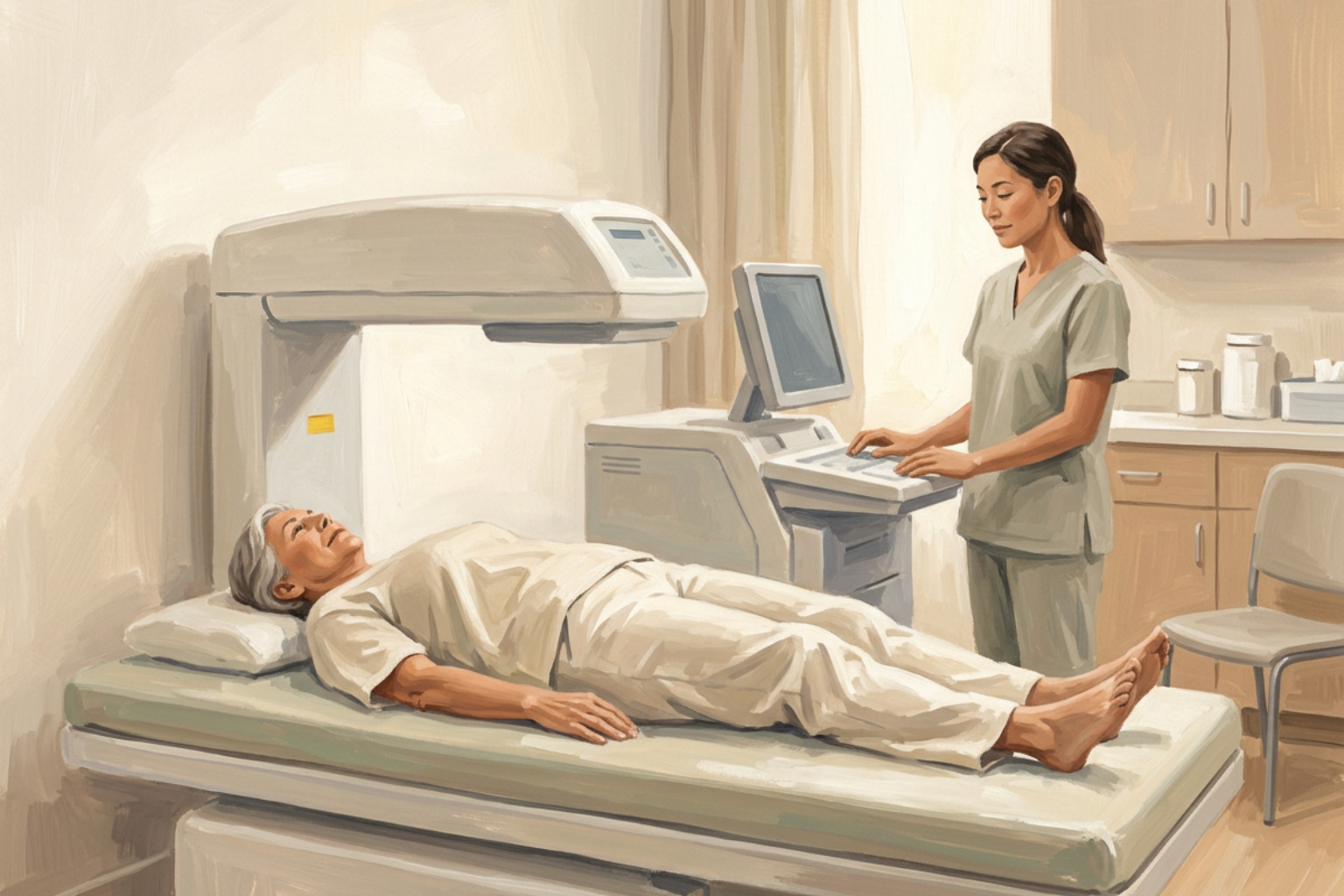
During the 15-minute test, you lie flat on a padded table while a scanner passes over your body. The test usually checks your hip, spine, and sometimes your forearm. These are the areas where bones are most likely to break if they become weak.
Your results will show two main numbers:
- T-score: This compares your bone strength to that of a healthy young adult. A T-score of -1.0 or higher is normal. A score between -1.0 and -2.4 means you have osteopenia, which is a mild thinning of the bones. A score of -2.5 or lower means you have osteoporosis, which is more severe bone thinning.
- Z-score: This compares your bone strength to other people of your same age, gender, and size. It helps your doctor see if something unusual is causing your bone loss.
You can learn more about how Medicare views these measurements by reading the Scientific guidelines on bone mass measurements.
How Medicare Part B Covers Bone Density Testing
Medicare Part B covers bone density tests as a preventive service. This means Medicare wants you to get this test to catch bone loss early, rather than waiting until you break a bone.
However, Medicare does not cover these scans for everyone automatically. You must meet specific medical rules to qualify for full coverage.
Who Qualifies for a Covered DEXA Scan?
To get your scan paid for, a Medicare-enrolled doctor must order the test, and you must meet at least one of these five criteria:
- Estrogen deficiency: You are a woman at risk for osteoporosis, and your doctor determines you are low in estrogen. Estrogen acts like a shield, slowing down the cells that break down bone. When estrogen drops after menopause, bone loss can speed up.
- Vertebral abnormalities: An X-ray shows you may have osteoporosis, osteopenia, or a vertebral fracture, which is a small break in your spine.
- Steroid use: You are taking, or plan to start taking, prednisone or other steroid-type medications. These drugs can weaken bones over time.
- Primary hyperparathyroidism: You have overactive parathyroid glands, which produce too much hormone and cause your body to pull calcium out of your bones.
- Monitoring treatment: You have already been diagnosed with osteoporosis and are taking an FDA-approved drug to see if your therapy is working.
You can read a more detailed breakdown of these rules in this guide on Medicare.gov: Bone Mass Measurements coverage.
How Often Medicare Pays for a Bone Density Scan
Medicare generally covers a DEXA scan once every 24 months. This two-year gap gives your bones enough time to show measurable changes.
However, Medicare will pay for a scan more often if your doctor documents that it is medically necessary. For example, if you start taking a high-dose steroid medication, or if you are tracking how well a new osteoporosis treatment is working, your doctor can request a repeat scan sooner than 24 months.
What Are the Out-of-Pocket Costs for a Covered Scan?
If you qualify for the scan and your doctor orders it, your costs depend on whether the provider accepts Medicare assignment. Assignment means the provider agrees to accept the Medicare-approved amount as full payment.
| Scenario | What You Pay |
|---|---|
| Provider accepts assignment | $0 (No copay, no coinsurance, and the deductible is waived) |
| Provider does not accept assignment | You may pay a 20% coinsurance, plus any excess charges up to the limiting charge |
| Scan is not deemed medically necessary | You may be responsible for the full cost of the scan |
To avoid unexpected bills, always ask the imaging facility if they accept Medicare assignment before your appointment.
Limitations, Exclusions, and Special Coverage Rules
While Medicare is generous with central DEXA scans of the spine and hip, it does have strict limits on other types of bone testing:
- Peripheral tests: Scans of your wrist, heel, or finger are sometimes used as quick screening tools. While Medicare may cover these, they are not considered accurate enough to monitor osteoporosis treatment.
- Body composition scans: Some clinics use DEXA machines to measure body fat and muscle mass. Medicare does not cover these scans for fitness or weight-loss tracking. These are billed under CPT code 76499 and are considered investigational.
- Non-covered technologies: Older technologies, such as single-photon absorptiometry, are no longer covered by Medicare.
You can view the official billing limitations in the CMS Local Coverage Determination guidelines.
How Providers Bill Medicare for Bone Mass Measurements
For Medicare to pay for your scan, your healthcare provider must follow specific billing steps. The test must be ordered by a doctor who is enrolled in Medicare, and your medical record must clearly show why you need the test.
CPT Codes and Diagnosis Requirements for Reimbursement
Billing departments use specific codes to tell Medicare what service you received and why.
- CPT 77080: This is the most common code. It represents a central DEXA scan of the spine, hip, or forearm.
- CPT 77085: This code is used when a doctor performs a central DEXA scan along with a vertebral fracture assessment, which looks for tiny breaks in the spine.
Your doctor must pair these procedure codes with the correct diagnosis codes (ICD-10 codes). If the codes do not match your medical history, Medicare may deny the claim.
If your doctor thinks Medicare might not cover your scan — for instance, if you are getting it sooner than the 24-month limit — they may ask you to sign an Advance Beneficiary Notice (ABN). This form lets you know that you might have to pay for the test yourself if Medicare denies the claim. When an ABN is signed, the biller adds modifier GA to the claim.
To learn more about how medical offices bill for these services, you can read this CPT coding guide for DEXA scans.
Frequently Asked Questions About Medicare Bone Density Coverage
Does Medicare cover bone density tests for men?
Yes. While the rules specifically mention estrogen deficiency for women, men can qualify for a covered DEXA scan if they meet any of the other risk factors. This includes taking steroid medications, having overactive parathyroid glands, showing signs of bone loss on an X-ray, or monitoring osteoporosis treatment.
What should I do if my DEXA scan claim is denied?
If Medicare denies your claim, you have the right to appeal. First, check with your doctor's office to ensure they used the correct diagnosis and CPT codes. Often, a simple coding error is the cause of a denial. If the codes are correct, your doctor can submit medical records to Medicare to prove the test was medically necessary.
Does Medicare Advantage cover DEXA scans differently than Original Medicare?
Medicare Advantage plans must cover the same preventive benefits as Original Medicare, including DEXA scans. However, these private plans may require you to use an in-network imaging facility or get prior authorization before you have the scan. Check with your plan's customer service department before booking your appointment.
Getting Your Scan Covered and Acting on the Results
Understanding DEXA Medicare Part B coverage helps you take control of your bone health without worrying about unexpected bills. By ensuring you meet the eligibility rules, using a provider who accepts Medicare assignment, and scheduling your scans at the proper intervals, you can get this essential preventive care at no cost.
Your DEXA results can be a useful starting point, not just a score on a report. If they show low bone density or osteoporosis, Groove Health can help you turn that information into a practical plan for staying strong and reducing fracture risk. The program connects you with clinical support, including a physician and physical therapist, to build a personalized, home-based approach. That may include strength work, balance training, and guided physical therapy shaped around your results, health history, and goals.
If you want to take the next step in protecting your bone health, you can Check your eligibility for Groove Health.
Works Cited
- Medicare.gov. "Bone Mass Measurements." U.S. Centers for Medicare & Medicaid Services, accessed 2026.
- Centers for Medicare & Medicaid Services. "Billing and Coding Guidelines: Bone Mass Measurement (L34639)." CMS Medicare Coverage Database, 2015.
This content is for informational purposes only and does not constitute medical advice. Consult a qualified healthcare professional for diagnosis and treatment. If you are on Medicare and interested in a personalized bone health program, you can check your eligibility at groovehealth.com.