
How to Absorb Calcium Better for Maximum Bone Strength
How much calcium you absorb matters more than how much you take. See how vitamin D, meal timing, food choices, and the right supplement form help you get the most calcium for stronger bones.

Why Absorption Matters More Than the Amount You Take
If you are looking for calcium absorption tips, here is a quick answer:
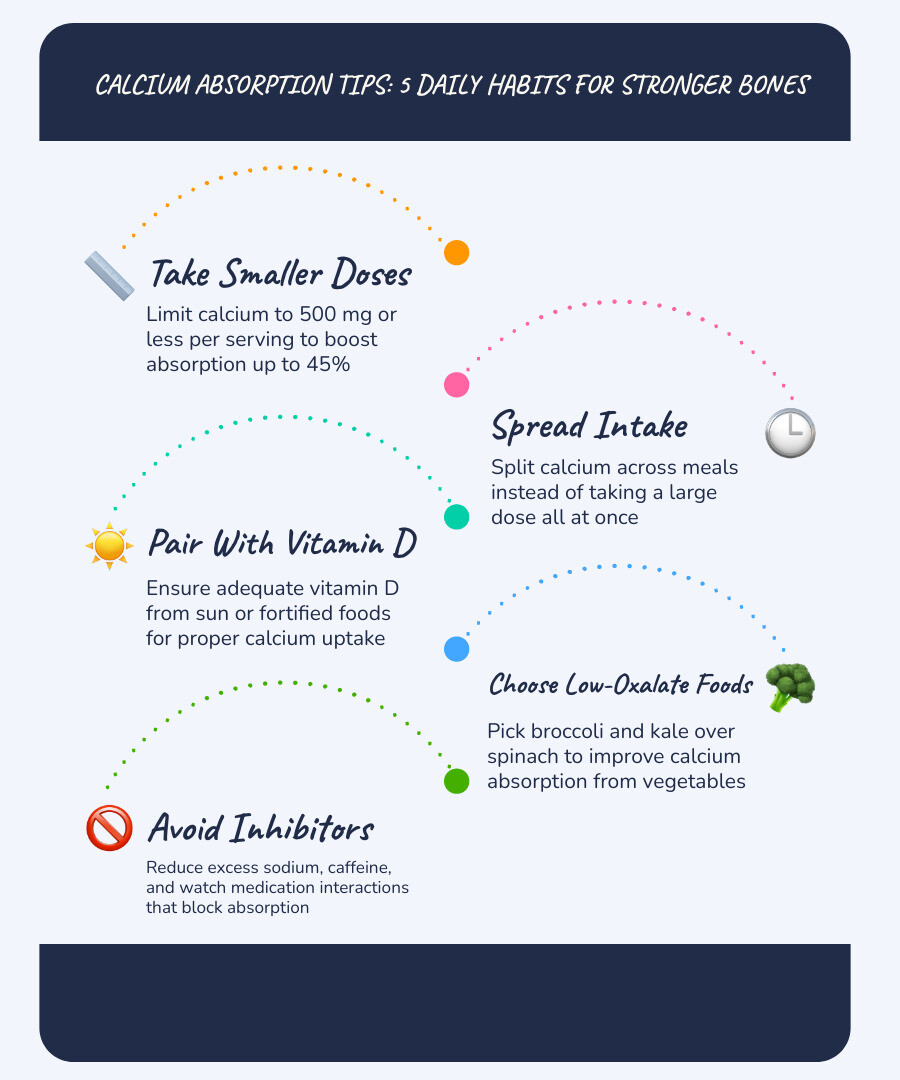
- Take smaller doses — limit calcium to 500 mg or less at one time
- Spread it through the day — split your intake across meals rather than taking it all at once
- Get enough vitamin D — your body cannot absorb calcium properly without it
- Choose the right supplement — calcium citrate absorbs well with or without food; calcium carbonate needs a meal
- Pick low-oxalate vegetables — broccoli and kale absorb better than spinach
- Watch what you pair it with — high sodium, excess caffeine, and certain medications can reduce absorption
- Account for age — absorption naturally declines as you get older, so strategy matters more over time
Most people know calcium is important for strong bones. But here is what many people miss: how much calcium you absorb matters just as much as how much you take in.
Research shows that absorption efficiency declines as intake rises. Your body absorbs roughly 35-40% of calcium at moderate doses, around 300 mg, but closer to 28% at a 1,000 mg dose, according to NIH data. At chronic high intakes, absorption can fall to about 35% or lower. In other words, more is not always better.
For older adults especially, this gap between intake and absorption can quietly lead to bone loss over time. Bones are living tissue. They are constantly being broken down and rebuilt, and they need a steady supply of well-absorbed calcium to stay strong. When the body does not get enough from food or supplements, it pulls calcium directly from bone, weakening it gradually.
The good news is that small, practical changes to when, how, and what you eat can make a real difference in how much calcium your body actually uses.
What is Calcium and Why Do Your Bones Need It?

Calcium is the most abundant mineral in the body. About 99 percent is stored mostly in your bones, with a much smaller amount in your teeth, where it helps provide structural strength. The remaining 1 percent is still essential. It helps your muscles contract, supports nerve signaling, regulates your heart rhythm, and assists with blood clotting.
Because these daily metabolic functions are so critical, the body must keep blood calcium levels within a very tight, constant range. If your diet does not provide enough calcium, your body will borrow what it needs from your "bone bank."
This borrowing process is part of bone remodeling, a lifetime cycle where old bone is broken down and replaced by new bone. When you are young, your body builds bone faster than it breaks it down. However, bone mass peaks around age 30. After that, bone breakdown begins to outpace bone formation.
If your body constantly pulls calcium from your bones without adequate replacement, it leads to bone thinning. This can result in osteopenia, a mild thinning of the bones, which can eventually progress to osteoporosis, a disease that makes bones brittle and highly prone to breaks.
To protect your bone density, you must meet your daily calcium requirements. According to clinical guidelines, daily needs differ by age and sex:
- Adults aged 19 to 50: 1,000 mg daily
- Women aged 51-70 1,200 mg daily (due to postmenopausal estrogen loss; estrogen plays a key role in bone remodeling by keeping bone-destroying cells in check, so when estrogen levels drop after menopause, bones break down faster than they can rebuild)
- Men aged 51 to 70: 1,000 mg daily
- Men and women aged 71 and older: 1,200 mg daily
To learn more about how to protect your bones, you can read the Research on calcium requirements provided by the Bone Health and Osteoporosis Foundation.
Essential Tips to Boost Calcium Absorption
To get the most out of your diet, it helps to understand how your gut absorbs calcium. The small intestine absorbs calcium using two distinct pathways:
- Active transport: This pathway relies on vitamin D to enable calcium movement across the intestinal wall. It occurs mainly in the duodenum, the first part of the small intestine. Active transport is highly efficient when calcium intake is low, but it has a physical limit and becomes saturated easily.
- Passive diffusion: This pathway primarily does not require vitamin D. When there is a high concentration of calcium in your digestive tract, the mineral simply passes between the cells of your intestinal wall.
Stomach acid is also essential for this process. Acidic conditions dissolve and ionize calcium compounds, turning them into a soluble form that your intestines can actually absorb.
Unfortunately, net calcium absorption naturally declines with age. While infants and young children can absorb up to 60 percent of dietary calcium to support rapid growth, that rate drops to about 25-30 percent in healthy adults and may decline further with age. This happens partly because aging kidneys can become less efficient at converting vitamin D into its active form, and the gut may become less responsive to the signals that drive active calcium transport.
To counteract this natural decline, you must pay attention to how your food choices interact in your digestive tract. You can dive deeper into this topic by reviewing the Scientific research on food matrix effects on calcium.
How Vitamin D Unlocks Calcium Absorption
Without vitamin D, your body can only absorb a small fraction of the calcium you consume. Vitamin D acts as a hormone in the body, binding to receptors that turn on the genes responsible for producing calcium transporter proteins in your gut.
The best form to look for is vitamin D3 (cholecalciferol), which is more effective at raising and maintaining blood levels of vitamin D than vitamin D2 (ergocalciferol).
While your skin can make vitamin D when exposed to sunlight, the process varies a lot from person to person. Season, latitude, time outdoors, skin tone, clothing coverage, and age can all affect how much vitamin D your body produces. As you get older, your skin becomes less efficient at making vitamin D, and your kidneys may become less effective at converting it into calcitriol, the active hormone form of vitamin D.
To help you get enough, look to dietary sources and fortified foods. For example, one eight-ounce serving of fortified milk often provides about 100 IU of vitamin D, which is now roughly 12% of the daily value on current nutrition labels. Fatty fish, such as salmon, is a useful natural source. Many older adults may need a daily supplement of 800 IU to 1,000 IU of vitamin D3 to support healthy calcium absorption, though it is important to stay below the safe upper limit of 4,000 IU daily unless a doctor recommends otherwise.
Practical Tips for Everyday Meals
Not all calcium-rich foods are created equal. The food matrix, which refers to the physical and chemical structure of food, heavily influences how much calcium your body can actually extract.
| Food Source | Calcium Content per Serving | Estimated Absorption Rate |
|---|---|---|
| Cooked Bok Choy | \~158 mg per cup | \~51% |
| Cooked Broccoli | \~60-62 mg per cup | \~47% |
| Milk / Yogurt | \~300 mg per cup | 30% to 32% |
| Fortified Orange Juice | \~300 mg per cup | \~30-36% |
| Cooked Spinach | \~245 mg per cup | \~5% |
As the table shows, vegetables like broccoli, bok choy, and kale have a very high absorption rate. Spinach, on the other hand, has a very low absorption rate of about 5 percent. This is because spinach is rich in oxalates, which are naturally occurring acids that bind to calcium in the gut, forming insoluble crystals that pass straight through your digestive system.
Other compounds can also block calcium absorption or increase calcium loss:
- Phytates: Found in whole grains, beans, and nuts, phytates can bind to calcium. Soaking, sprouting, or cooking these foods can help reduce their effect.
- Sodium: Higher salt intake can increase calcium loss in urine. A practical estimate is about 20-40 mg of calcium lost for every 2,300 mg of sodium consumed.
- Caffeine and Alcohol: High caffeine intake may slightly reduce calcium absorption and increase calcium loss in urine. Excessive alcohol can have a stronger effect by disrupting calcium balance, vitamin D activity, and bone-building cells.
To maximize your bone health, you should also focus on magnesium and vitamin K2. Women 31 and older need 320 mg of magnesium daily. Since about 50 to 60 percent of your body's magnesium is stored in your bones, and it acts as a critical helper for the enzymes that metabolize vitamin D, maintaining adequate magnesium levels is essential. Vitamin K2 is also important because it activates the proteins that bind calcium to your bone matrix, ensuring the calcium goes into your bones rather than building up in your blood vessels.
How to Choose and Take Calcium Supplements Safely
If you cannot get enough calcium from your diet, a supplement can help fill the gap. However, choosing the right type and taking it correctly is key to avoiding side effects and maximizing absorption.
The two most common forms of calcium supplements are:
- Calcium carbonate: This form is 40 percent elemental calcium (the actual amount of calcium your body can use). It is generally inexpensive and widely available. However, calcium carbonate requires stomach acid to dissolve, meaning you must take it with a meal for proper absorption.
- Calcium citrate: This form is 21 percent elemental calcium. Because it does not require stomach acid to dissolve, you can take it with or without food. This makes it the preferred choice for older adults, individuals with lower stomach acid, and anyone taking proton pump inhibitors (PPIs) or H2 blockers for acid reflux.
You must also be mindful of drug interactions. Calcium can bind to certain medications in your gut, preventing them from absorbing. For safety, separate your calcium supplements from levothyroxine (thyroid medication) by at least 4 hours, and from quinolone antibiotics by at least 2 hours.
Finally, keep safety limits in mind. Food-based calcium is generally not linked to higher kidney stone risk and may be protective when eaten with meals, because it binds oxalate in the gut. High-dose supplements, especially between meals, can raise risk. The daily upper limit is 2,500 mg for adults 19 to 70 and 2,000 mg for adults 71+, from food and supplements combined. Going over can cause constipation, bloating, hypercalcemia, and vascular calcification. Focus on food first; use supplements only to fill the gap.
Frequently Asked Questions about Calcium Absorption
What are the signs of calcium deficiency?
In its early stages, mild calcium deficiency often has no symptoms. Over time, however, low calcium levels can cause muscle cramps, spasms, weak or brittle nails, and a tingling sensation in your fingers and toes. A chronic shortage of calcium forces your body to pull the mineral from your skeleton, leading to silent bone loss and an increased risk of fractures.
Which calcium supplement is best for older adults?
Calcium citrate is generally the best option for older adults. As we age, our stomachs naturally produce less acid. Because calcium citrate does not require stomach acid to break down, it is absorbed much more easily than calcium carbonate and is gentler on the digestive tract.
Can you take too much calcium?
Yes. Consuming too much calcium, particularly from supplements, can cause side effects like constipation, gas, and bloating. It can also increase the risk of developing kidney stones. Older adults should aim to keep their total daily calcium intake from both food and supplements below 2,000 mg.
Key Takeaways for Better Calcium Absorption
Understanding how to improve your calcium absorption is a powerful step toward protecting your skeleton and maintaining your independence as you age. By spacing out your doses, pairing calcium with vitamin D and magnesium, and choosing highly absorbable food sources, you can ensure your body actually uses the nutrients you consume.
However, while maximizing your calcium absorption provides the essential raw materials your body needs to rebuild bone, nutrition is only one part of the equation. To actually signal your bones to grow stronger and prevent dangerous fractures, you must combine good nutrition with targeted, weight-bearing exercise.
Groove Health can help. As a Medicare-covered bone health program, Groove Health connects older adults with an MD and a physical therapist for personalized support with bone health, exercise, balance, and fall prevention. These customized plans are designed to help you build strength, move more safely, and make the most of the calcium your body absorbs.
If you are ready to take control of your bone health, you can Start your personalized bone health plan with Groove Health today.
Works Cited
- Shkembi, B., and Huppertz, T. “Calcium Absorption from Food Products: Food Matrix Effects”. Nutrients, 2022.
- Bone Health & Osteoporosis Foundation. “Calcium and Vitamin D”. Bone Health & Osteoporosis Foundation, 2026.
This content is for informational purposes only and does not constitute medical advice. Consult a qualified healthcare professional for diagnosis and treatment. If you are on Medicare and interested in a personalized bone health program, you can check your eligibility at groovehealth.com.