
How to Check DEXA Scan Coverage Fast
A broken bone can be the first sign of osteoporosis. Here's how Medicare Part B covers a DEXA bone density scan after a fracture: who qualifies, how often you can be tested, and the codes that prevent a denied claim.

DEXA Scan and Medicare: Costs, Coverage, and Eligibility
Medicare coverage of a DEXA scan after a fracture is something many older adults need to understand quickly, especially after an unexpected break. Here is the short answer:
Medicare Part B covers bone density testing (DEXA scans) after a fracture when your doctor determines it is medically necessary. Coverage is based on specific eligibility criteria, not just the fact that you broke a bone.
Quick coverage summary:
| What you want to know | The short answer |
|---|---|
| Is a DEXA scan covered after a fracture? | Yes, if you meet Medicare's eligibility criteria |
| Which part of Medicare covers it? | Medicare Part B |
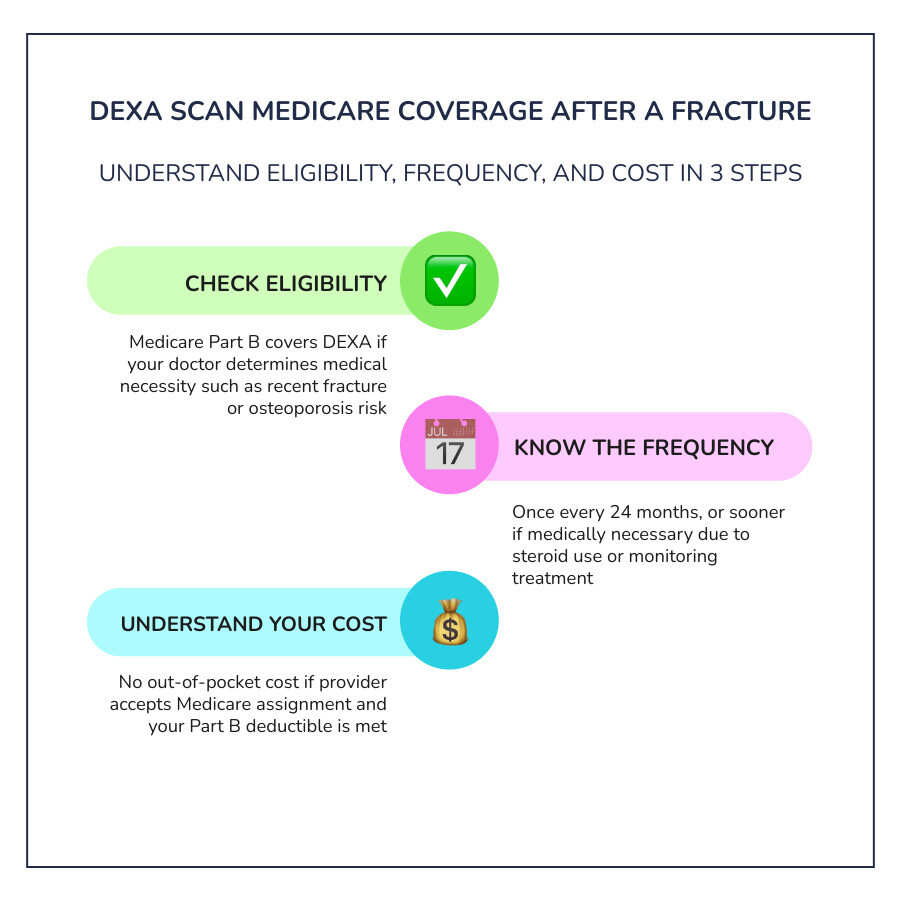
| How often will Medicare pay? | Once every 24 months, or more often if medically necessary |
| What does it cost you? | Nothing after the Part B deductible is met and if your provider accepts Medicare assignment; otherwise, 20% coinsurance applies |
| Do you need a doctor's order? | Yes, from a Medicare-enrolled provider |
The concern is real and common. Studies of Medicare fracture patients find that fewer than 1 in 5 get a bone density test even within the next year. Follow-up varies by fracture type--hip, vertebral, and other breaks--and men are tested far less often than women.
Understanding the coverage rules ahead of time means fewer surprises and a better chance of getting the care you actually need.
What is a DEXA Scan and Why Do You Need One After a Break?
A DEXA scan is a quick, painless imaging test. DEXA stands for dual-energy X-ray absorptiometry. It is an X-ray that measures your bone mineral density. The machine uses two very low-dose X-ray beams to see through your soft tissue and estimate the mineral content in your bones.
When you get your results, you will usually see two main numbers:
- T-score: This compares your bone density to that of a healthy young adult. For postmenopausal women and men over 50, a T-score of -1.0 or higher is considered normal. A score between -1.0 and -2.5 means osteopenia, or mild bone thinning. A score of -2.5 or lower means osteoporosis.
- Z-score: This compares your bone density to people your same age, sex, and body size. Z-scores are used more often for younger patients, such as premenopausal women, men under 50, and children, so many Medicare-age adults will see more emphasis on the T-score.
If you recently broke a bone from a minor fall or low-impact event, your doctor may call it a fragility fracture and should order a DEXA scan. That kind of break can be an early warning sign of osteoporosis. Finding bone loss sooner helps you start treatment before another fracture happens. You can read more about how these scans are used in this Medicare.gov: Bone Mass Measurements coverage.
How Medicare Covers a DEXA Scan After a Fracture
Medicare Part B pays for bone density tests under its preventive services benefit. However, you must meet at least one of Medicare's approved medical necessity criteria to qualify.
According to official Medicare Bone Mass Measurements Coverage guidelines, Medicare covers the test if you fall into one of these five groups:
- Estrogen-deficient women: Women who are at risk for osteoporosis due to a lack of estrogen. Estrogen acts like a shield, slowing down the cells that break down bone.
- People with vertebral abnormalities: Anyone whose X-ray shows signs of osteoporosis, osteopenia, or vertebral fractures (breaks in the bones of the spine).
- Steroid users: People who are taking long-term steroid medications like prednisone.
- People with hyperparathyroidism: People with overactive parathyroid glands. This condition causes too much calcium to leave the bones and enter the bloodstream.
- People on osteoporosis medication: Anyone who needs to be monitored to see if their prescribed bone-building drug is working.
| Coverage Type | Initial DEXA Scan | Repeat DEXA Scan |
|---|---|---|
| Primary Requirement | Must meet one of the 5 eligibility groups | Must show medical necessity for monitoring or drug therapy |
| Frequency | Once as a baseline | Generally, once every 24 months |
| Out-of-Pocket Cost | $0 if provider accepts assignment and you have met deductible | $0 if provider accepts assignment and you have met deductible |
How Often Will Medicare Pay for Your Bone Density Test?
Medicare generally covers a bone density test once every 24 months. This is often called the 24-month rule. If you had a normal scan last year, Medicare will not pay for another routine screening until two full years have passed.
When will Medicare Cover a DEXA scan before the 24-month mark?
There are times when you can get a scan before the 24-month mark. Medicare will pay for a repeat test early if your doctor documents a clear medical necessity.
Common reasons for an early scan include:
- You started long-term steroid therapy.
- You began a new FDA-approved osteoporosis drug, and your doctor needs to monitor your progress.
- Your doctor may be able to justify an earlier central DEXA if a prior screening used a less accurate peripheral device, though coverage depends on how medical necessity is documented.
A study on Osteoporosis Care and DXA Reimbursement notes that access to these essential scans is highly dependent on proper clinical documentation to justify why a repeat test is needed early.
Billing Codes and Medical Records Your Doctor Needs
To ensure Medicare pays for your scan, your healthcare provider must submit the correct billing codes. According to a Study on Medicare DXA Denial Rates, administrative errors and incorrect codes are the leading causes of claim denials.
CPT and HCPCS Codes for Bone Density Tests
The doctor's office will use specific Current Procedural Terminology (CPT) codes to bill Medicare:
- CPT 77080: This is used for a central DEXA scan, which measures the hips, pelvis, or spine. This is the standard, most accurate test.
- CPT 77081: This is used for a peripheral DEXA scan, which measures the wrist, heel, or finger.
- CPT 77082: This is used for a vertebral fracture assessment, which is a specialized scan to look for silent breaks in the spine.
Your doctor will also include a diagnosis code confirming medical necessity. If your claim is denied, ask your provider's billing office to verify that the correct code was used and that your fracture history is documented clearly.
Limitations and Situations Medicare Will Not Cover
There are several situations where Medicare may refuse to pay for a bone density test:
- Non-covered technologies: Medicare coverage policies do not cover outdated photon absorptiometry tests, including CPT codes 78350 and 78351.
- Portable X-ray equipment: This exclusion comes from Medicare Administrative Contractor bone mass measurement policies, which state that bone density tests done with portable X-ray equipment are not covered.
- Duplicate testing: A second scan within 24 months may be denied unless the record clearly documents a Medicare-allowed medical exception.
Frequently Asked Questions About Medicare Bone Density Coverage
What is the difference between a central DEXA and a peripheral test?
A central DEXA measures bone density in your hip and spine, which are the most critical areas for predicting future breaks. A peripheral test measures smaller bones in your wrist, heel, or finger. While peripheral tests are useful for quick screenings, a central DEXA is the gold standard for diagnosing osteoporosis.
Can men get a Medicare-covered DEXA scan?
Yes, but men do not have the same age-based routine screening benefit that some women do under Medicare. For a man's DEXA scan to be covered, the medical record needs to show a documented clinical risk factor, such as long-term steroid use, hyperparathyroidism, a fragility fracture, or an X-ray showing vertebral bone loss.
Next Steps to Get Your Scan Covered
Getting a DEXA scan after a fracture is a critical first step in identifying bone loss, but the scan itself is only the diagnostic starting point. Once a DEXA scan confirms osteoporosis or low bone density after a break, the next crucial step is taking active measures to rebuild strength and reduce future fracture risk. This is where Groove Health's personalized bone health support can help. By connecting you to a care team that includes physician guidance, physical therapy, strength and balance work, and fall-prevention strategies, Groove Health helps you move from "I got the scan" to "I know what to do next." The goal is simple: safer movement, stronger bones, and fewer repeat fractures.
Ready to take control of your bone health? Sign up for Groove Health's bone health program today to check your eligibility.
Works Cited
- Curtis, J. R., et al. "Regional Variation in the Denial of Reimbursement for Bone Mineral Density Testing Among U.S. Medicare Beneficiaries." Journal of Clinical Densitometry, 2008.
- Hayes BL, Curtis JR, Laster A, et al. "Osteoporosis Care in the United States After Declines in Reimbursements for DXA." Journal of Clinical Densitometry, 2010.
- Weaver, J., et al. "Diagnosis and Treatment of Osteoporosis Before and After Fracture: A Side-by-Side Analysis of Commercially Insured and Medicare Advantage Osteoporosis Patients." Journal of Managed Care & Specialty Pharmacy, 2017.
- Centers for Medicare & Medicaid Services. "Bone mass measurements." Medicare.gov, 2026.
This content is for informational purposes only and does not constitute medical advice. Consult a qualified healthcare professional for diagnosis and treatment. If you are on Medicare and interested in a personalized bone health program, you can check your eligibility at groovehealth.com.