
Everything You Need to Know About Bone Turnover Markers Tests
A bone turnover markers test measures how fast bone is being broken down and rebuilt. Learn what CTX and P1NP show, when doctors order them, how to prepare, and why they can't replace a DEXA scan.

What Is a Bone Turnover Markers Test and How Does It Work?
A bone turnover markers test measures how fast bone is being removed and rebuilt right now, while a dual-energy X-ray absorptiometry (DEXA) scan measures how much bone you have. Doctors use markers (such as CTX for breakdown and P1NP for formation) mainly to check within 3 to 6 months whether an osteoporosis medication is working, and sometimes to gauge current bone loss. While your skeleton feels solid, it is living tissue that constantly undergoes remodeling to stay strong.
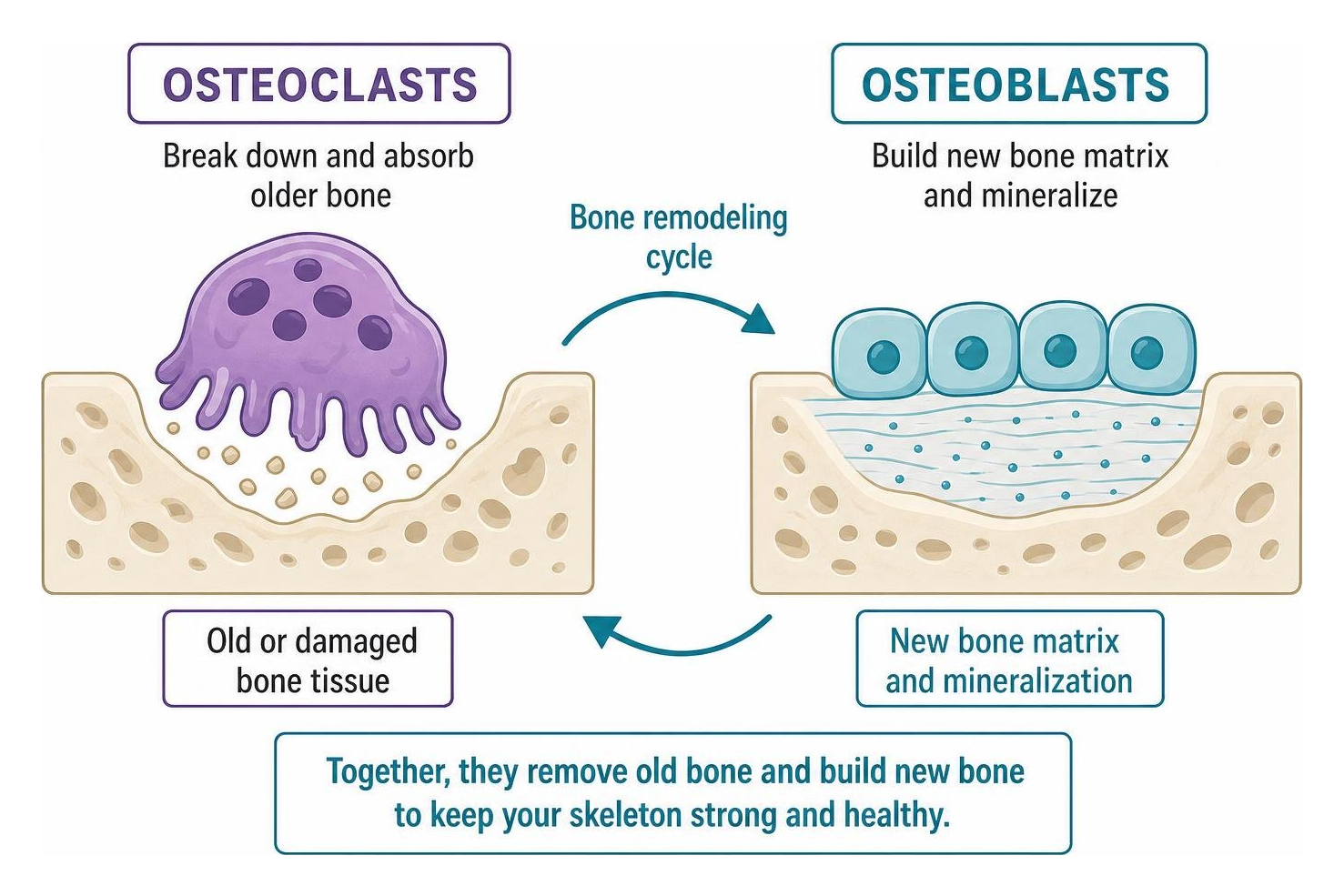
Bone remodeling relies on two main types of cells working together:
- Osteoclasts: Specialized cells that break down and absorb older or damaged bone tissue.
- Osteoblasts: Specialized bone-building cells that lay down new collagen frames and fill them with minerals.
When these cells do their daily work, they spill tiny protein fragments into your bloodstream. Lab tests measure these fragments to gauge the current balance between bone breakdown and bone formation. An international consensus from the International Osteoporosis Foundation (IOF) and the International Federation of Clinical Chemistry and Laboratory Medicine (IFCC) recommends CTX and P1NP as the reference bone turnover markers for monitoring osteoporosis treatment. This real-time snapshot helps your doctor understand how active your bone cells are at any given moment.
Bone Resorption Markers (CTX)
Bone resorption means the breakdown and removal of old bone tissue by osteoclasts. The standard blood marker used to measure this process is serum C-telopeptide, often abbreviated as CTX.
When osteoclasts break down type 1 collagen (the main protein structure of your bones), CTX fragments enter your bloodstream. A higher level of CTX means your osteoclasts are actively breaking down bone at a rapid pace. Lower levels mean bone breakdown has slowed down.
Bone Formation Markers (P1NP)
Bone formation is the building of new bone tissue by osteoblasts. A key blood marker used to track this process is procollagen type 1 N-terminal propeptide, or P1NP.
As osteoblasts make new type 1 collagen for bone, small end pieces are released into the blood. These pieces are called P1NP. Higher P1NP levels usually mean your body is actively forming new bone matrix, while lower levels can point to a slower rate of bone formation.
Bone Turnover Markers vs. DEXA Scans: Understanding the Difference
A bone turnover test measures your current speed of bone remodeling, while a dual-energy X-ray absorptiometry (DEXA) scan measures your total structural bone mineral density at a single point in time.
Think of a DEXA scan as a snapshot of your bone savings account: how much bone density you have today. A bone turnover test is more like recent transaction history, showing whether bone is being built or broken down quickly.
| Feature | Bone Turnover Markers Test | DEXA Scan |
|---|---|---|
| What It Measures | Current rate of bone breakdown and bone formation | Total mineral density and structural thickness of bone |
| Sample Type | Blood draw (or occasionally urine) | Low-dose X-ray imaging scan |
| How Fast It Changes | Changes within 3 to 6 months after starting therapy | Takes 1 to 2 years to show measurable changes |
| Primary Clinical Role | Monitoring early medication response and adherence | Diagnosing osteoporosis and establishing baseline T-scores |
| Testing Frequency | Baseline, then repeated at 3 to 6 months if monitoring meds | Typically repeated every 1 to 2 years |
A DEXA scan provides standard scores, such as T-scores, that define whether you have normal bone density, osteopenia, or osteoporosis. To learn more about how those numbers work, check our guide on what T-scores mean.
Because bone density builds slowly over time, scanning your bones too frequently will not show meaningful structural changes. Reviewing recommended DEXA scan frequency helps ensure you schedule imaging at the most useful intervals. For the rest of the printout, see our walkthrough on how to read a DEXA scan report.
Why and When Are Bone Turnover Tests Ordered?
Doctors order a bone turnover markers test to check baseline remodeling speed, confirm that an osteoporosis medication is working as expected, and evaluate possible secondary causes of bone loss.

The International Osteoporosis Foundation estimates that osteoporosis affects 200 million women worldwide. When managing bone health in adults 65 and older, waiting two years for a repeat DEXA scan can feel like a long time to find out if a treatment is helping.
Bone marker tests give doctors an early signal of how your body is responding within just 3 to 6 months.
When Doctors Order a Bone Turnover Markers Test
Doctors commonly consider bone turnover testing in several clear clinical situations:
- Before Starting Medication: Getting a baseline measurement of CTX and P1NP helps your provider know your starting rate of bone remodeling. This helps guide choices on when to start osteoporosis treatment.
- Checking Antiresorptive Treatments: Medications like oral bisphosphonates or denosumab work by slowing down overactive osteoclasts. A repeat CTX test after 3 to 6 months can show if bone breakdown has dropped as intended.
- Checking Bone-Building Treatments: Anabolic medications work by stimulating osteoblasts to build new bone. A repeat P1NP test after 1 to 3 months can confirm an early surge in new bone formation.
- Evaluating Drug Holidays: When taking a planned break from long-term bisphosphonate therapy, doctors may monitor CTX levels to see when bone turnover begins to rise again.
- Investigating Secondary Causes: Very high marker levels can prompt your doctor to look for underlying conditions, such as parathyroid hormone imbalances or vitamin D deficiencies, that might be accelerating bone loss.
Monitoring Medication Response and the Least Significant Change
In a large analysis of US insurance claims, only about 20% of women prescribed an oral bisphosphonate (alendronate or risedronate) kept refilling it without gaps over two years, and just 43% refilled often enough to count as compliant. Tracking bone markers helps confirm that your body is absorbing the medicine and responding properly.
To decide if a test result represents a real biological change rather than normal daily lab variation, doctors use a concept called the least significant change (LSC).
Because lab values naturally shift slightly from day to day, a result must cross a specific percentage threshold to prove the medicine is working:
- For serum CTX, a drop of roughly 30% from your baseline is generally needed to confirm a meaningful therapeutic response.
- For serum P1NP, a decrease of roughly 20% from your baseline confirms a true biological shift.
When starting antiresorptive medications, bone breakdown markers often fall by more than 40% within the first 3 months. Seeing this drop provides reassurance to both you and your doctor that the treatment plan is on track.
How to Prepare and What Can Affect Your Results
You should prepare for a bone turnover markers test by completing an overnight fast and scheduling your blood draw for the early morning.
Bone marker levels can change with time of day, food, and supplements. Simple preparation helps make your results more accurate and useful.
Preparing for Your Bone Turnover Markers Test
- Morning Timing: Bone breakdown markers, especially CTX, follow a strict diurnal rhythm. Levels peak during the middle of the night and drop to their lowest point in the afternoon. Blood samples should always be drawn between 7:30 AM and 10:00 AM.
- Fasting Overnight: Eating food triggers gut hormones that temporarily lower your CTX levels. Be sure to fast overnight for 10 to 12 hours before your morning blood draw, drinking only water.
- Supplement Timing: High doses of over-the-counter biotin (vitamin B7) can interfere with certain lab testing equipment. Ask your doctor if you should pause biotin, collagen, or multivitamin supplements for a few days before your test.
- Use the Same Lab: Different laboratory companies use different testing equipment. Always have your follow-up tests done at the same laboratory facility so results can be directly compared to your baseline.
- Avoid Strenuous Exercise: Vigorous physical exertion right before testing can temporarily shift marker levels. Stick to light activity the day before your draw.
Limitations and What Bone Markers Cannot Tell You
While bone turnover tests provide helpful clues, they have clear medical limits:
- They Cannot Diagnose Osteoporosis: High bone turnover does not automatically mean you have osteoporosis, and normal marker levels do not mean your bones are dense. Diagnosis requires a DEXA scan or a confirmed fragility fracture.
- Recent Fractures Skew Results: When a bone breaks, your body naturally floods the area with remodeling cells to repair the fracture. Marker levels can stay elevated for 6 to 12 months after a fracture, making them less reliable for general monitoring during that healing period.
- Kidney Function Matters: Some marker fragments are cleared from the body through the kidneys. If your kidney function is reduced, certain markers can build up in the blood. In these cases, doctors often choose bone-specific alkaline phosphatase (BSAP) instead.
Questions to Ask Your Doctor About Bone Turnover Testing
When discussing bone turnover marker tests with your healthcare provider, here are helpful questions to ask:
- Why are you ordering this test, and which specific markers are we measuring?
- Do I need a baseline test before I start or switch my osteoporosis medication?
- How many months after starting my treatment should I repeat this test?
- Do I need to stop taking my calcium, vitamin D, or biotin supplements before the blood draw?
- How do these test results fit together with my DEXA scan results to guide my care plan?
Exercise and Bone Health Management
While a bone turnover markers test tracks how bone remodeling responds to medical therapy, targeted movement provides the direct physical stimulus your bones need to stay strong. Medications and lab monitoring are only one part of caring for your skeleton; protecting against fractures also requires personalized physical activity designed to safely load your bones and improve balance.
Building bone strength requires progressive resistance training using compound movements that safely load the hips and spine, such as squats, step-ups, and hip hinges. Keep your back in a strong, neutral position and avoid bending forward under heavy loads.
To lower your chance of falling, practice progressive balance exercises using a sturdy, fixed support, such as a sturdy kitchen counter or a heavy chair placed flat against a wall. Never use movable objects for balance support.
Groove Health is a Medicare covered bone health program for adults that pairs each member with a physician and a physical therapist who designs a personalized exercise plan.
Frequently Asked Questions About Bone Turnover Testing
Can a bone turnover marker test diagnose osteoporosis?
No, a bone turnover marker test cannot diagnose osteoporosis on its own. It only measures the speed of bone remodeling, not your actual bone thickness or structural strength. A DEXA scan remains the established standard for diagnosing osteopenia and osteoporosis based on bone mineral density measurements.
Does Medicare cover bone turnover marker tests?
According to Medicare.gov and the Centers for Medicare & Medicaid Services (CMS), Medicare Part B covers medically necessary diagnostic laboratory tests when your doctor or provider orders them. Whether a specific bone marker test qualifies depends on your doctor documenting medical necessity. However, exact coverage and out-of-pocket costs may vary based on your specific Medicare Advantage plan or supplemental coverage.
How quickly do bone turnover markers change after starting treatment?
Bone turnover markers change rapidly, often showing significant shifts within 3 to 6 months after starting an osteoporosis medicine. Bone resorption markers like CTX typically drop significantly within several weeks of beginning an antiresorptive therapy, providing much faster feedback than a DEXA scan.
Works Cited
- Vasikaran S, Eastell R, Bruyère O, et al. "Markers of bone turnover for the prediction of fracture risk and monitoring of osteoporosis treatment: a need for international reference standards." Osteoporosis International, 2011.
- Bhattoa HP, Vasikaran S, Trifonidi I, et al. "Update on the role of bone turnover markers in the diagnosis and management of osteoporosis: a consensus paper from The European Society for Clinical and Economic Aspects of Osteoporosis, Osteoarthritis and Musculoskeletal Diseases (ESCEO), International Osteoporosis Foundation (IOF), and International Federation of Clinical Chemistry and Laboratory Medicine (IFCC)." Osteoporosis International, 2025.
- Eastell R, Szulc P. "Use of bone turnover markers in postmenopausal osteoporosis." The Lancet Diabetes & Endocrinology, 2017.
- Siris ES, Harris ST, Rosen CJ, et al. "Adherence to bisphosphonate therapy and fracture rates in osteoporotic women: relationship to vertebral and nonvertebral fractures from 2 US claims databases." Mayo Clinic Proceedings, 2006.
- International Osteoporosis Foundation. "Epidemiology." International Osteoporosis Foundation, accessed September 30, 2026.
- Centers for Medicare & Medicaid Services. "Diagnostic laboratory tests." Medicare.gov, accessed September 30, 2026.
This content is for informational purposes only and does not constitute medical advice. Consult a qualified healthcare professional for diagnosis and treatment. If you are on Medicare and interested in a personalized bone health program, you can check your eligibility at groovehealth.com.