
Demystifying Your DEXA Scan: Bone Density T-Scores Explained Simply
A T-score compares your bone density to a healthy young adult, and small differences change your diagnosis. Here's how to read your DEXA result and what you can do to improve it.
Why Your T-Score Matters More Than You Might Think
T-score meaning explained simply: your T-score is a single number that tells you how strong your bones are compared to a healthy young adult at peak bone density. Doctors use it to diagnose osteopenia (early bone thinning) and osteoporosis (significant bone loss that raises your risk of breaking a bone).
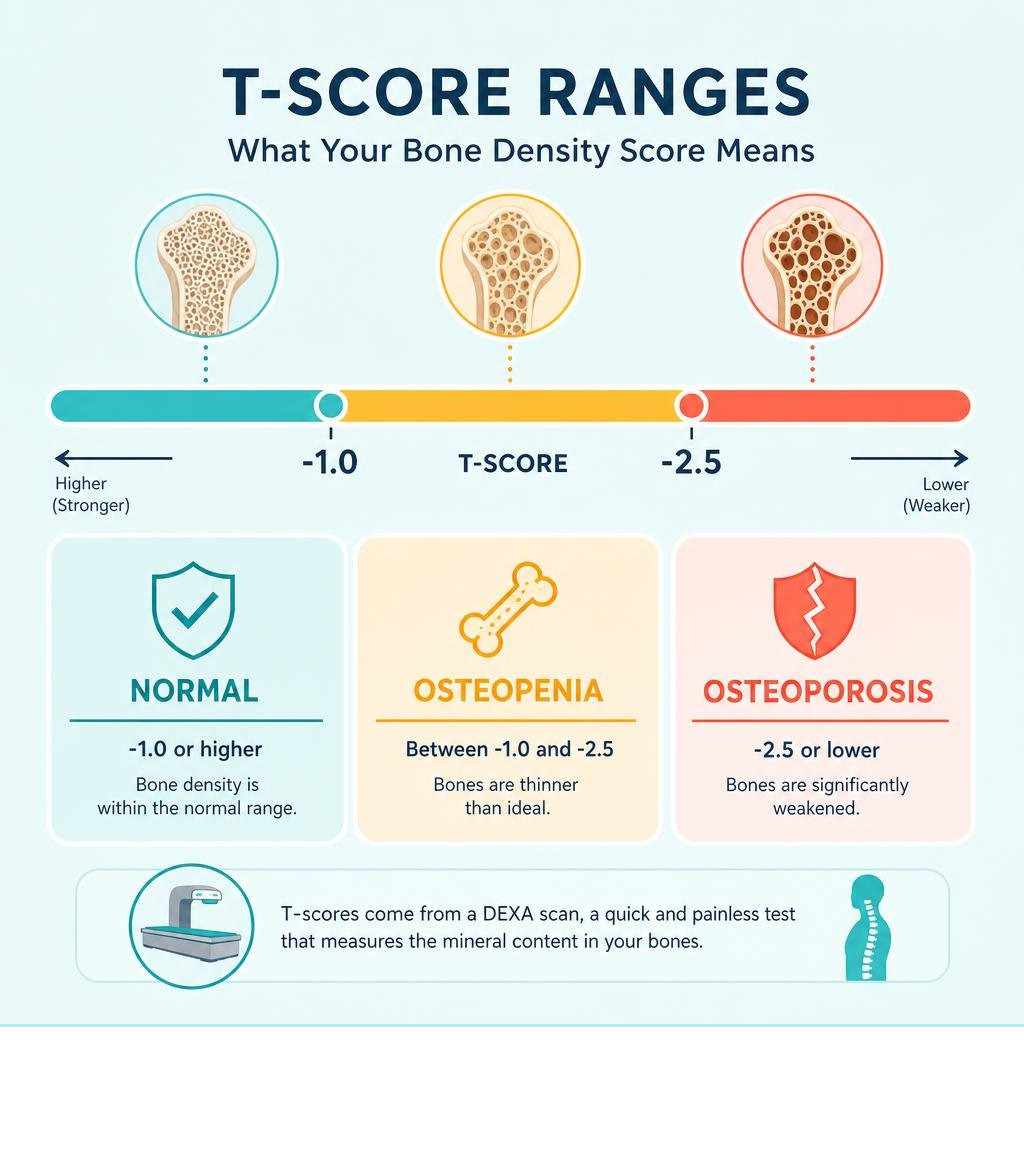
Here is what each T-score range means at a glance:
| T-Score | What It Means |
|---|---|
| -1.0 or higher | Normal bone density |
| Between -1.0 and -2.5 | Osteopenia — bones are thinner than ideal |
| -2.5 or lower | Osteoporosis — bones are significantly weakened |
Your T-score comes from a DEXA scan (short for dual-energy X-ray absorptiometry), a quick, low-dose X-ray that measures the mineral content in your bones, usually at the hip and spine. The scan typically takes under 30 minutes and is painless.
The number you receive is a starting point, not a grade. It tells you where you stand today and helps your doctor decide what steps, if any, to take next.
According to the Bone Health and Osteoporosis Foundation, one in two women over age 50 will break a bone because of osteoporosis during her lifetime. While that statistic is alarming, T-scores exist to identify bone loss before a fracture occurs- when there is still an opportunity to slow progression, strengthen bones, and reduce the risk of a future break.
This guide walks you through everything you need to understand your results, what affects them, and what you can do about them.
What Is a DEXA Scan and How Does It Measure Bone Strength?
A DEXA scan is the most common and accurate way to measure bone strength. It stands for dual-energy X-ray absorptiometry. This scan uses two very low-dose X-ray beams to see how many grams of calcium and other bone minerals are packed into a specific segment of bone.
The test usually focuses on two main areas: your lower spine and your hips. These are the central sites where breaks can cause the most serious health issues. During the scan, you lie flat on a padded table while a scanner arm passes slowly over your body.
A DEXA scan is highly accurate, quick, and safe. The radiation exposure is very low. In fact, it is about the same amount of radiation you would receive during a typical airplane flight across the country. To learn more about what to expect during this test, you can read about Interpreting DEXA Scan Results.
T-Score Meaning Explained Simply: What Your Results Tell You
To understand your T-score, it helps to know what a DEXA scan compares your results against. As explained by Northwell Health, a T-score measures your bone density relative to the average peak bone density of a healthy young adult rather than reporting your bone mineral density as a standalone value.
Your T-score is measured in standard deviations. This is a mathematical term that simply means how far your bone density is from the average young adult. Each standard deviation represents about a 10 to 12 percent difference in bone mass.
If your score is 0, your bone density is exactly the same as a healthy young adult. A positive number means your bones are stronger than average. A negative number means your bones are thinner than the young adult baseline.
The World Health Organization created the official categories for bone health based on these scores. To explore these categories in deeper detail, you can read NIAMS: Bone Mineral Density Tests — What the Numbers Mean.
What Your T-Score Means If You Have Osteopenia
If your T-score falls between -1.0 and -2.5, you have osteopenia. This term simply means you have low bone density. Your bones are thinner than average, but they are not yet fragile enough to be classified as osteoporosis.
Think of osteopenia as an early warning sign. It is not a disease, and it is not a guarantee that you will break a bone. Instead, it is a window of opportunity. By making key lifestyle changes now, you can often slow down bone loss and protect your independence. For a complete guide on how to read these numbers, see How to Interpret Bone Density.
What Your T-Score Means If You Have Osteoporosis
A T-score of -2.5 or lower means you have osteoporosis. The word osteoporosis means porous bones. When bone density drops this low, the internal structure of your bones becomes thin and weak, much like a delicate honeycomb.
With osteoporosis, the risk of breaking a bone rises significantly. Simple daily activities like bending over, lifting a heavy grocery bag, or even sneezing can sometimes cause a tiny break in the spine. If your score is in this range, your doctor will likely discuss medical treatment options alongside lifestyle changes. You can read more about how this score relates to your personal risk at DEXA T-Score Fracture Risk.
T-Score vs. Z-Score
When you receive your DEXA report, you will see two different scores: a T-score and a Z-score. It is easy to confuse the two, but they serve different purposes.
While your T-score compares you to a healthy young adult, your Z-score compares you to people of your same age, sex, weight, and ethnic background. To understand the differences in how doctors use these scores, you can read What Is A T-Score And What Does It Mean?.
Most doctors focus on the T-score to diagnose osteoporosis. However, a Z-score is still helpful. If your Z-score is unusually low (below -2.0), it means your bone density is significantly lower than expected for someone your age. This can alert your doctor to look for secondary osteoporosis, which is bone loss caused by an underlying medical condition or a specific medication.
Why We Use a Young Adult Baseline
You might wonder why a 70-year-old’s DEXA report is compared with a healthy young adult. That’s built into the T-score definition: groups like the World Health Organization and International Society for Clinical Densitometry define it as your bone density compared with a young adult reference group, around peak bone mass.
Humans reach peak bone density between late teens and early 30s. After age 40, our bodies slowly begin to lose more bone than they build. If we only compared older adults to other older adults, a person might have a "normal" score for their age, even if their bones were very weak and likely to break. Comparing your bones to a young adult standard gives an absolute measure of how strong your bones truly are. You can find more details on this comparison at T Scores and bone density: when to be concerned.
What Factors Can Affect the Accuracy of Your Bone Density Test?
A DEXA scan is highly reliable, but certain factors can affect the accuracy of your T-score. Understanding these factors can help you prepare for your scan and interpret your results correctly.
First, simple preparation mistakes can distort the scan. For example, taking a calcium supplement within 24 hours of your test can leave unabsorbed calcium in your digestive tract, which the scanner might mistake for bone. Wearing clothing with metal zippers, buttons, or snaps can interfere with the X-ray beams.
Second, physical changes in your body can skew the results. If you have severe spinal arthritis, the extra bone spurs caused by arthritis can falsely raise your spine T-score, making your bones look stronger than they are. Similarly, if you are very small-framed, a standard 2D DEXA scan might slightly underestimate your actual bone density. To learn more about these technical details, read DXA scan results - the terminology explained.
How to Improve a Low T-Score with Safe, Progressive Loading
Your bones are living tissue that constantly adapts to the forces you place on them. Inside your bones, specialized cells called osteoblasts work to lay down new bone minerals. However, these cells are most active when they receive a strong signal that the bone needs to be stronger.
To trigger these osteoblasts, you must apply an osteogenic load. This means a physical force heavy enough to signal the bone to grow. Research suggests that light activities, like walking or using light resistance bands, are excellent for your heart and muscles but may not create enough force to build bone.
To build bone strength, you need progressive resistive exercise, which means gradually lifting heavier weights over time. Studies indicate that lifting heavy weights for a low number of repetitions (around 75 to 85 percent of the maximum weight you can lift once) is an effective way to stimulate bone growth.
To protect your hip and spine, you should focus on large compound movements that load these specific areas. Excellent options include:
- Squats: These load both the hips and the spine.
- Hip Hinges: Moves like the Romanian deadlift teach you to bend at the hips while keeping your back long and straight, rather than rounding your spine.
- Spinal Extension: Gently arching or straightening your upper back is safe and helps strengthen the muscles that support your spine.
Always avoid loaded spinal flexion, which means rounding your back forward while holding weight, as this can increase the risk of a spinal fracture.
Finally, do not forget power and balance. Power is the ability to move quickly, which is what you need to catch yourself if you trip. Dynamic single-leg balance exercises, where you move your arms or opposite leg while balancing, help train your brain and muscles to prevent falls. Preventing falls is critical, as the Centers for Disease Control and Prevention reports that 88 percent of hip fracture hospitalizations in older adults are caused by falls. For safe movement ideas, check out How to Interpret Bone Density.
Designing a Safe Exercise Plan for Bone Strength
If you have low bone density, starting a weight lifting program can feel intimidating. That is why professional guidance is so valuable.
Groove Health offers a personalized bone health and exercise program covered by Medicare. When you join, a physical therapist designs a personalized, progressive exercise plan tailored to your current physical ability. This plan is designed to help you safely build up to the heavier loads needed to strengthen your bones and improve your balance. You can learn more about how to get started with the Groove Health Program.
Frequently Asked Questions about T-Scores
How often should I get a follow-up DEXA scan?
Because bone remodeling is a very slow process, you do not need to get scanned constantly. For most people not on treatment, a follow-up scan is recommended every 2 to 5 years. If you have normal bone density, you can often wait longer — some guidelines suggest 4 to 8 years or more. If you have osteoporosis and are taking medication, your doctor may recommend a repeat scan every 1 to 3 years to monitor your progress.
Can a T-score improve over time?
Yes. Your T-score is a snapshot of your bone health today, not a permanent label. Through a combination of targeted progressive resistance training, a diet rich in calcium and vitamin D, and prescribed bone-protecting medications, many people are able to stop bone loss and even see improvements in their T-scores over time.
Does a low T-score guarantee I will break a bone?
No. A T-score is just one piece of the puzzle. Your actual fracture risk also depends on your muscle strength, your balance, and your lifestyle. By focusing on fall prevention and building a strong, powerful body, you can dramatically lower your chance of breaking a bone, even if your T-score is low.
Your Next Steps Toward Stronger Bones
Understanding your T-score meaning explained simply is the first step toward taking control of your bone health. Whether your score indicates normal bone density, osteopenia, or osteoporosis, bones are dynamic tissues that can get stronger when given the right signals. By staying active, focusing on progressive loading, and working with professionals to prevent falls, you can protect your mobility and independence for years to come. Groove Health supports this journey directly through our specialized care model, which pairs you with a physical therapist to deliver personalized exercise plans designed specifically to build bone strength and prevent fractures. To explore more articles on managing bone health, visit our Osteoporosis Resources.
Works Cited
- National Institute of Arthritis and Musculoskeletal and Skin Diseases. "Bone Mineral Density Tests: What the Numbers Mean." NIAMS, National Institutes of Health, 2025.
- Northwell Health. "What Is a T-Score and What Does It Mean?." The Well by Northwell, 2025.
- Royal Osteoporosis Society. "DXA Scan Results: The Terminology Explained." Royal Osteoporosis Society, 2025.
- World Health Organization Study Group. "Assessment of Fracture Risk and Its Application to Screening for Postmenopausal Osteoporosis." WHO Technical Report Series 843, 1994.
- International Society for Clinical Densitometry. "2023 Official Adult Positions." ISCD, 2023.
This content is for informational purposes only and does not constitute medical advice. Consult a qualified healthcare professional for diagnosis and treatment. If you are on Medicare and interested in a personalized bone health program, you can check your eligibility at groovehealth.com.