
Designing a Low-Impact Strength and Mobility Circuit Routine for Home
Home circuit training uses a short series of chair-assisted and bodyweight moves to build strength, balance and mobility. Here is how to structure safe routines from beginner to advanced.

Home Circuit Training, at Your Own Pace
Home circuit training means doing a short series of different exercises in your own space, then repeating the series. You might move from chair-assisted squats to wall push-ups, gentle marching, and a balance exercise while resting as needed between moves.
You do not need gym machines to get started. A sturdy chair and clear floor space can help you build a routine around your strength and mobility. If you have osteoporosis or trouble with balance, ask your care team which movements are right for you before trying a new circuit. Building a safe routine often starts with understanding strength training for bone health, and you can explore bone strengthening workouts as your confidence grows.
Understanding the Fundamentals: What is Home Circuit Training?
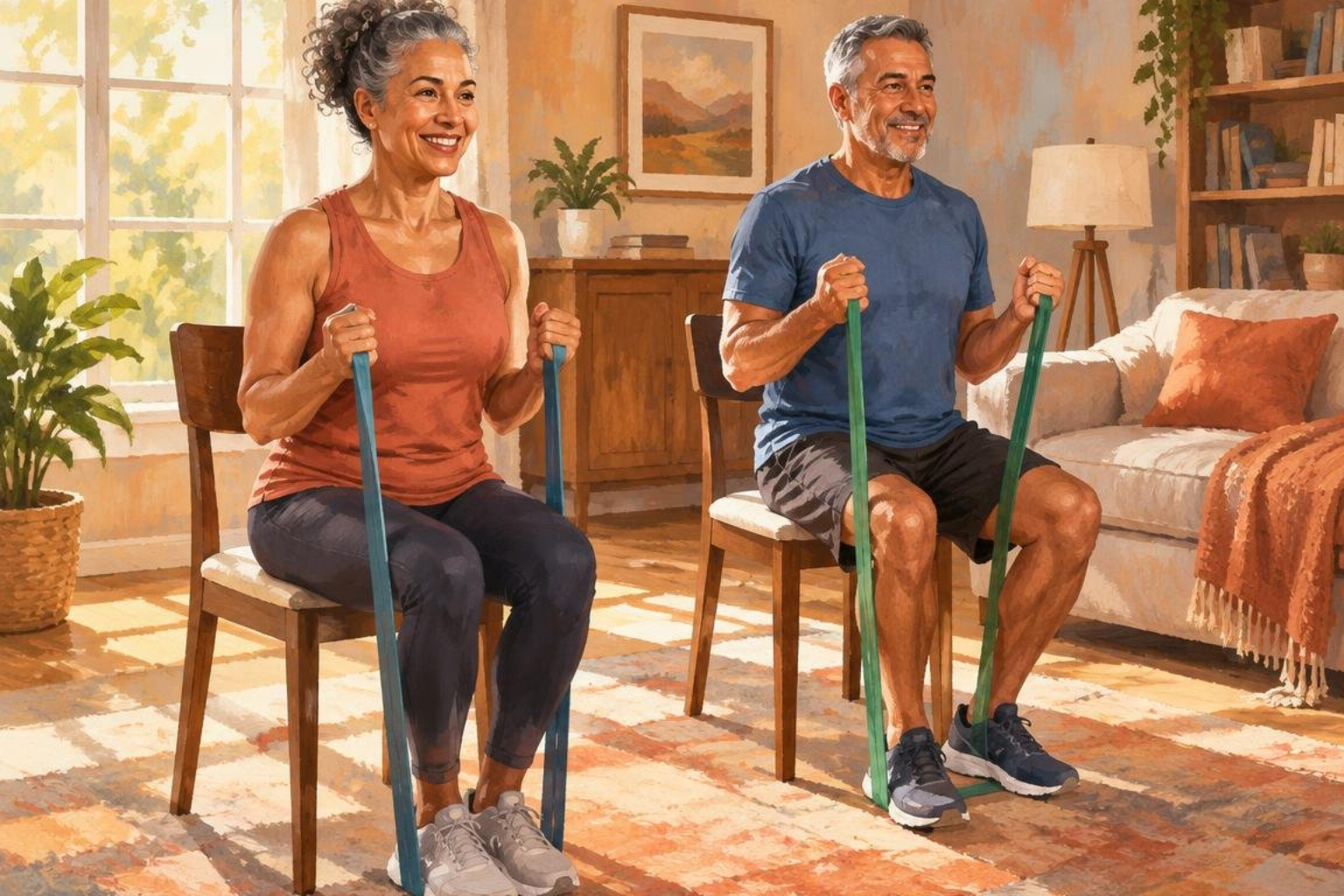
Home circuit training is an exercise method where you perform several distinct movements in a specific order with brief rest periods between them. A single routine typically combines four to eight exercise stations covering upper body, lower body, core, and aerobic conditioning. Completing all stations in the sequence equals one round, and most sessions involve repeating the sequence two to three times for a comprehensive 20 to 30 minute workout.
In an effective home circuit, you alternate between opposing movement patterns, such as pairing a pushing exercise with a pulling exercise, or alternating lower-body strength with low-impact cardiovascular steps. This structure allows one muscle group to recover while another is actively working, keeping your heart rate elevated without overloading any single joint. Adding targeted strength training for bone health into these short work-to-rest intervals provides both aerobic and muscular benefits in a single, compact session.
How Does Home Circuit Training Compare With Gym Workouts?
Traditional gym workouts often rely on heavy machines, crowded weight rooms, and long rest breaks of two to three minutes between sets of a single exercise. In contrast, home circuit training replaces fixed machinery with bodyweight resistance, elastic bands, and functional household setups like a sturdy chair.
Because you move directly from one station to the next in your living room, home circuits dramatically reduce total workout time while maintaining cardiovascular engagement. You maintain full control over the pace, transitioning smoothly between movements without waiting for equipment or navigating crowded fitness facilities.
What Can Home Circuit Training Do for Bone Density and Balance?
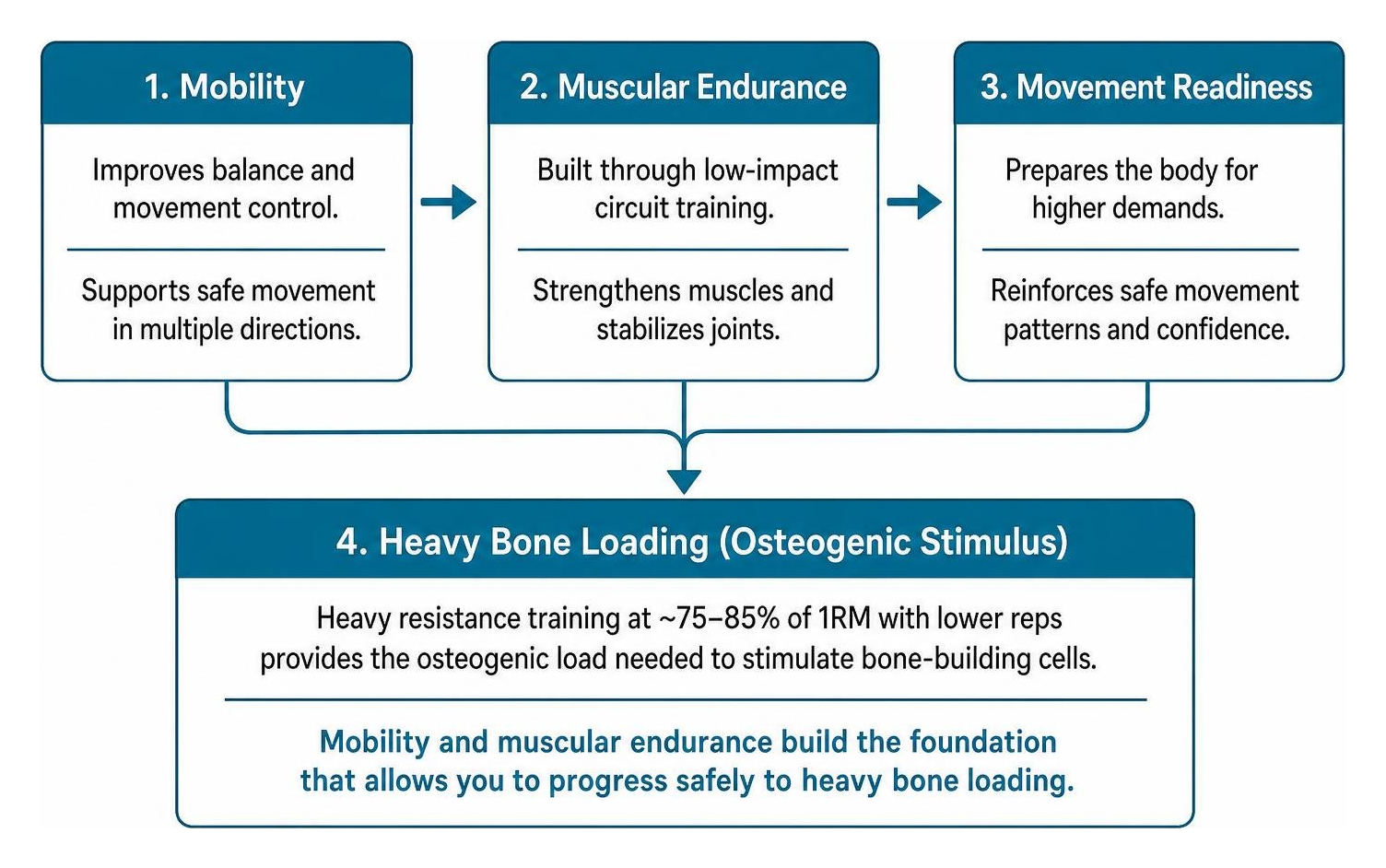
Home circuits improve balance and mobility by challenging your neuromuscular coordination across multiple directions. Moving safely from standing exercises to controlled stepping develops functional stability, which helps protect against unexpected trips. To lower your chance of falling, organizations like the Centers for Disease Control and Prevention (CDC) highlight regular balance and strength training as central components of fall prevention.
While circuits build muscular endurance, bone strengthening requires an osteogenic load, meaning heavy resistance training at more than 85% of your one-rep maximum (1RM) with lower repetitions to stimulate bone-building cells called osteoblasts. While bodyweight circuits and light resistance bands may not build new bone density directly, they serve as an essential foundation. They prepare muscles, stabilize joints, and reinforce safe movement patterns so you can progressively advance toward the heavier loading found in dedicated fall prevention bone exercises.
Main Benefits of Low-Impact Circuit Training at Home
Low-impact home circuits offer a time-efficient way to preserve joint health, elevate heart rate, and enhance everyday physical function without leaving the house.
| Feature | Home Low-Impact Circuit | Traditional Gym Weight Training |
|---|---|---|
| Primary Focus | Muscular endurance, aerobic stamina, and joint mobility | Isolated muscle hypertrophy and heavy bone-loading strength |
| Equipment Needed | Sturdy chair, floor mat, light dumbbells or bands | Barbells, weight machines, cable racks, and benches |
| Joint Impact | Low to minimal; exercises keep at least one foot on the floor | Variable; depends on exercise choice and external load |
| Typical Duration | 20 to 35 minutes total | 45 to 75 minutes including extended rest intervals |
| Cardiovascular Benefit | Continuous moderate heart rate elevation | Intermittent heart rate spikes with long rest recovery |
| Bone Density Stimulus | Supportive conditioning; prepares joints for heavy load | High potential for osteogenic loading at more than 85% 1RM |
Consistently performing home exercise helps maintain active muscle mass, supports metabolic health, and preserves the range of motion required for daily activities like climbing stairs or carrying groceries.
Essential Equipment and Safety Guidelines for Home Workouts
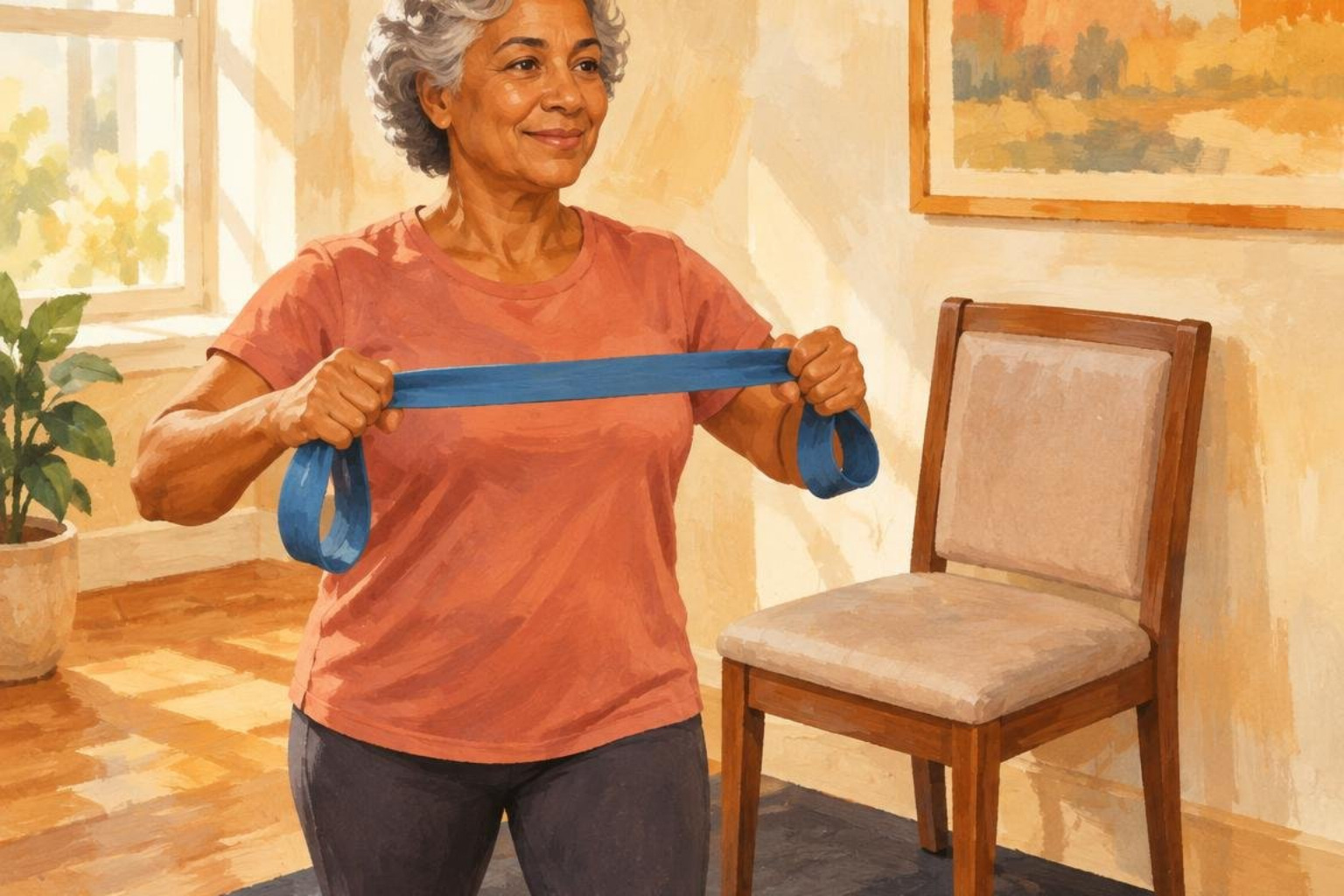
Setting up an effective home workout space requires minimal equipment, but safety and stability must come first. Before starting any routine, ensure your training area is clear of clutter and provides ample room to move in all directions.
- Sturdy, armless chair: Any chair used for balance or seated movements must be firm and braced against a wall so it cannot slip or tip. Avoid rolling office chairs or soft folding chairs.
- Non-slip floor mat: A firm exercise mat provides traction for your feet and cushioning for standing or seated joint support.
- Loop resistance bands and light dumbbells: These tools allow you to gradually increase resistance on compound movements without placing harsh strain on delicate joints.
- Spinal alignment cues: Maintain an upright posture with your shoulders resting comfortably back and your deep core engaged. Prioritize spinal extension and avoid loaded spinal flexion, which means never round your lower or mid-back while holding weights.
- Perceived exertion and hydration: Keep a water bottle nearby and monitor your breathing. Aim for a moderate effort where you can speak a full sentence but cannot sing.
How to Structure a Balanced Low-Impact Circuit Routine
A balanced home circuit covers the fundamental movement patterns of the human body: pushing, pulling, squatting, hip hinging, and core stabilization. Structuring your stations around these patterns ensures whole-body muscular balance while preventing overuse in any single area.
- Station 1 (Lower Body Squat or Sit-to-Stand): Trains the quadriceps, glutes, and hips to preserve chair-transfer ability.
- Station 2 (Upper Body Push): Wall push-ups or seated chest presses build strength in the chest, shoulders, and triceps.
- Station 3 (Hip Hinge): Romanian deadlifts or glute bridges load the posterior chain while practicing a straight-spine hinge.
- Station 4 (Upper Body Pull): Resistance band rows strengthen the upper back, supporting upright spinal extension.
- Station 5 (Core Stabilization and Balance): Static single-leg stands near a braced wall or seated anti-rotation presses develop trunk control.
Allow 30 to 45 seconds of work at each station, followed by 15 to 30 seconds of rest to transition safely. Rest for 1 to 2 minutes after completing the entire sequence before starting the next round.
Step-by-Step Sample Home Circuits for Different Fitness Levels
When designing your home routine, selecting suitable osteoporosis exercises means prioritizing joint protection and safe spine mechanics across every level.
Beginner Chair-Assisted Circuit
Perform each movement for 30 seconds, resting 30 seconds between stations. Complete 2 rounds.
- Chair Sit-to-Stand: Stand up from a braced chair without using your hands if able, keeping your chest open and spine tall.
- Wall Push-Up: Place hands shoulder-width apart on a clear wall, lowering your chest under control with a straight torso.
- Seated Resistance Band Row: Sit tall on the edge of your chair, loop a band around your feet, and pull your elbows back, squeezing the shoulder blades.
- Static Single-Leg Balance: Stand tall holding a sturdy, braced counter or chair back. Lift one foot one inch off the floor, holding for 15 seconds per side.
Intermediate Standing Resistance Routine
Perform each movement for 40 seconds, resting 20 seconds between stations. Complete 3 rounds.
- Bodyweight Squat to Chair Tap: Squat down until your hips lightly brush the chair surface, then press through your heels to stand tall.
- Resistance Band Chest Press: Anchor a band behind you or loop it across your upper back, pressing forward at chest height.
- Dumbbell Hip Hinge (Romanian Deadlift): Hold light weights against your thighs, pushing your hips backward while maintaining a flat, neutral spine with zero rounding.
- Standing Banded Row: Stand with soft knees, hinge slightly at the hips with a flat back, and row the band toward your ribcage.
- Tandem Stance Hold: Place one foot directly in front of the other (heel-to-toe) near a sturdy support, holding for 20 seconds before switching feet.
Advanced Multi-Planar Progression
Perform each movement for 45 seconds, resting 15 seconds between stations. Complete 3 to 4 rounds. Power-based movements like gentle step-ups or rapid heel drops should only be introduced after consulting your physical therapist or physician.
- Reverse Lunge with Support: Step backward into a controlled lunge, keeping your front knee tracking over your shoelaces, holding a wall if needed.
- Incline Push-Up: Place your hands on a sturdy, braced counter or heavy table, maintaining a rigid plank line from head to heels.
- Single-Leg Romanian Deadlift: Hinge on one leg while extending the other straight back, keeping hips level and back flat, lightly touching a chair for balance.
- Standing Pallof Press: Anchor a band at chest height to the side, pressing both hands forward while resisting trunk rotation.
- Dynamic Clock Taps: Stand on one leg and tap the free foot to the front, side, and rear while maintaining stability on the standing hip.
Proper Warm-Up, Cool-Down, and Recovery Protocols
A structured warm-up prepares your joints by circulating synovial fluid, which lubricates cartilage and reduces stiffness. Spend 5 minutes before your circuit doing dynamic movements such as shoulder rolls, gentle ankle circles, seated torso rotations, and marching in place.
After finishing your circuit, dedicate 5 minutes to cooling down. Shift to slow, rhythmic breathing and perform static stretches for your calves, hamstrings, and chest, holding each position for 20 to 30 seconds without bouncing. Integrating these post-workout stretches alongside focused balance exercises for osteoporosis helps calm the nervous system and supports neuromuscular recovery.
Frequently Asked Questions About Home Circuit Workouts
How often should beginners do home circuit training each week?
Beginners should aim for 2 to 3 non-consecutive days per week. Scheduling at least one full day of rest between sessions allows muscle tissues and joints adequate time to adapt and repair, lowering your risk of overuse soreness.
Can home circuit training build bone density without heavy gym weights?
According to the LIFTMOR randomized trial, building new bone mineral density takes progressive, supervised resistance training with heavier loads (more than 85% of 1RM) that directly compress the hip and spine. While home bodyweight circuits improve muscle tone, balance, and stamina, they serve primarily as a stepping stone toward heavier, bone-stimulating loads.
What is the difference between low-impact circuit training and HIIT?
Low-impact circuit training focuses on controlled movement quality, joint preservation, and continuous moderate heart rate elevation without jumping. High-Intensity Interval Training (HIIT) pushes heart rates toward near-maximum capacity using rapid, often explosive intervals that create higher joint stress and require longer recovery periods.
Start Small and Progress Safely
Home circuit training provides an accessible, time-efficient approach to building full-body muscular endurance, improving functional mobility, and supporting cardiovascular health from the comfort of your living room. By moving smoothly between balanced stations that target pushing, pulling, squatting, and core stability, you can maintain steady physical conditioning without placing excessive stress on your joints.
While low-impact bodyweight circuits support everyday stamina, balance, and joint safety, building bone strength and preventing fractures requires targeted, progressive resistance training under safe mechanics. Following a personalized, home-based exercise plan tailored to your specific bone health ensures every movement builds functional strength safely to protect against falls and preserve long-term independence.
For specific guidance in building a routine consider Groove Health. Groove is a Medicare covered bone health program for adults 65 and older that pairs each member with a physician and a physical therapist who designs a personalized exercise plan. Having professional guidance ensures each movement station aligns with your current bone health diagnosis and physical capabilities.
Works Cited
- Watson SL, Weeks BK, Weis LJ, Harding AT, Horan SA, Beck BR. "High-Intensity Resistance and Impact Training Improves Bone Mineral Density and Physical Function in Postmenopausal Women With Osteopenia and Osteoporosis: The LIFTMOR Randomized Controlled Trial." Journal of Bone and Mineral Research, 2018;33(2):211-220.
- Giangregorio LM, Papaioannou A, Macintyre NJ, et al. "Too Fit To Fracture: Exercise Recommendations for Individuals With Osteoporosis or Osteoporotic Vertebral Fracture." Osteoporosis International, 2014;25(3):821-835.
- Sherrington C, Fairhall NJ, Wallbank GK, et al. "Exercise for Preventing Falls in Older People Living in the Community." Cochrane Database of Systematic Reviews, 2019;1(1):CD012424.
- Centers for Disease Control and Prevention. "Preventing Falls and Hip Fractures." CDC, 2026.
- National Institute of Arthritis and Musculoskeletal and Skin Diseases. "Exercise for Your Bone Health." National Institutes of Health, 2023.
This content is for informational purposes only and does not constitute medical advice. Consult a qualified healthcare professional for diagnosis and treatment. If you are on Medicare and interested in a personalized bone health program, you can check your eligibility at groovehealth.com.