The Ultimate Guide to How to Interpret Bone Density
Confused by your bone density report? This guide explains how to read your T-score, Z-score, and FRAX fracture risk, what counts as osteoporosis, and the steps to take to protect your bones.
Why Knowing How to Interpret Bone Density Results Could Protect Your Health
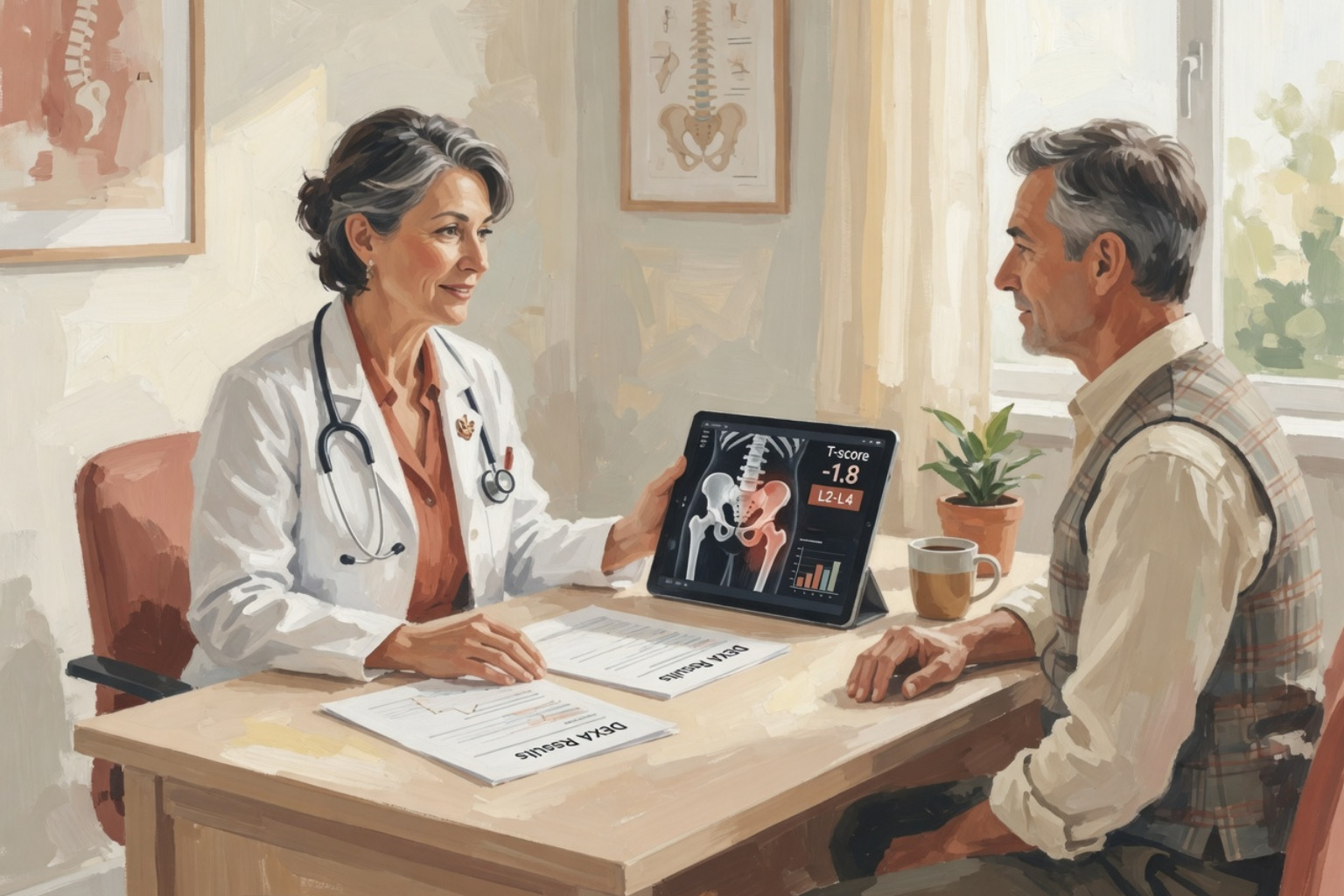
Learning how to interpret bone density results is one of the most important things you can do after getting a scan — yet most people leave the clinic with a printout full of numbers they don't fully understand.
Here is a quick-reference guide to what those numbers mean:
| Score | Category | What It Means |
|---|---|---|
| -1.0 or higher | Normal | Bone density is within a healthy range |
| -1.0 to -2.5 | Low bone mass (osteopenia) | Bones are thinner than normal but not yet at the osteoporosis level |
| -2.5 or lower | Osteoporosis | Significant bone loss; higher risk of breaking a bone |
| Z-score below -2.0 | Below expected for your age | May signal an underlying cause beyond normal aging |
These numbers come from a test called a DEXA scan (Dual-Energy X-ray Absorptiometry) — a quick, low-radiation X-ray that measures how much calcium and mineral is packed into your bones. The result is reported as a T-score, which compares your bone density to that of a healthy young adult at peak bone strength.
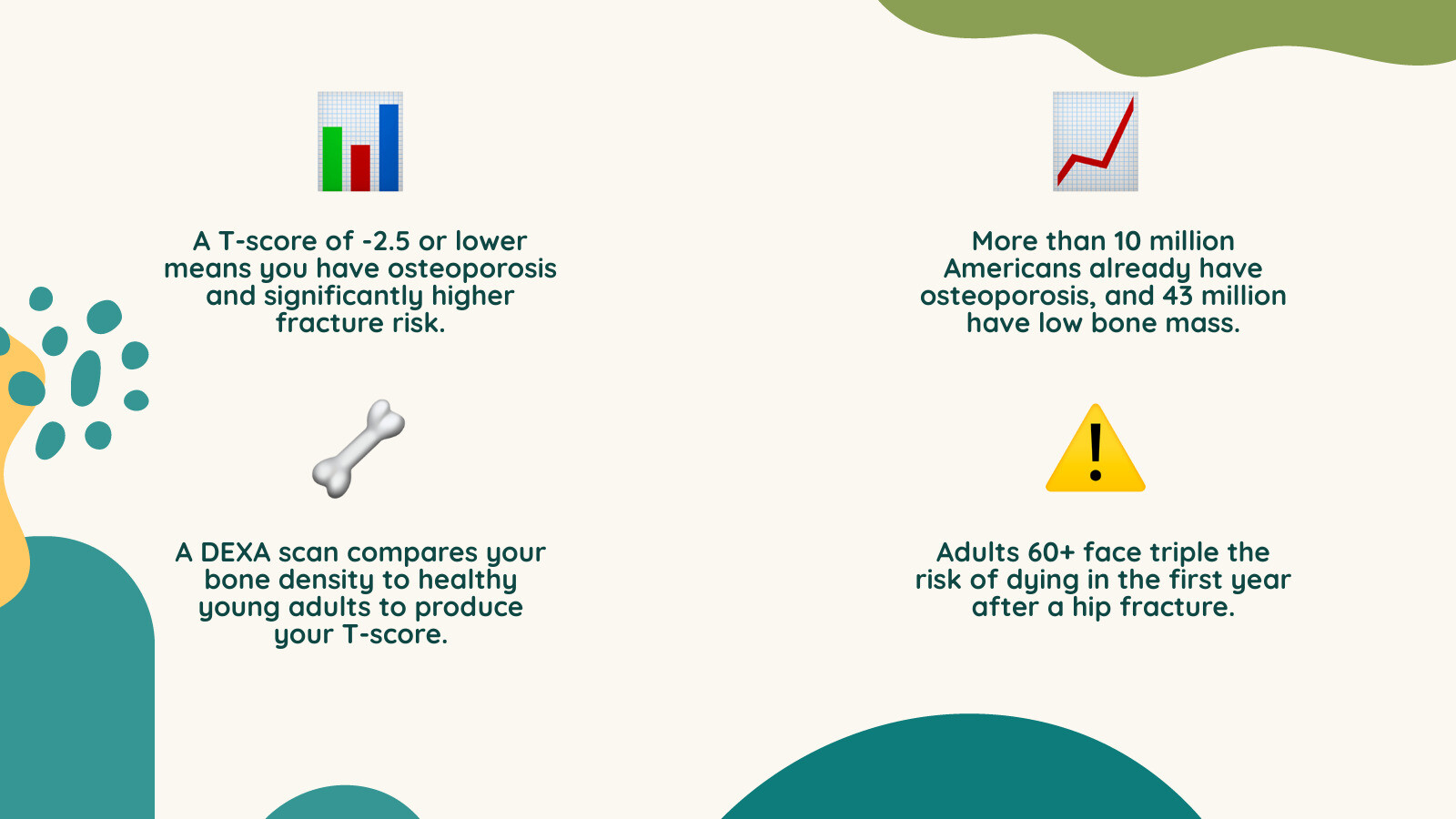
More than 10 million Americans already have osteoporosis, and another 43 million are estimated to have low bone mass. Fractures from weaker bones can have serious consequences: in adults 60 and older, hip fractures are associated with a nearly twofold higher risk of death in the following year, an association that likely also reflects related health complications and frailty.
The good news? A bone density test can catch bone loss before a fracture happens — giving you and your doctor time to act.
This guide explains exactly what your results mean, which numbers matter most, and what steps to take next.
What is a Bone Density Test and How Does It Work?
A bone density test measures the strength of your bones. The most common and accurate method is a central dual-energy X-ray absorptiometry scan, also known as a DEXA scan. This specialized imaging test uses two low-dose X-ray beams to tell the difference between your bones and the soft tissues around them.
Standard X-rays can only detect bone weakness after a significant amount of bone has already been lost. A DEXA scan can spot very small drops in bone strength much earlier. This early detection gives you a chance to take action before a fracture occurs.
During the test, you lie on a padded table while a scanner passes over your body. The test usually takes about 10 minutes. It is completely painless and non-invasive.
Many people worry about radiation during medical scans. A DEXA scan uses an extremely small amount of radiation. The exposure is less than what you would receive during a cross-country airplane flight, or equivalent to about one day of natural background radiation at sea level.
To learn more about how this technology works, you can read about Bone Densitometry from Johns Hopkins Medicine.
Understanding Your T-Score and Z-Score
When you receive your bone density report, you will see two primary numbers: a T-score and a Z-score. Understanding the difference between these two numbers is the key to learning how to interpret bone density results.
Your T-score is the most important number for diagnosing bone thinning. This score shows how much your bone density differs from the average bone density of a healthy 30-year-old. Doctors use a young adult baseline because that is when human bones reach their peak strength.
The T-score is measured in standard deviations, which are simply units of measurement that show how far your score is from the average. Every one standard deviation drop in your T-score means your bone density has decreased by about 10% to 12%, which roughly doubles your risk of breaking a bone.
Your Z-score compares your bone density to the average bone density of people who are your same age, sex, and ethnic background.
- If your Z-score is normal (above -2.0): Your bone loss is likely a result of the normal aging process.
- If your Z-score is low (-2.0 or lower): Your bone density is below the expected range for your age. This is a warning sign that something other than normal aging may be causing you to lose bone. Your doctor may run blood tests to check for underlying issues like vitamin D deficiency, hormone imbalances, or side effects from medications.
For a detailed breakdown of these scores, visit the guide on Bone Mineral Density Tests from the National Institutes of Health.
Reading Your Results at Different Skeletal Sites
A central DEXA scan does not measure every bone in your body. Instead, it focuses on specific areas that are most likely to break if you have osteoporosis. The standard skeletal sites measured are:
- The Lumbar Spine: Your lower back (specifically vertebrae L1 through L4). This area is highly prone to compression fractures, which can cause loss of height or a stooped posture.
- The Hip: This includes the femoral neck (the narrow part of the thigh bone just below the joint) and the total hip. Hip fractures are the most serious type of bone break in older adults.
- The Forearm: Specifically measured at the 33% radius of your non-dominant arm.
Doctors do not always measure the forearm. According to the International Society for Clinical Densitometry, a forearm measurement is only used under specific conditions. These include when your hip or spine cannot be accurately scanned due to severe arthritis or surgery, when a patient exceeds the weight limit of the DEXA table, or in cases of hyperparathyroidism (a condition where overactive glands cause the body to lose calcium).
For more details on professional scanning standards, read the Official Adult Positions from the International Society for Clinical Densitometry.
How Doctors Diagnose Osteoporosis From Your Scores
Doctors use your lowest T-score from the lumbar spine, femoral neck, or total hip to make a diagnosis.
- Normal Bone Density: A T-score of -1.0 or higher.
- Low Bone Mass (Osteopenia): A T-score between -1.0 and -2.5. This means your bones are weaker than average, but you do not have osteoporosis. It is an early warning sign to start protecting your bones.
- Osteoporosis: A T-score of -2.5 or lower. At this stage, your bones have lost significant strength and are much more fragile.
It is important to know that you can also be diagnosed with osteoporosis even if your T-score is better than -2.5. If you are over the age of 50 and have experienced a fragility fracture — a bone that breaks from a minor fall, such as falling from standing height — you may be diagnosed with osteoporosis regardless of what your scan says.
To learn more about these diagnostic categories, you can review the Bone mineral density test entry in the MedlinePlus Medical Encyclopedia.
Assessing Fracture Risk with FRAX and Other Tools
While a T-score tells you how dense your bones are, it does not tell the whole story. Your risk of breaking a bone is also shaped by your "bone quality," which includes the inner structure and flexibility of your bones.
To get a more complete picture of your bone health, doctors may use a tool called the FRAX calculator. FRAX stands for Fracture Risk Assessment Tool. It is an online program developed by the WHO Collaborating Centre at the University of Sheffield that combines your T-score with other important personal health details, such as:
- Your age and sex
- Your history of previous fractures
- Whether your parents have broken a hip
- Whether you smoke or drink alcohol regularly
- Whether you take oral steroid medications like prednisone
The FRAX tool calculates your 10-year probability of breaking a bone. It gives you two percentages: your risk of a major osteoporotic fracture (in your spine, hip, shoulder, or wrist) and your risk of a hip fracture.
Doctors generally recommend starting bone-strengthening treatments if your FRAX 10-year risk of a major fracture is 20% or higher, or if your 10-year risk of a hip fracture is 3% or higher.
Who Should Get Tested and How Often?
Bone loss is silent. You cannot feel your bones getting weaker, which is why screening is so important.
The U.S. Preventive Services Task Force recommends routine bone density testing for:
- All women aged 65 and older
- Women under 65 who are postmenopausal and have higher osteoporosis risk, such as low body weight, family history of fractures, or smoking
Note: Screening recommendations for men are covered separately. Guidance to screen men aged 70 and older comes from organizations such as the Bone Health and Osteoporosis Foundation and AACE/ACE.
For most people, bone density changes very slowly. Because of this, repeating a scan too quickly is rarely helpful. The standard recommendation is to wait at least two years between bone density scans. This two-year interval gives your body enough time to show real, measurable changes in bone strength, and it helps your doctor see if your treatment plan is working.
Medicare covers bone mass measurements once every 24 months for qualified individuals who meet specific criteria, such as being at risk for osteoporosis or taking medications that can cause bone loss.
Frequently Asked Questions about Bone Density Results
What is the difference between osteopenia and osteoporosis?
The main difference is the severity of the bone loss. Think of osteopenia (which clinical guidelines now prefer to call "low bone mass") as a warning zone. Your bones are thinner than they should be, but they are not yet brittle. Many people with low bone mass never develop osteoporosis.
Osteoporosis is an actual disease where the bones have become so fragile that everyday activities — like lifting a bag of groceries, bending over, or even a strong sneeze — can cause a bone to break.
Can arthritis or spinal issues affect my bone density results?
Yes. Spinal abnormalities like severe osteoarthritis, bone spurs, or scoliosis can artificially raise your spine T-score. This happens because the DEXA scanner cannot tell the difference between healthy bone tissue and the extra calcium build-up caused by arthritis.
If you have severe arthritis in your lower back, your spine T-score may look much healthier than it actually is. To prevent an incorrect diagnosis, a radiologist will look at the individual vertebrae (L1 through L4) and may exclude specific bones from the final calculation if there is more than a 1.0 T-score difference between adjacent vertebrae.
How often should I repeat my bone density scan?
For most adults, repeating the scan every two years is the ideal timeframe. This allows your doctor to monitor your bone health and see if lifestyle changes, exercises, or medications are successfully preserving your bone strength. If you are taking a new osteoporosis medication, your doctor may recommend a follow-up scan in one to two years to ensure the treatment is working.
Key Takeaways for Reading Your Results
Understanding how to interpret bone density results is the first step toward taking control of your health. Your T-score, Z-score, and FRAX results are valuable tools that help you and your doctor build a personalized plan to protect your bones and prevent falls.
If you have been diagnosed with low bone mass or osteoporosis, you do not have to navigate your journey alone. Groove Health offers a comprehensive, Medicare-covered bone health program. The program pairs you with a specialized doctor and a personal physical therapist to help you build bone strength, improve your balance, and lower your risk of fractures through safe, home-based care.
To find out if you qualify, you can Check your eligibility for Groove Health.
Works Cited
- National Institute of Arthritis and Musculoskeletal and Skin Diseases "Bone Mineral Density Tests: What the Numbers Mean." NIAMS, 2023.
- International Society for Clinical Densitometry "2023 ISCD Official Positions – Adult." ISCD, 2023.
- Centers for Disease Control and Prevention "Keep on Your Feet – Preventing Older Adult Falls." CDC, 2024.
- Centers for Medicare & Medicaid Services "Bone Mass Measurements." Medicare.gov, 2026.
- Wright NC, Looker AC, Saag KG, et al. "The Recent Prevalence of Osteoporosis and Low Bone Mass in the United States Based on Bone Mineral Density at the Femoral Neck or Lumbar Spine." Journal of Bone and Mineral Research, 2014.
- Hung WW, Egol KA, Zuckerman JD, Siu AL. "Hip Fracture Management: Tailoring Care for the Older Patient." JAMA, 2012.
- Camacho PM, Petak SM, Binkley N, et al. "American Association of Clinical Endocrinologists/American College of Endocrinology Clinical Practice Guidelines for the Diagnosis and Treatment of Postmenopausal Osteoporosis – 2020 Update." Endocrine Practice, 2020.
- Cummings SR, Bates D, Black DM. "Clinical Use of Bone Densitometry: Scientific Review." JAMA, 2002.
This content is for informational purposes only and does not constitute medical advice. Consult a qualified healthcare professional for diagnosis and treatment. If you are on Medicare and interested in a personalized bone health program, you can check your eligibility at groovehealth.com.