
A – Z Guide to DEXA Medicare Guidelines 2026
Medicare Part B pays for a DEXA bone density scan every 24 months at no cost to you, but only if you meet one of five specific conditions. Here is who qualifies, what it costs, and which billing codes matter.
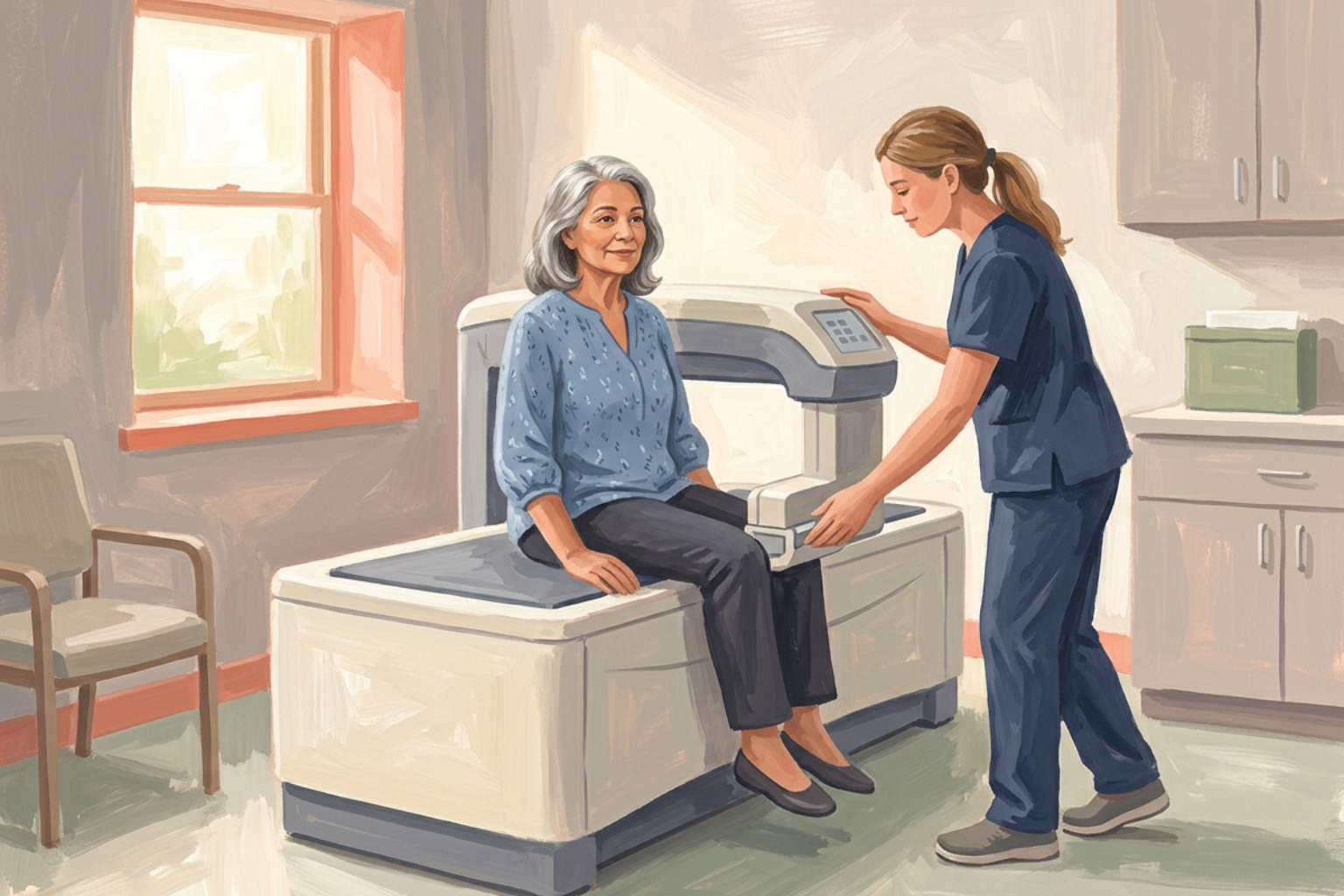
What the DEXA Medicare Guidelines 2026 Actually Mean for You
DEXA Medicare guidelines 2026 cover bone mass measurements under Medicare Part B as a preventive service, with $0 out-of-pocket cost when your provider accepts Medicare assignment. Here is what you need to know at a glance:
- Who qualifies: Adults who meet at least one of five clinical criteria (see below)
- How often: Once every 24 months, or more often if medically necessary
- What you pay: $0 if your provider accepts Medicare assignment
- What test is covered: A DEXA scan (dual-energy X-ray absorptiometry, the standard imaging tool for measuring bone density) of the spine, hip, or forearm
- Where to confirm: Medicare.gov covers bone mass measurements under Part B as a preventive service
The five qualifying conditions at a glance:
| Condition | Example |
|---|---|
| Estrogen deficiency (a lack of the hormone that protects bones from breaking down) with osteoporosis risk | Postmenopausal woman, early menopause |
| X-ray showing bone loss, fracture, or osteopenia (mild bone thinning) | Vertebral changes found on imaging |
| Long-term steroid or prednisone use | Taking prednisone now or planning to |
| Primary hyperparathyroidism (an overactive gland condition that pulls calcium out of your bones) | Overactive parathyroid gland diagnosis |
| Monitoring osteoporosis drug therapy | Already taking an FDA-approved bone drug |
If you recently got a bone density result you are trying to make sense of, or you are wondering whether Medicare will pay for your next DEXA scan, you are not alone. The rules around coverage, billing codes, and frequency limits can feel like they were written for insurance specialists, not patients.
This guide breaks it all down in plain language: who qualifies, how often Medicare pays, what it costs, which billing codes matter, and what to do with your results once you have them.
Important DEXA Medicare guidelines 2026 terms:
Who Qualifies for a Medicare-Covered Bone Density Scan?
To get a bone density scan covered by Medicare, you cannot just request one. Your doctor must order the test, and you must meet at least one of the five official eligibility criteria.
According to Medicare bone health coverage rules, Medicare covers bone mass measurements for "qualified individuals." Let's look at who qualifies under Does Medicare Cover DEXA Bone Density Scans? to see if you fit the criteria.
Estrogen Deficiency and Menopause
For women, estrogen acts like a shield. It slows down the cells that break down bone. When women go through menopause, their estrogen levels drop, which can cause bones to thin quickly.
Medicare covers bone density testing for women whose doctors determine they are estrogen-deficient and at risk for osteoporosis, which is a disease that makes bones weak and brittle. This includes women who experience premature menopause, which means menopause that occurs before age 45. If you are at risk due to hormone changes, you can learn more from the Endocrine Society Osteoporosis Resource.
Long-Term Steroid Use
Steroids like prednisone or other glucocorticoids, which are strong medications used to reduce swelling and treat autoimmune conditions, can cause rapid bone loss.
Medicare covers bone density scans if you are currently taking these steroid-type drugs or plan to begin this treatment. Medicare's rule is specific: the therapy must be equivalent to an average of 5 mg of prednisone or more per day, and your doctor must expect it to last more than three months. You can read more about how steroids affect bone health on the NIAMS Osteoporosis Overview page.
Other qualifying conditions include:
- Primary hyperparathyroidism: This is a condition where your parathyroid glands, which are tiny glands in your neck, produce too much hormone. This causes calcium to leave your bones and enter your blood, making your bones weak.
- Osteoporosis drug monitoring: If you are already taking an FDA-approved medication to treat osteoporosis, Medicare covers scans to see if your drug therapy is working.
- Vertebral fractures: If an X-ray of your spine shows signs of a fracture, osteopenia (mild bone thinning), or osteoporosis, Medicare covers a DEXA scan to confirm the diagnosis and measure the severity.
How Often Does Medicare Cover a Bone Density Scan?
Under the standard guidelines, Medicare Part B covers a preventive bone density scan once every 24 months.
However, the administrative rule is often called the "23-month rule." This means that at least 23 full months must pass after the month of your last covered scan before you can get your next routine screening. Keeping track of this timeline is the best way to avoid unexpected bills. You can read more about this timing on our guide to DEXA Scan Frequency.
When Medicare Pays for a Scan Sooner Than 24 Months
Medicare may pay for more frequent bone density scans if your doctor documents that a repeat test is medically necessary.
Common reasons for more frequent testing include:
- You have started a new steroid treatment that raises your risk of rapid bone loss.
- Your doctor needs to monitor whether an FDA-approved osteoporosis medication is working.
- You have a medical condition that causes fast bone thinning, such as chronic kidney disease or rheumatoid arthritis.
To make sure an early scan is covered, your doctor must submit detailed medical records showing why the extra scan is needed. You can review the clinical criteria in the Medicare Benefit Policy Manual, Chapter 15, Section 80.5.
Understanding Your Costs and Billing Codes Under Medicare Part B
The cost of your DEXA scan depends on whether you have Original Medicare or a Medicare Advantage plan, and whether your doctor "accepts assignment." Accepting assignment means your doctor agrees to accept the Medicare-approved amount as full payment for the service.
| Insurance Type | Out-of-Pocket Cost | Deductible | Key Requirement |
|---|---|---|---|
| Original Medicare (Part B) | $0 | Does not apply | Provider must accept assignment |
| Medicare Advantage (Part C) | $0 (usually) | May apply | Must use an in-network facility |
If your doctor does not accept Medicare assignment, they can charge more than the Medicare-approved amount. In that case, you might have to pay a portion of the bill. To learn how to avoid these extra fees, read about DEXA Medicare Part B Coverage.
CPT Codes and Billing Rules for Bone Density Scans
Medical billers use CPT codes, which are standard five-digit numbers, to tell Medicare what services you received.
The main CPT codes for bone density studies include:
- CPT 77080: This code is used for a central DEXA scan, which measures bone density in your hip, spine, or forearm.
- CPT 77081: This code is used for a peripheral DEXA scan, which measures bone density in your wrist, heel, or finger.
- CPT 77085: This code is used when a doctor performs both a central DEXA scan and a vertebral fracture assessment (VFA) during the same session.
- CPT 77086: This code is used for a vertebral fracture assessment on its own.
Medicare has strict bundling rules. For example, you cannot bill CPT 77080 and CPT 77086 separately for the same visit. Instead, the provider should use the combined code CPT 77085.
Additionally, Medicare does not cover bone density scans performed by portable X-ray suppliers. The test must be done in an approved facility with permanent equipment. You can find more technical details in the CMS Billing and Coding article for Bone Mass Measurement (A57132) and the official CMS Local Coverage Determination Guidelines.
ICD-10 Diagnosis Codes That Support Medical Necessity
To prove that your scan is medically necessary, your doctor must include specific ICD-10 diagnosis codes on the claim form.
Some of the most common codes include:
- Z79.83: Long term (current) use of bisphosphonates. CMS lists this code for DXA testing while you are taking medicine for osteoporosis or osteopenia.
- Z79.52: Long term (current) use of systemic steroids. Take care not to substitute Z79.51, which CMS defines as long term use of inhaled steroids.
- Z90.721 and Z90.722: Acquired absence of ovaries, unilateral and bilateral. CMS directs that one of these be reported for women after an oophorectomy.
If your doctor uses a general screening code instead of a specific diagnostic code when you have a qualifying condition, the claim might be denied. For help understanding how these codes relate to your health records, read our guide on Interpreting DEXA Scan Results.
How to Build Stronger Bones After Your DEXA Scan
Getting your DEXA scan is just the first step. Once you know your bone density, you can take action to protect your skeleton.
To build new bone, your body needs to experience physical resistance that is heavy enough to signal that your skeleton needs to grow stronger.
Research suggests that heavy resistance training is a highly effective way to create this healthy stress on your bones. This means lifting heavier weights for a low number of repetitions, rather than lifting very light weights many times. While light weights and resistance bands help build muscle and coordination, they do not provide enough force to stimulate bone growth.
To strengthen your hip and spine, focus on exercises that target these specific areas:
- Squats and Lunges: These movements put healthy physical demand on your hips and thighs.
- Hip Hinges: Movements like Romanian deadlifts teach you to bend at your hips while keeping your back long and straight, which safely strengthens your spine.
- Spinal Extension: Gently arching or straightening your back helps strengthen your spine muscles. You should avoid rounding your back forward while holding weights, as this can increase the risk of a spine fracture.
Power is also important. Power is strength combined with speed. It is what helps you react quickly to catch yourself if you stumble. Safe, low-impact power movements like gentle hopping or stepping quickly can help, but you should always clear these movements with a professional first.
Finally, balance training is essential for preventing falls. According to the CDC Older Adult Falls resource, most hip fractures are caused by falls. Balance training should progress from static balance (holding still on one leg) to dynamic balance (moving safely while balancing), which prepares your body for real-world movements.
Frequently Asked Questions About Medicare DEXA Coverage
Does Medicare cover bone density scans for men?
Yes, but the criteria are different. While women can qualify based on estrogen deficiency, Medicare does not cover bone density scans for men based solely on hypogonadism (low testosterone), despite its link to bone loss. Medicare has no age-based rule for men: a man qualifies only by meeting one of the same five conditions, most often long-term steroid therapy, primary hyperparathyroidism, an X-ray suggesting osteoporosis, or monitoring of an osteoporosis drug. Clinical guidelines do advise screening men from age 70, but that is a practice recommendation, not a Medicare coverage criterion. For more details, see How to Interpret Bone Density.
What is the difference between a T-score and a Z-score?
Your DEXA report will show two main scores:
- T-score: This compares your bone density to a healthy 30-year-old adult. A T-score of -1.0 or higher is normal. A score between -1.0 and -2.4 indicates osteopenia (mild thinning), and a score of -2.5 or lower indicates osteoporosis.
- Z-score: This compares your bone density to other people of your same age, sex, and ethnic background.
To learn more about what these numbers mean for your fracture risk, read T-Score Meaning Explained Simply.
Does Medicare cover whole-body DEXA scans for body composition?
No. While the same DEXA machine can be used to measure body fat and muscle mass, Medicare only covers DEXA scans that measure bone mineral density to screen for or monitor osteoporosis. Scans used solely to determine body composition are considered investigational and are not covered. You can read the policy details in the Medicare bone mass measurement coverage rules document.
Turning Your DEXA Results Into a Bone-Building Plan
Understanding DEXA Medicare guidelines 2026 helps you access the preventive bone density scans you need without unexpected costs. However, getting your DEXA scan results is only the beginning. Once you know your bone density, the most critical step is taking action to protect your skeleton and prevent future injuries.
Groove Health directly supports this next step by offering a Medicare-covered bone health program designed to turn your DEXA results into a practical, life-changing plan. Through personalized exercise plans, Groove Health helps older adults build bone strength and prevent fractures where they are most vulnerable. When you join, a dedicated physical therapist designs a progressive exercise program tailored specifically to your physical ability, guiding you safely toward the resistance training your bones need to grow stronger while incorporating balance training to prevent falls.
To take the first step in your bone health journey, check out Grooves Osteoporosis Starter Guide.
Works Cited
- Centers for Medicare & Medicaid Services. "Medicare Benefit Policy Manual, Chapter 15, Section 80.5: Bone Mass Measurements." CMS Pub. 100-02, 2007.
- Centers for Medicare & Medicaid Services. "Billing and Coding: Bone Mass Measurement (A57132)." CMS Medicare Coverage Database.
- Centers for Medicare & Medicaid Services. "Billing and Coding Guidelines L34639: Bone Mass Measurement." CMS Medicare Coverage Database.
- Centers for Medicare & Medicaid Services. "Bone Mass Measurements." Medicare.gov.
- Watson, S. L., Weeks, B. K., Weis, L. J., Harding, A. T., Horan, S. A., and Beck, B. R. "High-Intensity Resistance and Impact Training Improves Bone Mineral Density and Physical Function in Postmenopausal Women With Osteopenia and Osteoporosis: The LIFTMOR Randomized Controlled Trial." Journal of Bone and Mineral Research, 2018.
- Moreland, B. L., Legha, J. K., Thomas, K. E., and Burns, E. R. "Hip Fracture-Related Emergency Department Visits, Hospitalizations and Deaths by Mechanism of Injury among Adults Aged 65 and Older, United States 2019." Journal of Aging Health, 2023.
This content is for informational purposes only and does not constitute medical advice. Consult a qualified healthcare professional for diagnosis and treatment. If you are on Medicare and interested in a personalized bone health program, you can check your eligibility at groovehealth.com.