The Complete Guide to T-Score Osteopenia Range
A T-score between -1.0 and -2.5 puts you in the osteopenia range. Here is what that number means for your fracture risk, how doctors use FRAX alongside it, and the nutrition and training that rebuild bone.
What the T-Score Osteopenia Range Chart Actually Tells You
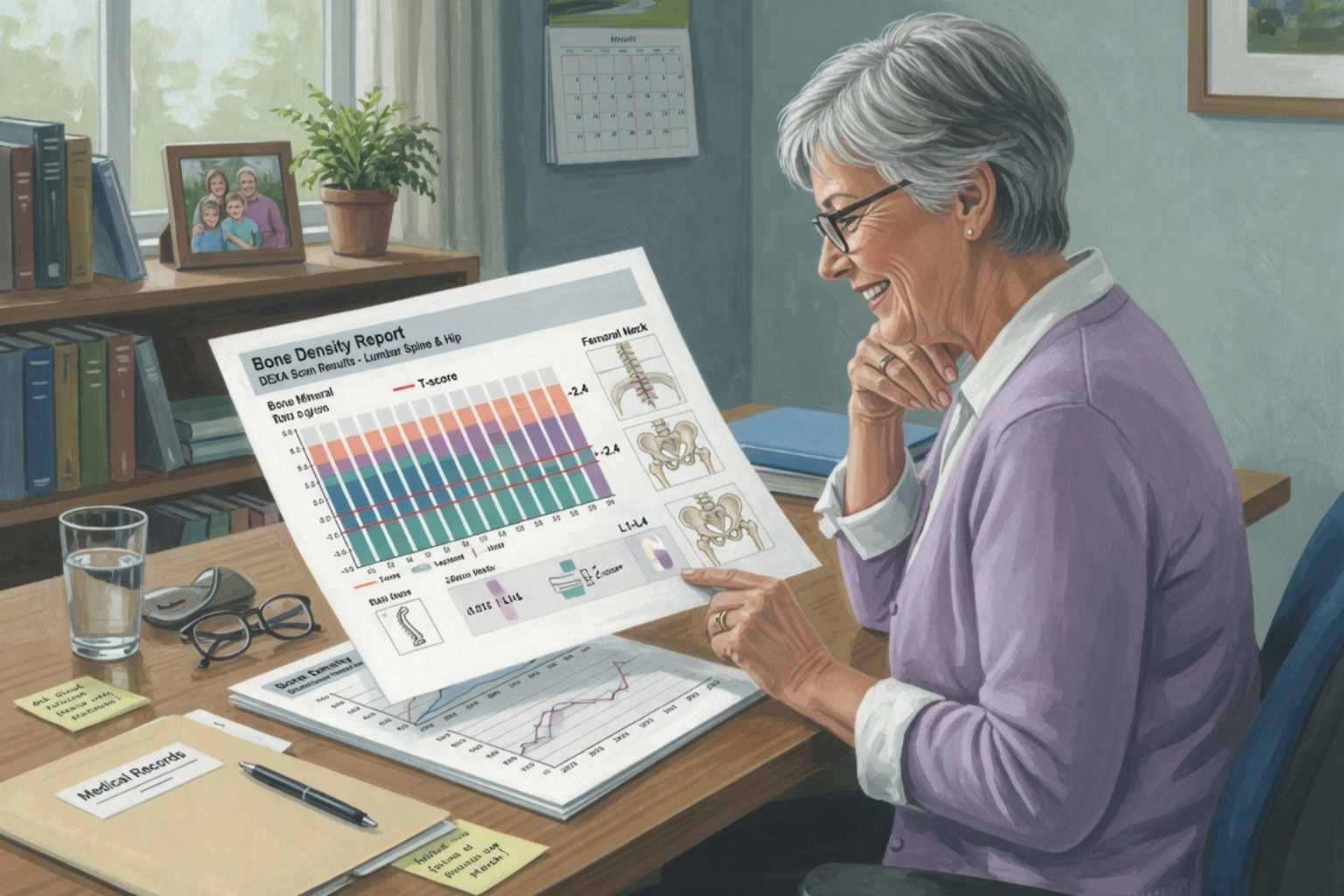
The T-score osteopenia range chart is the key to understanding your DEXA scan results. A DEXA scan (short for dual-energy X-ray absorptiometry) is a quick, painless X-ray that measures how strong and dense your bones are. The result comes back as a number called a T-score, and that number tells your doctor which category your bone density falls into.
Here is what the chart looks like:
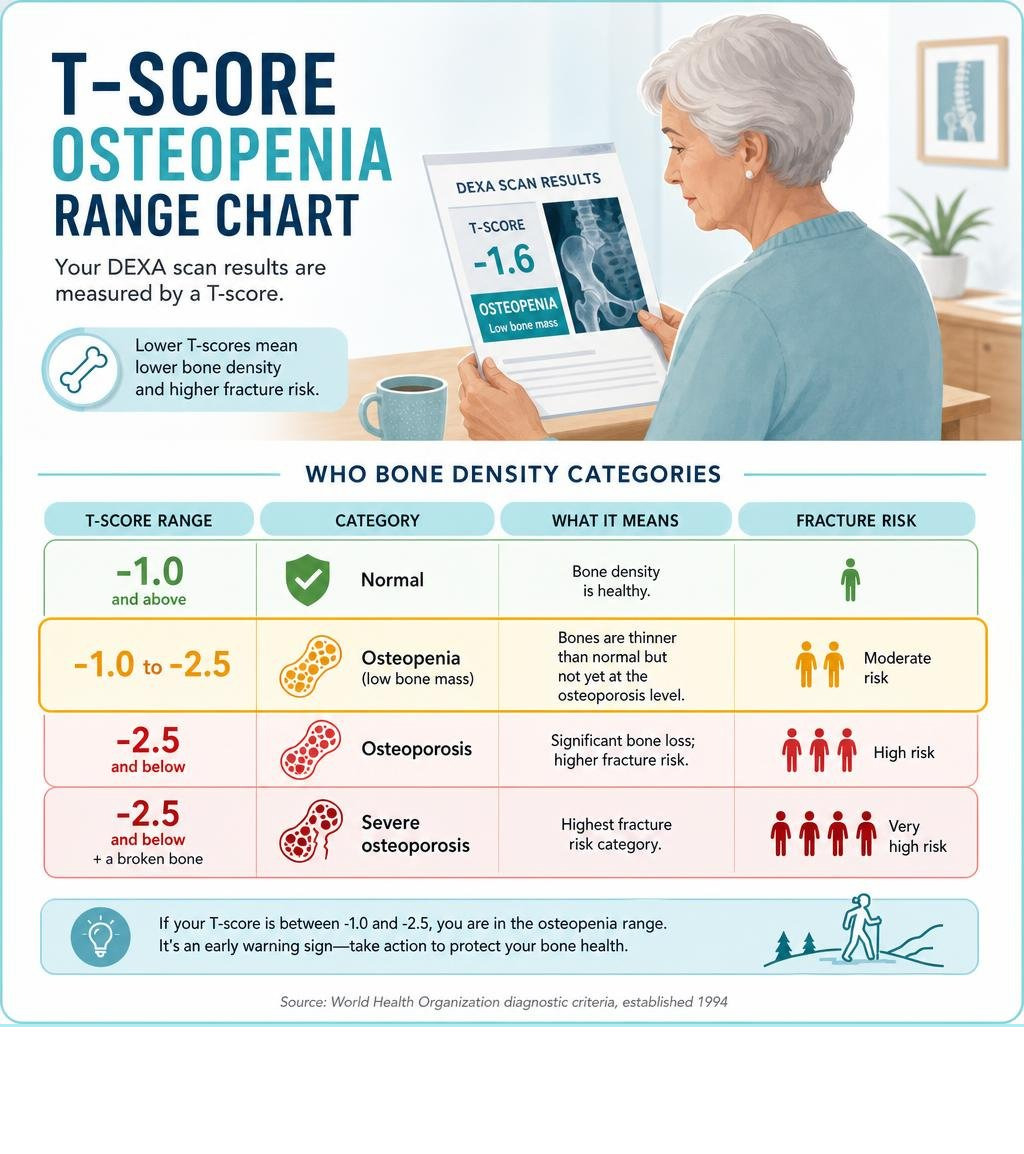
| T-Score Range | Category | What It Means |
|---|---|---|
| -1.0 and above | Normal | Bone density is healthy |
| -1.0 to -2.5 | Osteopenia (low bone mass) | Bones are thinner than normal but not yet at the osteoporosis level |
| -2.5 and below | Osteoporosis | Significant bone loss; higher fracture risk |
| -2.5 and below + a broken bone | Severe osteoporosis | Highest fracture risk category |
Source: World Health Organization diagnostic criteria, established 1994
If your T-score is between -1.0 and -2.5, you are in the osteopenia range. That means your bones are thinner than what is typical for a healthy young adult, but you have not yet crossed into osteoporosis territory. It is an early warning sign, not a crisis, but it is worth taking seriously.
About 43.3 million U.S. adults over 50 have bone density in this range, according to recent estimates. You are far from alone.
What many people find surprising is that most broken bones from everyday falls, what doctors call fragility fractures, actually happen in people with osteopenia-level bone density, not full osteoporosis. That is largely because there are so many more people in the osteopenia range. It is one reason your doctor will not just look at your T-score in isolation, but will likely factor in your age, health history, and your DEXA T-score fracture risk before deciding what comes next.
If you are still learning how to interpret bone density, the most important thing to know is that osteopenia is not automatically a medication diagnosis. Your doctor may also use a tool called the FRAX score to estimate your 10-year fracture risk and decide when to start osteoporosis treatment.
This guide walks you through all of it in plain language.
Understanding What Your Bone Density Number Actually Means
To understand your bones, it helps to understand what the T-score actually measures. Your bone density changes throughout your life. It is not a static number. Your bones are living tissue that constantly break down and rebuild.
When you get a DEXA scan, the machine measures your bone mineral density, which is the amount of calcium and other minerals packed into your bones. The scan typically focuses on your hip and spine, as these are the areas most likely to break if you fall.
To see how your results are classified, you can look at the World Health Organization Criteria for Bone Density. This standard helps doctors put your results into clear categories. For more help reading your scan, check out this guide on Interpreting DEXA Scan Results.
How to Read a T-Score Osteopenia Range Chart
A T-score compares your bone density to the peak bone density of a healthy 30-year-old of your same sex.
A T-score of 0 means your bone density is exactly equal to that young adult average. If your score is a positive number, like +1.0, your bones are stronger than average. If your score is a negative number, your bones are thinner.
Each step down of -1.0 is called a standard deviation. In plain terms, each standard deviation represents roughly a 10% to 12% loss of bone mass. So, a T-score of -2.0 means you have lost about 20% to 24% of your bone density compared to when you were at your peak.
Why Your Doctor Relies on These Categories
Your doctor uses these categories to guide your care. Because bone loss happens slowly and has no symptoms, the T-score acts like a warning light on your car's dashboard.
If your score is in the normal range, you simply want to maintain what you have. If your score falls into the osteopenia range, your doctor will want to look at why your bones are thinning and how to prevent them from getting weaker. If your score falls to -2.5 or lower, you have crossed into osteoporosis, and your doctor may discuss medications to help rebuild your bone strength.
Average T-Scores by Age for Women and Men
Most people reach their peak bone mass between the ages of 25 and 30. After age 40, we all start to slowly lose bone density as a natural part of aging.
For women, this process speeds up during the menopausal transition, usually between ages 50 and 60. During this time, women can lose up to 10% of their bone mass in just a few years. This happens because estrogen levels drop. Estrogen acts like a shield, slowing down the cells that break down bone. When that shield weakens, bone loss speeds up. In healthy bone remodeling, cells called osteoclasts break down old bone, while cells called osteoblasts build new bone. Estrogen helps keep this process in balance by keeping the bone-breaking cells in check; when estrogen drops, the bone-breaking cells outpace the bone-building cells, leading to rapid bone loss.
By age 65, the average lumbar spine T-score for a woman is between -1.5 and -2.2. By age 80, about 27% of women have osteopenia, and 70% have osteoporosis.
Men also lose bone density as they age, but their decline is more gradual. Testosterone helps protect male bones, and because testosterone declines slowly over time rather than dropping suddenly, men tend to develop thinning bones later in life. Still, by age 50, about 30% of men have low bone mass.
To learn more about how these numbers change, you can read the Osteopenia Clinical Reference.
T-Score vs. Z-Score: What is the Difference?
When you look at your DEXA report, you will see two different scores: a T-score and a Z-score. It is easy to confuse the two, but they serve very different purposes.
While your T-score compares your bones to a healthy 30-year-old, your Z-score compares your bones to typical people of your same age, sex, and ethnic background. To learn how to make sense of both numbers, see this article on How to Interpret Bone Density.
When is a Z-Score Used Instead of a T-Score?
For older adults, the T-score is the most important number because it tells us your absolute bone strength and your actual risk of breaking a bone.
However, for premenopausal women and younger men, doctors look at the Z-score instead. If a Z-score is -2.0 or lower, it means your bone loss is much worse than expected for your age. This is a warning sign that something other than normal aging is causing your bone loss, which doctors call secondary osteoporosis. This could be caused by thyroid problems, vitamin deficiencies, or certain medications like steroids.
Factors That Can Cause Falsely Elevated or Lowered Results
DEXA scans are highly accurate, but certain things can skew the results. For example, spinal arthritis can cause extra bone growths called bone spurs. The DEXA scanner cannot tell the difference between healthy bone and arthritis buildup, so it might show a falsely high T-score, making your spine look stronger than it actually is.
Other factors that can affect your results include:
- Metal hardware in your spine or hips from past surgeries
- Lying in the wrong position during the scan
- Differences in calibration between different DEXA machines
To get the most accurate picture, doctors often recommend scanning both hips simultaneously, since bone density can vary between your left and right sides.
How Your T-Score and FRAX Score Predict Fracture Risk
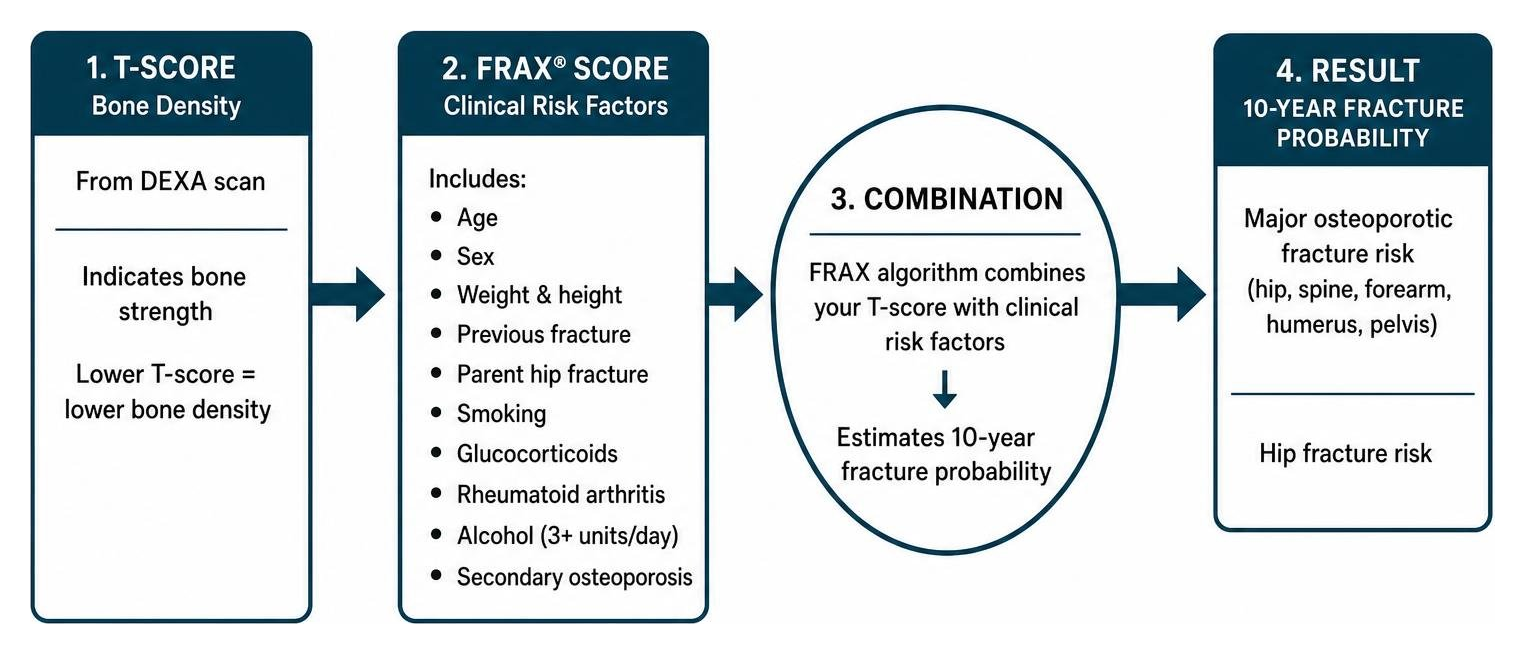
Your T-score is a great tool, but it does not tell the whole story. Your actual risk of breaking a bone depends on many factors, including your age, your balance, and whether you have fallen recently.
To understand how your specific T-score relates to your risk, you can read DEXA T-Score Fracture Risk.
What Each Standard Deviation Below Normal Means
As your T-score drops, your risk of a break rises quickly.
- A T-score of -1.0 carries about double the risk of a break compared to a normal score of 0.
- A T-score of -2.0 carries about four times the risk of a break.
- A T-score of -2.5 or lower carries four to eight times the risk.
This is why even a small drop in your T-score is worth paying attention to.
How the FRAX Score Guides Treatment Decisions
To help make treatment decisions, doctors use a tool called FRAX (Fracture Risk Assessment Tool). FRAX is a questionnaire that combines your T-score with other important health details, such as your age, family history of hip fractures, smoking habits, and alcohol use.
The FRAX tool calculates your absolute risk: the exact percentage chance that you will break a bone in the next 10 years.
According to medical guidelines, if your FRAX score shows a 10-year risk of 3% or higher for a hip break, or 20% or higher for any major bone break (like your spine, wrist, or shoulder), your doctor may recommend starting medication, even if your T-score is only in the osteopenia range.
When to Get Screened or Retested for Osteopenia
The U.S. Preventive Services Task Force recommends that all women have a bone density test starting at age 65. If you are a postmenopausal woman under 65 with extra risk factors, such as a family history of broken bones, you should get screened sooner.
If your scan shows normal bone density, you may not need another scan for 5 to 10 years. However, if your results show osteopenia, your doctor will likely recommend a follow-up scan every 2 to 5 years to monitor your bone health and ensure your bones are not thinning too quickly.
Practical Steps to Strengthen Your Bones and Prevent Falls
If your T-score is in the osteopenia range, there is a lot you can do to protect your bones. You do not have to just sit back and watch your bones thin.
Nutrition and Lifestyle Interventions for Thinning Bones
Your bones need the right building blocks to stay strong.
- Calcium: Postmenopausal women and men over 70 should aim for 1,200 milligrams of calcium daily, ideally from foods like yogurt, leafy greens, and fortified foods.
- Vitamin D: You need 800 to 1,000 IU of vitamin D daily to help your body absorb that calcium.
- Lifestyle: Avoiding smoking and limiting alcohol to under two drinks a day can also slow down bone loss.
Heavy Resistance Training and the Osteogenic Load
To actually build new bone, you have to challenge your skeleton. Light activity like walking is great for your heart, but it does not create enough force to trigger bone growth.
Your bone cells that build new bone are called osteoblasts (the cells that lay down new bone). To get these cells to work, you need an osteogenic load, which means a load heavy enough to grow bone.
Studies show that heavy resistance training is the most effective way to do this. This means lifting weights that are heavy enough that you can only lift them a few times (usually around 75% to 85% of your maximum strength), for low reps, a few days a week.
Large compound movements that load your hips and spine are best. These include squats, lunges, and hip hinges like Romanian deadlifts (RDLs). When doing a hip hinge, remember to bend from your hips while keeping your back long, not rounded.
Spinal extension exercises, where you gently arch or straighten your back, are safe and help strengthen your spine. You should avoid loaded spinal flexion, which means bending forward while holding weights, as this can increase the risk of a spine break.
Dynamic Balance and Fall Prevention
About 9 in 10 hip breaks are caused by a fall. Protecting your bones means preventing falls in the first place.
While strength training helps, you also need balance training. Dynamic single-leg balance work, where you move your body while balancing on one leg, challenges your balance the way real life does. Power training, which means strength plus speed, is also important. It helps you react quickly enough to catch yourself if you stumble.
If you want professional guidance, Groove Health can help. Through Groove Health's bone health and exercise program, a physical therapist designs a personalized, progressive exercise plan that safely builds your strength and balance, customized to your current abilities.
Frequently Asked Questions about Osteopenia
What is the difference between osteopenia and osteoporosis?
Osteopenia and osteoporosis are different stages of bone loss. Osteopenia means your bones are thinner than normal, with a T-score between -1.0 and -2.5. Osteoporosis is more advanced bone loss, diagnosed when your T-score drops to -2.5 or lower, meaning your bones are much weaker and more likely to break.
Do I need medication if my T-score is in the osteopenia range?
Not necessarily. Many people with osteopenia can manage their bone health through nutrition, lifestyle changes, and heavy resistance training. However, if your FRAX score shows a high 10-year risk of a break, or if you have already had a fragility fracture, your doctor may recommend medication.
Can walking alone strengthen my bones?
While walking is wonderful for your heart, muscles, and joint health, it does not provide enough load to stimulate the osteoblasts to build new bone. To strengthen your bones, you need to combine walking with progressive resistance training using heavier weights.
Turning an Osteopenia Result Into an Action Plan
A T-score in the osteopenia range is an opportunity to take control of your bone health. By understanding your numbers, working with your doctor, and focusing on heavy resistance training and balance, you can protect your lifestyle and stay active for years to come.
If you are on Medicare and want a personalized approach to your bone health, Groove Health can help. Our care model connects you with a physical therapist who designs a personalized, home-based exercise plan specifically tailored to build your bone strength and improve your balance, helping you prevent fractures and stay independent. You can see if you qualify for Groove Health's program today.
Start Your Bone Health Journey
Works Cited
- Lewiecki EM. Osteoporosis: Clinical Evaluation (Table: World Health Organization criteria for classification by bone mineral density). In: Endotext. MDText.com, Inc; 2024.
- Varacallo M, Seaman TJ, Jandu JS, Kaur J. Osteopenia. In: StatPearls. StatPearls Publishing; 2024.
- US Preventive Services Task Force. Screening for osteoporosis to prevent fractures: US Preventive Services Task Force recommendation statement. JAMA. 2025;333(6):498-508.
- International Society for Clinical Densitometry. 2023 ISCD Official Adult Positions. International Society for Clinical Densitometry; 2023.
- LeBoff MS, Greenspan SL, Insogna KL, et al. The clinician's guide to prevention and treatment of osteoporosis. Osteoporos Int. 2022;33(10):2049-2102.
- Kanis JA, Johnell O, Oden A, Johansson H, McCloskey E. FRAX and the assessment of fracture probability in men and women from the UK. Osteoporos Int. 2008;19(4):385-397.
- Watson SL, Weeks BK, Weis LJ, Harding AT, Horan SA, Beck BR. High-intensity resistance and impact training improves bone mineral density and physical function in postmenopausal women with osteopenia and osteoporosis: the LIFTMOR randomized controlled trial. J Bone Miner Res. 2018;33(2):211-220.
This content is for informational purposes only and does not constitute medical advice. Consult a qualified healthcare professional for diagnosis and treatment. If you are on Medicare and interested in a personalized bone health program, you can check your eligibility at groovehealth.com.