How Fast Does Osteoporosis Progress? A Timeline Guide
Osteoporosis rarely moves in weeks. It moves in years, with the fastest stretch arriving after menopause. Here is the stage-by-stage timeline, the T-score milestones that define each step, and the levers that slow it.

How Fast Does Osteoporosis Progress in Older Adults?
Osteoporosis usually gets worse gradually over years, not weeks or months. After age 65, untreated bone loss may average about 1% to 3% a year, but the pace varies widely. It can move faster with low starting bone density, a past fracture, long-term steroid use, smoking, poor nutrition, low physical activity, or health conditions that affect bone remodeling (the continuous cycle where the body removes old bone and builds new bone).
For many women, the fastest bone-loss phase happens during the first 5 to 7 years after menopause (when estrogen, a key hormone that protects bone strength, drops sharply). Bone loss often slows later, but fracture risk can still rise as bones become weaker and falls become more likely.
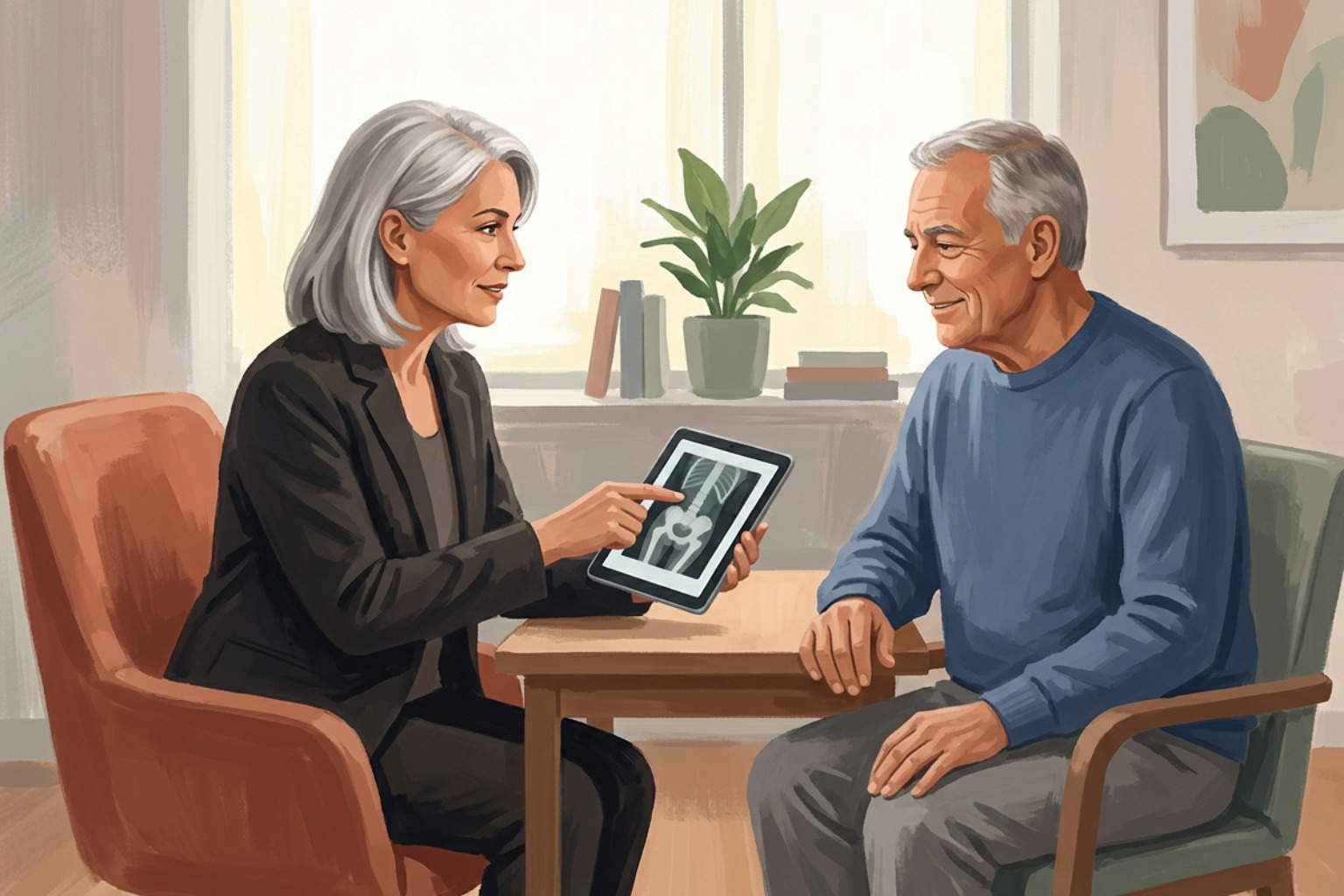
The practical next step is to track your T-score (a standard score comparing your bone density to a healthy young adult) and repeat dual-energy X-ray absorptiometry (DXA) scan on the schedule your clinician recommends. A combination of individualized medical treatment, safe strength and weight-bearing exercise, enough protein, calcium, and vitamin D can often slow bone loss and may improve bone density for some people.
If your latest scan showed osteopenia or osteoporosis, start with Groove's Osteoporosis Starter Guide to understand what your results mean and what to discuss with your care team.
The Typical Timeline: Bone Loss Rates by Life Stage
Bone loss typically progresses at a rate of 1% to 3% each year in older adults who are not receiving medical treatment. This slow, continuous loss occurs because the body breaks down old bone faster than it builds new bone.
Inside your body, bone is living tissue that constantly renews itself through a cycle called bone remodeling. Cells called osteoclasts remove old bone, while cells called osteoblasts build new bone matrix. In early adulthood, your body reaches its peak bone mass, which is the maximum density and strength your skeleton achieves. After age 30, osteoclasts slowly begin to outpace osteoblasts. In later decades, this imbalance leads to gradual thinning of the skeleton.
| Life Stage | Average Annual Bone Loss Rate | Primary Skeletal Driver |
|---|---|---|
| Early Adulthood (Ages 20–35) | 0% (Stable Peak Bone Mass) | Balanced bone formation and resorption |
| Premenopause (Ages 35–45) | ~0.5% to 0.6% per year | Slight natural slowdown in bone formation |
| Menopause Transition (First 5–7 years) | ~2% per year (up to 10%–20% total) | Rapid drop in protective estrogen levels |
| Older Adults (Ages 65+ Men and Women) | ~1% to 3% per year | Age-related decline in cellular activity and mineral absorption |

How Much Bone Do You Lose After Menopause?
Bone loss progresses at its most rapid pace during the first five to seven years following the menopausal transition, when women can lose up to 2% of their bone density each year.
During this window, the ovaries stop producing estrogen, a hormone that shields bone tissue by slowing down osteoclast activity. Without estrogen, bone breakdown speeds up significantly. This rapid loss affects trabecular bone, which is the spongy, honeycomb-like inner meshwork found inside the vertebrae and hip joints. Because the spine contains a large amount of trabecular bone, lumbar spine density can drop sharply. According to the Bone Health and Osteoporosis Foundation, accelerated bone loss in the spine substantially increases the risk of vertebral compression fractures, even during routine daily movements.
What Happens to Bone Density Without Treatment?
Without treatment, bone loss continues at an average pace of 1% to 3% per year in adults over age 65, steadily increasing the likelihood of a bone break.
As bones lose minerals and structural connectivity, thinning at the hip and femoral neck becomes particularly concerning. When older adults experience unmanaged bone loss alongside normal age-related changes in balance and muscle power, fracture probability rises every year. Understanding osteoporosis as a progressive condition allows you to take proactive steps before a minor slip or fall leads to a serious injury.
Stages of Bone Loss and T-Score Progression Timelines
Bone loss progresses through distinct clinical stages defined by your T-score, moving from normal bone to osteopenia and finally to osteoporosis over several years.
A dual-energy X-ray absorptiometry scan, commonly called a DEXA scan, is the standard test used to measure bone mineral density. A DEXA scan compares your bone density to that of a healthy young adult, generating a number known as a T-score. Medical organizations, including the World Health Organization, classify bone health into standard categories:
- Normal Bone Density: T-score of -1.0 or higher.
- Osteopenia (Low Bone Mass): T-score between -1.0 and -2.5.
- Osteoporosis: T-score of -2.5 or lower.
- Severe Osteoporosis: T-score of -2.5 or lower accompanied by one or more fragility fractures.
Understanding what T-scores and Z-scores mean in DEXA scans helps you and your physician track structural changes over time. Learning how to interpret bone density reports ensures you can spot significant downward trends early.
Transition from Normal Bone Density to Osteopenia
The shift from normal bone density to osteopenia generally takes several years, but the exact timeline depends on where your baseline score begins.
If your starting T-score sits near the higher end of normal (around 0.0), it may take 5 to 10 years of typical age-related loss to reach mild bone thinning. However, if your initial baseline T-score is already near -0.8 or -0.9, you may cross into osteopenia in less than two to three years without lifestyle support.
Progression from Osteopenia to Osteoporosis
Moving from osteopenia to osteoporosis often takes between 3 to 8 years, depending heavily on your starting T-score and personal health factors.
A patient with a mild baseline score of -1.2 will progress much more slowly than someone who starts at -2.2. A T-score below -2.5 reflects substantial microarchitectural deterioration inside the skeleton. When inner bone struts become thin and disconnect, the structural integrity of the bone weakens, making timely intervention essential.
Key Factors That Accelerate the Speed of Bone Loss
Bone loss accelerates significantly in the presence of certain medications, underlying health conditions, and lifestyle habits that disrupt mineral balance.
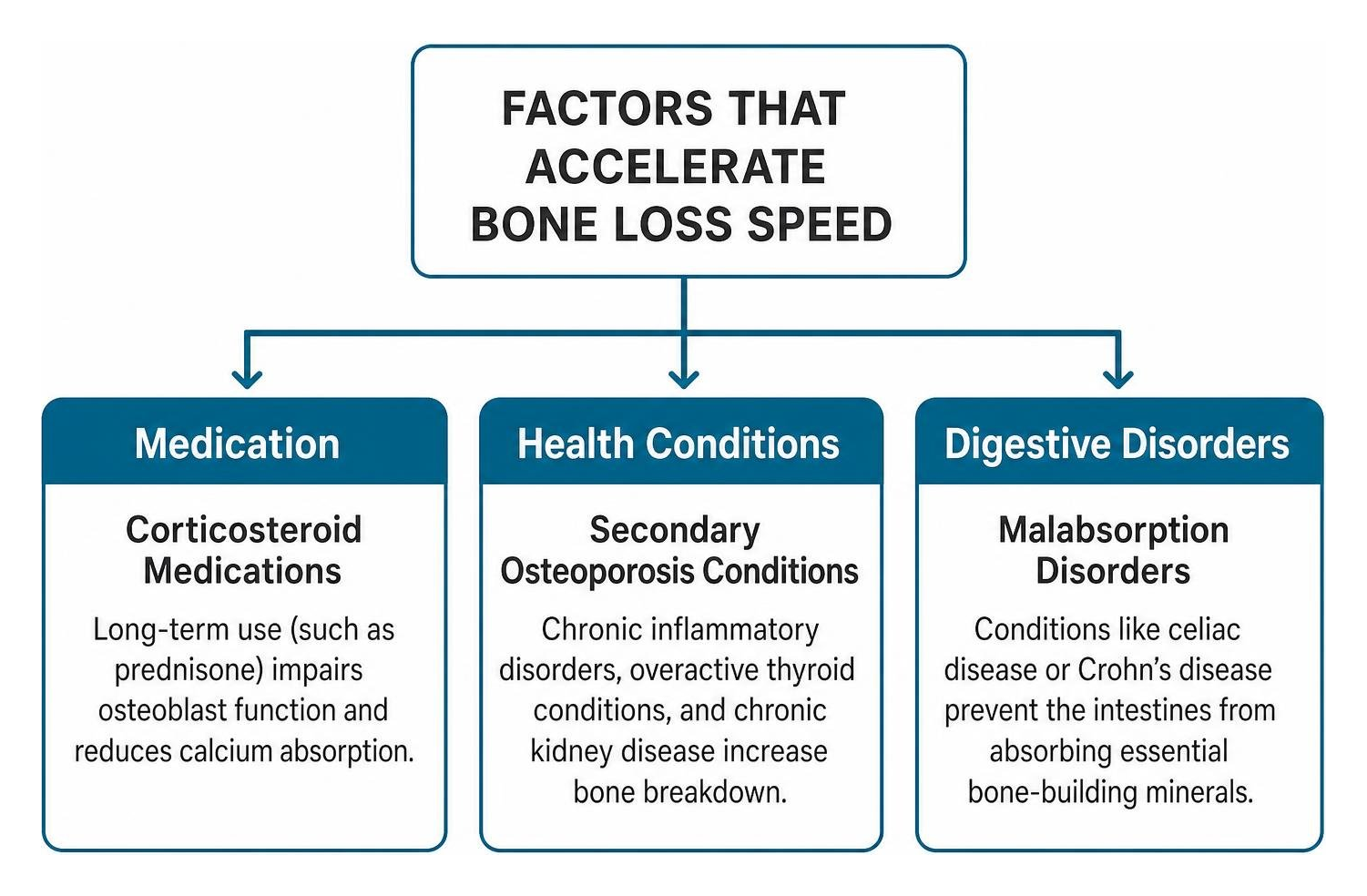
Certain clinical factors can cause bone density to decline much faster than the normal age-related average:
- Corticosteroid Medications: Long-term use of oral steroid medications (such as prednisone) directly impairs osteoblast function and reduces calcium absorption.
- Secondary Osteoporosis Conditions: Chronic inflammatory disorders like rheumatoid arthritis, overactive thyroid conditions, and chronic kidney disease increase bone breakdown.
- Malabsorption Disorders: Conditions like celiac disease or Crohn's disease prevent the intestines from absorbing essential bone-building minerals.
- Chronic Immune Activation: Long-term inflammatory conditions can accelerate skeletal remodeling and speed up bone thinning.
Lifestyle Influences on Bone Remodeling Speed
Sedentary habits, low nutrient intake, smoking, and excess alcohol intake can increase the rate of yearly bone loss.
Bones respond to mechanical signals; without regular physical challenge, remodeling can slow. Bone remodeling also depends on nutritional building blocks. According to the National Institutes of Health Office of Dietary Supplements, women aged 51 and older need 1,200 milligrams of calcium daily, while men need 1,000 milligrams daily until age 70, then 1,200 milligrams daily thereafter. Adults over 70 need 800 International Units of vitamin D daily to support calcium absorption.
Cigarette smoking decreases blood flow to bone tissue and reduces calcium absorption, while consuming more than two alcoholic drinks per day directly impairs bone-building cells. Adopting healthy daily habits offers meaningful ways to increase bone density naturally and helps maintain your bone bank.
Monitoring and Slowing Progression: DEXA Scans and Medical Care
Physicians monitor bone loss through periodic DEXA scans, allowing them to detect rapid thinning and prescribe targeted treatments before fractures happen.
Knowing your appropriate DEXA scan frequency helps prevent unnecessary radiation while ensuring your bones are evaluated regularly. According to Medicare.gov and the Centers for Medicare & Medicaid Services (CMS), Medicare covers a routine bone mass measurement scan every 24 months for eligible individuals at risk for osteoporosis, though coverage and out-of-pocket costs may vary by specific plan type.
Clinicians evaluate your T-score, medical history, and 10-year fracture risk when deciding when to start osteoporosis treatment.
To actively protect skeletal strength, exercise plays a foundational role. Building bone density requires osteogenic loading through heavy resistance training (low repetitions with heavier weights) that safely challenges the skeleton. Compound movements like squats, lunges, and hip hinges load the hips and spine effectively. When performing these exercises, maintain a neutral spine or slight spinal extension and avoid loaded spinal flexion (bending forward under heavy weight).
Fall prevention is equally critical for protecting fragile bones. Practice progressive balance training that moves from static balance (standing on one leg) to dynamic balance (stepping patterns), paired with lower-body power training. When performing balance exercises at home, always use stable, braced supports (such as a sturdy chair placed firmly against a wall or a bolted kitchen counter) rather than movable objects. Active older adults can also include carefully supervised power movements that combine strength and speed.
Groove Health is a Medicare covered bone health program for adults 65 and older that pairs each member with a physician and a physical therapist who designs a personalized exercise plan.
How Treatments Halt or Reverse Bone Loss
Modern osteoporosis medications slow down bone-destroying cells or stimulate bone-forming cells to reduce fracture risk significantly within 6 to 12 months.
Medical therapies fall into two main categories:
- Antiresorptive Therapies: Common options include alendronate (Fosamax), risedronate (Actonel), zoledronic acid (Reclast), and denosumab (Prolia). These slow osteoclasts, reducing bone breakdown so bone mineral density can stabilize.
- Anabolic (Bone-Building) Therapies: Common options include teriparatide (Forteo), abaloparatide (Tymlos), and romosozumab (Evenity). These help stimulate osteoblasts to build new bone tissue.
These treatments stabilize bone density within the first year of consistent use, cutting the risk of hip and spine fractures.
Frequently Asked Questions About Osteoporosis Progression
Can osteoporosis progression be reversed?
Osteoporosis progression can be slowed or halted, and bone mineral density can often be improved with prescription medications, progressive resistance training, and proper nutrition. While the underlying tendency for bone thinning remains as we age, combining bone-building therapies with heavy resistance exercise helps restore structural strength and lowers fracture risk.
How do doctors know if osteoporosis is worsening?
Doctors determine if osteoporosis is worsening by comparing repeat DEXA scan results to find measurable drops in bone mineral density. They also watch for clinical signs such as unexplained height loss, the development of a stooped upper back posture, or new fragility fractures occurring from minor bumps or everyday movements.
What is considered rapid bone loss?
Rapid bone loss is typically defined as losing more than 3% to 5% of bone mineral density in a single year on repeat DEXA testing. This accelerated rate often occurs following high-dose steroid therapy, sudden hormonal shifts, or severe malabsorption disorders, and it requires prompt medical evaluation to prevent bone breaks.
The Takeaway: Tracking Is What Slows the Timeline
Managing how fast osteoporosis progresses requires a proactive, consistent approach to protecting your skeleton. By tracking your bone density with regular scans, fueling your body with proper nutrients, and following a tailored exercise plan, you can slow bone loss and lower your risk of fractures. Programs like Groove Health support this journey by pairing members with a physician and a physical therapist who designs a personalized, exercise plan to safely build bone strength, improve balance, and prevent falls.
Works Cited
- Varacallo, Matthew A., Travis J. Seaman, Jagmohan S. Jandu, and Jasleen Kaur. "Osteopenia." StatPearls, StatPearls Publishing, 2025.
- LeBoff, M. S., S. L. Greenspan, K. L. Insogna, et al. "The clinician's guide to prevention and treatment of osteoporosis." Osteoporosis International, 2022;33(10):2049-2102.
- National Institutes of Health, Office of Dietary Supplements. "Calcium: Fact Sheet for Health Professionals." NIH Office of Dietary Supplements, 2025.
- National Institutes of Health, Office of Dietary Supplements. "Vitamin D: Fact Sheet for Health Professionals." NIH Office of Dietary Supplements, 2025.
- Centers for Medicare & Medicaid Services. "Bone mass measurements." Medicare.gov, 2026.
This content is for informational purposes only and does not constitute medical advice. Consult a qualified healthcare professional for diagnosis and treatment. If you are on Medicare and interested in a personalized bone health program, you can check your eligibility at groovehealth.com.