
Do Weighted Vests Work for Osteoporosis? A PT's Evidence Review
Weighted vests are having a moment, but do they actually build bone? A Groove physical therapist reviews the research and explains where a vest helps and where it doesn't.
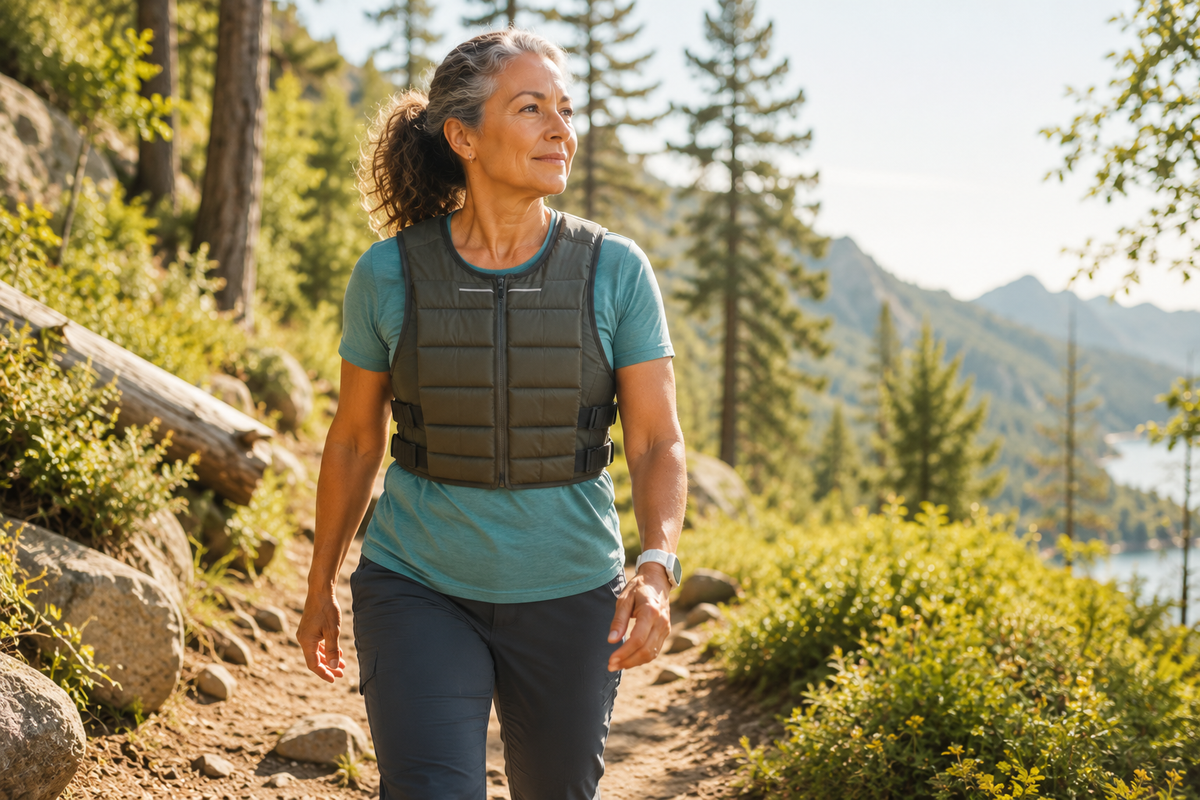
Weighted Vests for Osteoporosis: Do They Actually Build Bone?
The wellness market is flooded with tools promising stronger bones, but which are actually backed by science? This review discusses the whys, dos, and don’ts of weighted vests and their effectiveness for bone health from a physical therapist's perspective.
Osteoporosis affects millions of older adults. Falls and fractures are a leading driver of lost independence and mobility. As a physical therapist coach specializing in bone health, I strive to support my clients who want to do everything they can to improve their bone mineral density (BMD). One of the questions I'm most commonly asked is "Should I get a weighted vest?" Weighted vests are clearly a heavily marketed tool, but the science is mixed. That's why I took a deep dive into the evidence, to help people answer the question: Are weighted vests worth it, and for those who do decide to wear one, how can we maximize effectiveness?
First, How Does Bone Actually Respond to Exercise?
Let's go back to the basics for a second. What actually builds bone? Wolff's law states that bone tissue adapts in response to the mechanical loads placed upon it. Essentially, when we stress bone with weight-bearing exercises like step up’s or dancing, impact loading like heel drops or jumping, or progressive resistance training (weights, bands) bone gets stronger. When we don't do these things, our bones will get weaker. I talk about this in more detail in an article I wrote about how walking alone isn't enough to actually improve bone density (and what does). The question then becomes: Is a weighted vest able to provide sufficient loading on our skeletons to actually have an effect on the strength of our bones? The following studies attempt to answer it.
Weighted Vests: A Strong Case for Loading
The reasoning seems pretty straightforward: More weight = more load, right? Though it seems simple—who wouldn't want to throw on a vest to get more out of the walk you're already doing? The research is actually mixed, and in many of the studies I reviewed, what people did while wearing the vest had more benefit on bone strength than the vest itself.
A 2013 randomized controlled trial published in Rheumatology International compared vest wearing during exercise vs. exercise alone without a vest. This study evaluated the effects of treadmill walking at a moderate pace (with and without a weighted vest) on bones and balance in postmenopausal women with osteoporosis.
The results of the study show that the combination of weighted vest-wearing and treadmill walking did have a positive effect on bone health, and a significant improvement in balance!
So it looks like weighted vests work, right? Not so fast!
The sample size of the study was small (only 36 participants) and the effects on balance were stronger than the effects on bone strength. In another study, one of the largest randomized controlled trials to date, INVEST in Bone Health the results weren’t as straightforward. The authors found that adding a weighted vest (without changing anything else) did not have any effect on bone loss spurred by weight loss in study participants. (but neither did resistance training, which contradicts MANY other studies that confirm the effectiveness). So what gives?
After the study was published initially, the results were analyzed a second time. This time, the authors found that upright time was an important factor in whether study participants saw a positive effect on bone mineral density. Though there was not a direct correlation between stronger bones and weighted vests, the study did find that among the people who happened to be more active during their "vest wearing" time, bones did get stronger. The takeaway? What you DO while wearing a weighted vest matters.
A landmark study published in 2000 in the Journals of Gerontology by Snow et al. proves this further. This study evaluated a group of 18 postmenopausal women in their sixties over a period of five years. Nine women engaged in jumping exercises while wearing a weighted vest. The control group was active, but didn't follow a specific program. The authors concluded that the combination of weighted vest and jumping had a positive effect on hip bone mineral density; but this begs the question: Were the positive effects actually due to the vest, or the result of consistent adherence of a program involving jumping over a long-term time period? Likely, a little bit of both!
Final Answer
Weighted Vests: Helpful as an Adjunct, Not a Replacement for the Basics
The bottom line: Weighted vests have a small positive impact on bone mineral density and balance when combined with weight-bearing and impact-generating exercise, but are unlikely to make a meaningful difference when worn alone.
If you decide to utilize a weighted vest, consider the following:
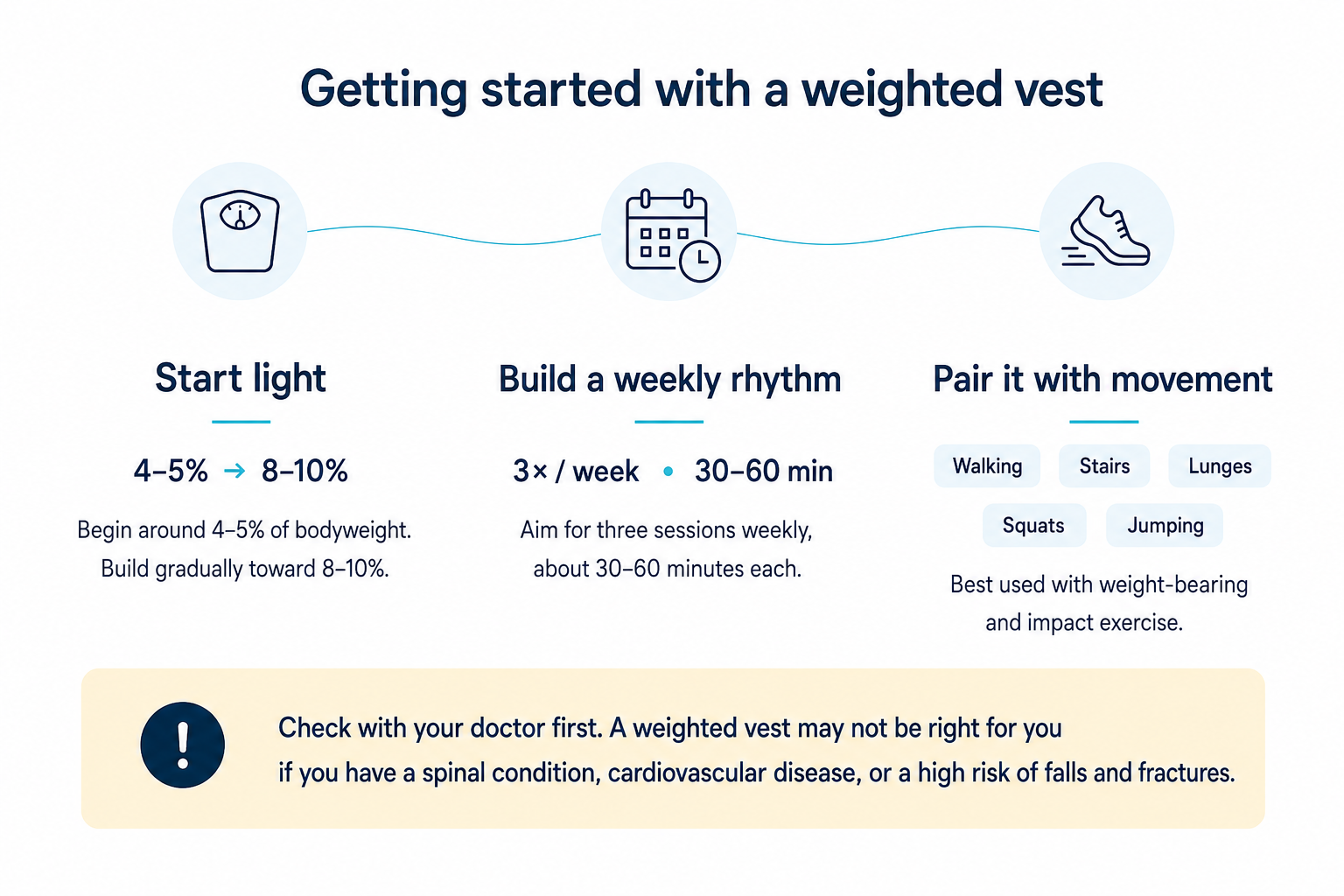
- If you have a spinal pathology, cardiovascular disease, or are at high risk for falls and spinal fractures, check with your doctor. Weighted vests may not be appropriate.
- Start conservatively: 4-5% of bodyweight is a good place to start, with gradual progression up to 8-10%
- Combine vest wearing with weight-bearing and impact exercises like walking, stair climbing, lunges, squats, or jumping
- Aim for three 30- to 60-minute sessions per week
The Bigger Picture: What the Research Consistently Supports
Research consistently proves that resistance training and weight-bearing exercises remain the gold standard for improving bone mineral density. Learn more here.
Even then, exercise is only one piece of the puzzle (Nutrition, fall prevention, medications when indicated, and hormone balance are all important too). The right interventions for you depend on your T-score, fracture history, and goals, which is why professional guidance and a customized plan will always beat tools, gadgets and quick fixes. Groove Health's physical therapist-guided exercise programs deliver measurable gains in strength, balance, and patient-reported outcomes.
Works Cited
- Chen JH, Liu C, You L, Simmons CA. "Boning Up on Wolff’s Law: Mechanical Regulation of the Cells That Make and Maintain Bone." Journal of Biomechanics, 2010.
- Snow CM, Shaw JM, Winters KM, Witzke KA. "Long-Term Exercise Using Weighted Vests Prevents Hip Bone Loss in Postmenopausal Women." Journals of Gerontology: Series A, 2000.
- Roghani T, Torkaman G, Movasseghe S, et al. "Effects of Short-Term Aerobic Exercise With and Without External Loading on Bone Metabolism and Balance in Postmenopausal Women With Osteoporosis." Rheumatology International, 2013.
- Beavers KM, Lynch SD, Fanning J, et al. "Weighted Vest Use or Resistance Exercise to Offset Weight Loss-Associated Bone Loss in Older Adults." JAMA Network Open, 2025.
- Fanning J, Beavers DP, Bluethmann SM, et al. "Does Time Spent Upright Moderate the Influence of a Weighted Vest on Change in Bone Mineral Density During Weight Loss Among Older Adults?" Frontiers in Aging, 2026.
- Luo H, Zhang X, Li H, Yin M, Li Z. "Weighted Vest Interventions in Older Adults: A Mini-Review of Implementation, Benefits, and Limitations." Frontiers in Public Health, 2026.